
ROBERT S. EDWARDS
Pacific Covenant
A Journey Between Worlds
A China memoir by Robert S. Edwards, drawing on four decades of teaching, trade, and friendship between America and China. Pacific Covenant explores how trustworthy relationships across cultures can change lives—and help shape relations between nations.
About the Book
Organized around the twelve animals of the Chinese zodiac, Pacific Covenant: A Journey Between Worlds brings together personal stories, historical reflection, and a proposal for greater cooperation across the Pacific.
From studying Mandarin in China in 1983 and teaching English in Xuzhou in 1984 to years in international trade and a return to teaching in Tennessee, Edwards explores the friendships and encounters that shaped his conviction that trust begins between people.
This memoir explores U.S.–China relations through the everyday work of citizen diplomacy: learning a language, building trust in business, and sustaining cross-cultural friendship.
One More Chair
Selected passages from the Epilogue of Pacific Covenant: A Journey Between Worlds, an unpublished memoir by Robert S. Edwards.
There is one final image I would leave with you.
Not a speech. Not a treaty. Not a monument.
A table.
Around it sit people whose languages are different. Whose histories are different. Whose memories, beliefs, loyalties, and customs remain their own.
No one has been asked to surrender identity as the price of admission. No one has been required to pretend that every difference can be resolved.
The purpose of the table is not uniformity.
It is fellowship.
I have watched Americans and Chinese conduct business, teach one another, become friends, form families, respond to disaster, exchange students, correct misunderstandings, and continue talking through political disagreement.
Those relationships did not erase conflict. They proved that conflict was not the only available reality.
The table is not complete. One chair remains open.
It belongs to the next person willing to enter the conversation.
Perhaps that person is a student who decides to learn another language. A teacher who opens another child’s horizon. A businessperson who chooses integrity over convenience. A city leader who revives a neglected friendship. A family that welcomes someone from another culture.
A critic who identifies a weakness in the Covenant and remains long enough to help repair it.
A neighbor who listens before judging.
A citizen who refuses to let love of country become hatred of another people.
History often changes that way. Quietly. One table at a time. One promise at a time. One trustworthy relationship at a time.
Basic Principles of the Pacific Covenant
One Ocean. Many Peoples. A Shared Future.
The Pacific Covenant is a proposal for voluntary cooperation among nations, communities, institutions, and citizens. These principles are offered for discussion and development.
- Equal human dignity. Every human life possesses equal dignity.
- Security without permanent fear. The security of one nation must not depend upon the permanent fear of another.
- Respect for cultural difference. Cultural difference is not a defect to be corrected, but an inheritance to be understood.
- Indigenous partnership. Indigenous peoples are not remnants of the past, but essential partners in humanity’s future.
- Stewardship of the ocean. The Pacific Ocean is a shared ecological trust.
- Commerce that serves people. Commerce should enlarge human opportunity without reducing human beings to instruments of profit.
- Science in service of life. Scientific achievement must serve life.
- Patient diplomacy. Disputes should be addressed through dialogue, mediation, law, and patient diplomacy before force is contemplated.
- A peaceful inheritance. Children should inherit an ocean of exchange rather than an ocean of war.
- Relationships that endure disagreement. Peace is not merely the absence of conflict. It is the continuing work of creating relationships strong enough to withstand disagreement.
The Invitation
Take what is useful. Question what is weak. Bring the people whose voices are missing, and help decide what can be built together.
There is one more chair. What will you bring to the table?
Share your thoughts with Robert S. Edwards: aidehua@gmail.com.
About the Author
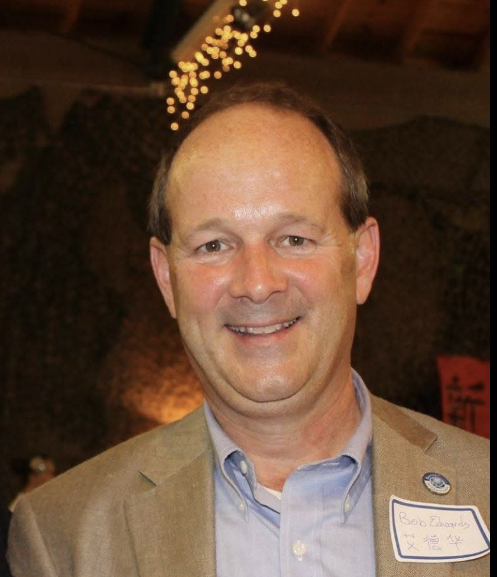
Robert S. Edwards is a Mandarin-speaking educator whose experience spans China trade, teaching, and community leadership. A graduate of Rhodes College with an MBA from Tulane University, he writes from more than four decades of engagement between America and China.
Follow Robert
Join Bob Edwards’ Newsletter on Substack for new writing and updates on Pacific Covenant.
Subscribe by email. Unsubscribe at any time.
For Publishers
Book proposal and sample chapters available upon request.
Edwards welcomes opportunities for speaking engagements, interviews, and educational conversations about cross-cultural friendship and citizen diplomacy.

