
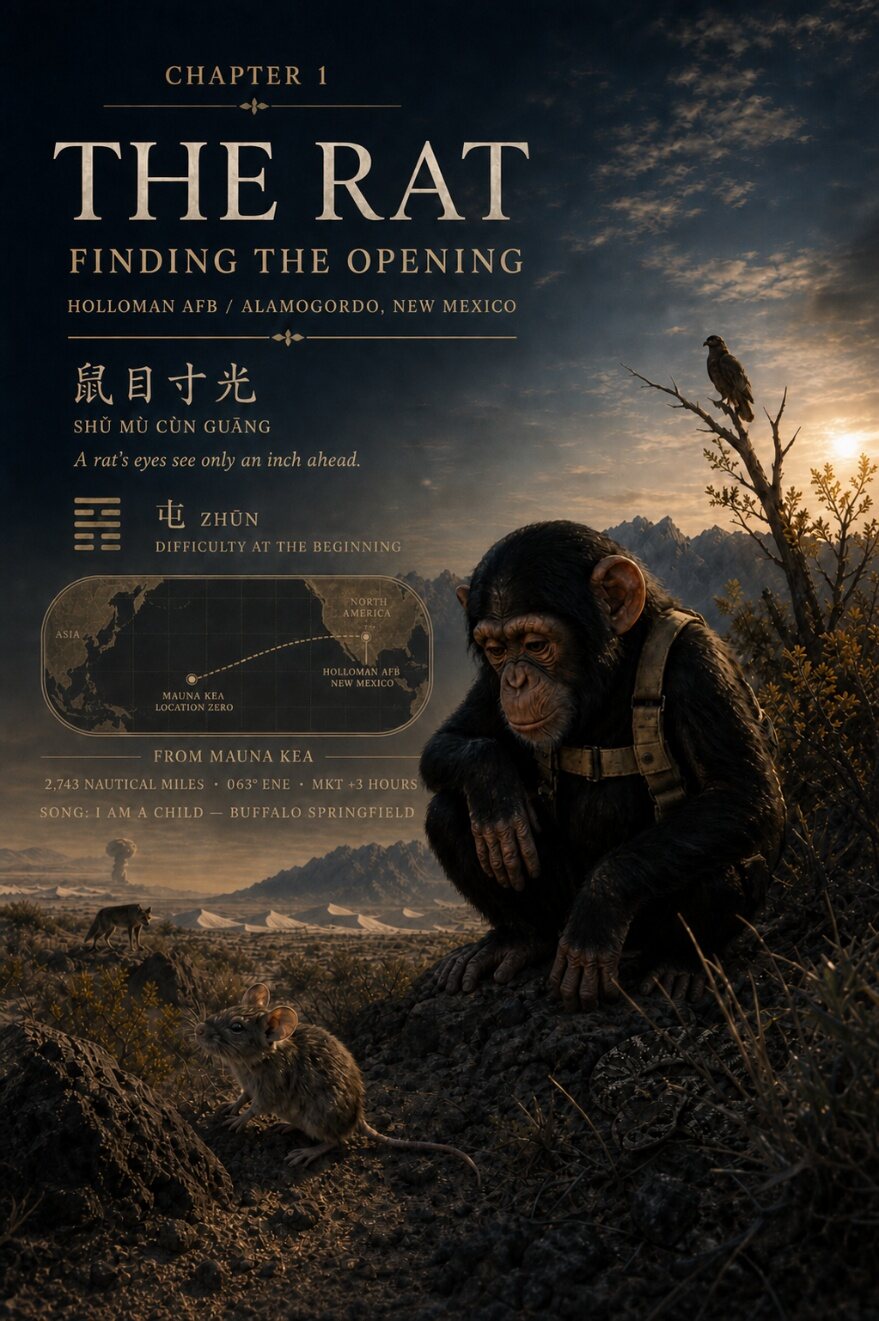
鼠目寸光
Shǔ mù cùn guāng
“A rat’s eyes see only an inch ahead.”
The rat begins the Chinese zodiac not because it is the largest or most beautiful animal, but because it finds the opening.
It lives close to the ground. It notices cracks in walls, stores food against winter, survives the collapse of grander structures, and enters rooms whose owners believed every door was closed. In the old zodiac story, the rat reaches the finish by intelligence, timing, and a ride on the back of the dependable ox. The tale contains admiration and warning. Resourcefulness can become opportunism. Cleverness can forget gratitude. A small creature can see an opening while failing to see the horizon.
My life began inside a family that had already crossed several frontiers.
My great-grandfather Eli Harrison Edwards survived the fighting at Chickamauga. Family memory says he was shot through the mouth and, in one desperate episode, obtained milk at knifepoint. His brother Sylvester did not return. Eli survived history’s machinery, came home, and built a log cabin in Morris, Alabama, near Gardendale.
A cabin is a modest monument. It does not announce a dynasty. It shelters a family through weather and gives the next generation a place from which to begin. That pattern—survive, return, build—became part of my inheritance.
My grandfather Ellis Hewitt Edwards entered another frontier. His mother died giving birth to him, and older sisters helped raise him. His older brother Jesse became a physician. Ellis, a rough-hewn and resourceful boy, found his own irregular route through pharmacy, medicine, military service, and a life wider than anyone might have predicted from his beginnings. He served as a medic during the First World War, learned French and met the woman he would marry aboard a train to New Orleans. Her name was Lida Scott McCarty from Owensboro, Kentucky. She was educated at Newcomb College and was known to hold her own in formidable company.
Ellis was also drawn to the Alaskan frontier. My father spent some of his early years there while his father provided medical care to Alaska Native communities. Family stories recall bears as part of the hazards he faced. Later, Lida and their five children moved to White Plains and then Scarsdale, New York. The part of that story I wish to carry forward is the willingness to go where care was needed.
My father recalled how, on Sundays, Dr. and Mrs. Edwards would drive into New York City’s Chinatown, where five dollars was enough to feed the whole family.
Those outings belonged to my father’s childhood, before I was born. They began our family’s lifelong love of Chinese cuisine. China had already found a place at the Edwards table.
I’m not the first Edwards to encounter the Chinese. My own journey would take me much farther, but it would follow a connection already present in family life.
My father, Dr. Robert Harrison Edwards, carried the family frontier into science. Born in 1927 near Alabama’s Gorgas Steam Plant, he became a pathologist and genetic researcher. His work took him through demanding institutions and eventually to Holloman Air Force Base in New Mexico, where the early space program placed national ambition beside the vulnerability of animals sent ahead of human beings. He worked in the scientific world associated with the chimpanzee Ham and studied rhesus-monkey blood groups.
My father had examined Ham after the chimpanzee returned safely from his suborbital flight. Years later, while my father was assigned to the Armed Forces Institute of Pathology at Walter Reed, we saw Ham again at the National Zoo. Ham did not recognize my father, but my father certainly recognized Ham.
Then came me: Robert Scott Edwards, born at Holloman on August 17, 1961.
Eli’s frontier had been war and land. Ellis’s had been medicine. My father’s had been science and space. Mine would become the space between civilizations.
Two Inheritances
The Edwards inheritance was only half of what formed me. On my mother’s side, I inherited the Carlsons and the Thomases: teachers, church builders, civic-minded women, and people connected to the great railroads that stitched the country together.
My maternal grandfather, Oscar Wilhelm Carlson, was an ordained Lutheran minister and a Latin teacher. He attended Gettysburg College and Seminary, was a debate champion at the college, and helped establish Ascension Lutheran Church in Towson, Maryland. His life joined faith and learning: a church built, a classical language taught, a community strengthened.
He married into the Thomas family, whose history was bound up with the Pennsylvania Railroad. Their story also taught me that communities depend upon connections—tracks, schools, congregations, and public institutions maintained across generations.
My mother, Harriett Pauline Carlson Edwards, carried that inheritance with unusual force. She became class president at Goucher College in Baltimore and earned a master’s degree in English at Northwestern University, located near Chicago. She was formidable—intelligent, determined, and every bit as much a leader as the accomplished men around her.
Before I was born, my mother worked at the Folger Shakespeare Library. Years later, in Florence, Alabama, I saw how much of herself she gave to the Shoals Symphony Orchestra. In my memory, her part in the symphony's life was essential. She helped sustain something that mattered to her community, and I do not want that work lost behind the account of my own travels.
The Shoals had a musical life whose reach was far greater than its size. FAME and Muscle Shoals Sound Studio helped make the area an international recording center. Lynyrd Skynyrd's song “Sweet Home Alabama” carried the name Muscle Shoals to listeners who might never have visited northwest Alabama. Memphis had Sun Studio and Elvis; the Shoals had its own sound and its own place in the world's imagination.
My mother's symphony work belonged to that larger landscape of people making music and making room for others to hear it. I think of her when I ask what it means to cultivate a community. The cultural life of a place depends upon people willing to give it their time. She was one of those people.
If my father’s family taught me endurance, my mother’s family taught me cultivation. Minds should be educated. Churches should be built. Languages should be learned. Civic life should be strengthened. I inherited not one tradition but two, and together they prepared me for a life between civilizations.
A Different Kind of Service
I often think of myself as the first Edwards in four generations who did not enter military service and go to war. Eli fought at Chickamauga. His descendants served in the conflicts and military institutions of their own eras. By the time my generation came of age, however, war had entered our living room through television.
I watched Vietnam on the screen. Even my father, an Air Force colonel, had become deeply skeptical of the Vietnam War. I saw young Americans sent into a conflict many of them scarcely understood, and I saw young radicals oppose it. I felt sympathy with them. Their anger could be reckless, but their refusal to accept war as the natural answer spoke to something already growing in me.
My father had volunteered for military service. He had chosen that life as a patriotic physician and scientist, and I grew up respecting the seriousness of his choice. My mother, a preacher's daughter, brought faith and a concern for how people ought to treat one another into the same household. Their examples traveled with me even when I began asking questions of my own. Watching Vietnam on television made those questions urgent. I wanted to find a way of serving that would bring Americans and Asians into closer understanding.
In the introduction to his 1958 collection Once There Was a War, John Steinbeck wrote that “all war is a symptom of man’s failure as a thinking animal.” The Pacific War, Korea, and Vietnam arose from different histories, but together they taught my generation how quickly fear, ideology, misreading, and political momentum could narrow the space for imagination. The Gulf of Tonkin would later stand as a warning about how uncertain evidence can become justification for escalation. Could Americans learn enough about Asia—and especially China—to interrupt that cycle before distrust hardened into war?
That was one reason I went to China. I went as an idealist. I did not imagine that one young Southerner with a dictionary could redirect history. I believed only that understanding had to begin somewhere, and that my role might be different from that of the Edwards men before me.
They had been called to make war. I felt called to make peace.
Years later at Chickamauga, I stood beside a marker for the 8th Kansas Volunteers, a Union regiment from a state torn apart by slavery. We can place Eli Harrison Edwards nearby on the Confederate side. Battlefield markers identify Eli’s 20th Tennessee Infantry in Bate’s Brigade and their advance on September 20, 1863, into the fighting west of the LaFayette Road. I cannot prove that Eli was shot by those particular Kansans, but the battlefield makes the larger pattern visible.
My great-grandfather entered Chickamauga carrying a rifle. I crossed the Pacific carrying a dictionary. He met strangers across a battlefield. I met them across classroom tables, factory floors, trade-fair booths, and family meals. History had not disappeared. My generation had been given the privilege of answering it differently.
That sentence sounds inevitable only in retrospect. Childhood never feels like a prologue while one is living it. It is a collection of accidents, wounds, advantages, humiliations, nicknames, and half-understood examples.
Books and the Far Shore
I grew up in a household where television was limited and books had room. My mother taught English, and reading was part of the air in our home. My father’s older brother, Uncle Bill, was an anthropologist who helped inspire my love of nature.
On my mother’s side, my Uncle Jim was a falconer. He raised peregrine falcons and pigeons, and he had a wonderful workshop in his barn. Families in Mongolia and in the Arab world have passed down the art of hunting with a trained bird for generations. When I hear the word falconry, I think of Uncle Jim and that barn. Some of my love of the natural world came from him.
I treasured my father’s weathered copy of Hugh Lofting’s Doctor Dolittle. As a child, I imagined Dolittle as a British gentleman, perhaps with a cane and top hat, as comfortable taking tea in London as setting out for distant shores. In The Voyages of Doctor Dolittle, his travels reach Spider Monkey Island, where he encounters the Great Glass Sea Snail. The picture enlarged the world before me: a gentleman could speak with animals throughout God’s creation and still set off into the unknown. Later, my mother introduced me to Tolkien’s The Lord of the Rings: The Fellowship of the Ring, The Two Towers, and The Return of the King. These books opened another world of fellowship, danger, endurance, and return. I cannot say they set me on a course to China. They made imagination a natural part of how I met unfamiliar worlds.
Looking back now, I find myself returning especially to Frodo Baggins. He leaves the Shire carrying the Ring that Sauron seeks, with dangers gathering around something he scarcely understands. The familiar world can no longer contain the responsibility he has inherited. That is the part of his departure that stays with me: a person can begin a journey before he understands the weight of what he carries.
I have sometimes smiled at the resemblance between Tolkien's Middle-earth and the Middle Kingdom that drew me across the Pacific. My own travels led through classrooms, train stations, factories, and homes. I never slew a dragon, but I befriended many kind people along the way. Their kindness changed the story I had imagined for myself.
The comparison comes to me in retrospect. I was a young American trying to learn a language and enter a society that had occupied my imagination for years. Only after many departures and returns could I see how much of my family, my reading, and my sense of obligation had gone with me. Frodo gives me a way to think about that inheritance and about the companions who help a traveler bear it.
C. S. Lewis offered another doorway. In The Lion, the Witch and the Wardrobe, an ordinary piece of furniture opens into Narnia. I loved the possibility that a familiar room might contain an entrance to a world beyond anything its occupants suspected. Learning Chinese eventually gave me something like that feeling. Sounds that had once been unintelligible began to carry another person's humor, worry, or welcome. A door opened a little further each time I understood.
Then there was C. S. Forester's Horatio Hornblower, a doctor's son whose life carried him across the seas. As the son of a physician myself, I felt an affinity with that beginning. His voyages, uncertainties, and reliance on loyal companions made adventure seem human. Brown's steadfastness remained with me. Years later, I would think of my friend Horace and recognize something of that loyalty close to home.
These stories made departure imaginable. My parents and the people around me gave departure its responsibilities. When I finally went to China with the Duke Study in China program in 1983, I was stepping into a place still remote from the experience of most Americans I knew. We spoke of the Bamboo Curtain. I wanted to meet the people on the other side and discover what a life among them might teach me.
Rudyard Kipling’s “If” gave me a line that speaks to me: “If you can talk with crowds and keep your virtue,Or walk with Kings—nor lose the common touch.” I thought of my father. He once spent thirty minutes with Richard Nixon in the 1960s. I imagine Dad would have been respectful but not intimidated. He would not have seen himself as lesser simply because the other man would one day become president. We all put on our pants one leg at a time. To me, Kipling’s line holds that same balance: one can meet people of great rank without losing the common touch.
During my freshman year, a short course on the British Commonwealth gave these books a larger frame. I was struck by how a relatively small island nation had sent a language and literature around the world. Nursery rhymes were part of that inheritance; later, I enjoyed seeing Jan learn them. Rudyard Kipling and William Shakespeare joined Tolkien and Doctor Dolittle in the British literary world that had shaped my imagination. These influences helped prepare me to study Chinese. They taught me that words and stories can cross borders, and that learning another language can open a door into another world.
Henry David Thoreau’s Walden added another voice to this company of writers. Its pond was a real place, but in my imagination it also stood for a life of attention—to nature, thought, and what a person truly needs. My mother taught English and my maternal grandfather taught Latin. In our family, learning was part of ordinary life. These writers did not point me toward a single destination. They enlarged the world I could imagine and the questions I was willing to ask.
The British writers enlarged my imagination, and my family’s years on the Alaskan frontier gave me another example of venturing beyond the familiar. Through my grandfather Carlson’s Lutheran faith, Martin Luther offered an example of a different kind: a man willing to challenge the religious and political authorities of his time. Others might choose Leonardo da Vinci or Galileo as the greatest Western figure between Christ and the Founding Fathers. I give Luther the highest credit.
That inheritance did not make me a model Christian. What reached me most powerfully was Luther’s defiant spirit. It helped lead me to question things I had grown up around, particularly war and what I came to see as the willful ignorance in America’s approach to China. I wanted to find out what we were refusing to see.
Why did I pursue China and adventure when my classmates seemed to be turning toward other lives? I cannot answer with a single cause. I can see a thread through Lake Mendota and the bayou, through my father’s scientific work with Ham, and through the books and relatives who widened my sense of what could be known. Those memories do not prove why I went to China. They help me understand why curiosity felt like a calling.
I was the oldest of three boys. My brother John Fergus Edwards was born in 1963 and has lived with cerebral palsy throughout his life. My youngest brother, Andrew Ellis Edwards, arrived in 1966. I felt fiercely protective of John. I do not remember an incident of someone bullying him; the readiness to stand beside him was there all the same. I could be rough myself, and I was not always easy, restrained, or tactful. That protective instinct was part of the defiance I carried into adult life.
Protection became one of my first forms of loyalty.
I have come to describe John's influence by saying that he made me fly twice as far as I might otherwise have gone. That is a reflection on my own restlessness and sense of responsibility. Growing up alongside him made me conscious of opportunities I could easily have taken for granted. The freedom to travel, to try something uncertain, and to begin again seemed to ask something of me.
When I speak of a cross to bear, I am trying to name the emotional weight I carried as his brother: love, protectiveness, and the wish to do something worthwhile with the possibilities before me. John had his own ambitions and his own determination. His education, career, and perseverance would give me plenty to admire. Our different paths have kept teaching me how many forms a full life can take.
My early nicknames included Bobcat. Later came Young Robert and China Bob. A nickname is a social experiment: other people try to reduce the unruly whole of a person into an animal, trait, or story they can remember. Sometimes the nickname reveals more than the formal name. Bobcat suggested a creature alert, independent, and not entirely domesticated.
The rat offers a different portrait of childhood. The rat is watchful. It notices where adults keep the keys. It learns which rules are real and which are merely announced. It studies abundance and scarcity. It may be physically small, but it is never mentally absent.
For four years in Ocean Springs, Mississippi, we lived with the tides. I played soccer, tended crab traps and fished for speckled trout right in our backyard. The bayous led out into the Back Bay of Biloxi. My parents had given me considerably less water to work with. I was supposed to keep our family’s johnboat in our little bayou.
The picture I’d keep from those years is of sitting on the dock on Deer Island. There’s Biloxi right across the water, and there I sit with a fishing pole, a treble hook and live shrimp for bait. I could have spent a good part of my life quite happily on that dock.
Once we took the johnboat all the way around Deer Island. I remember the sound of that little outboard and the way our boat rode the wakes of the bigger boats. It was a long way around. Somewhere out there I had time to think about what would happen if the motor quit. It kept running. We came around into the Bay of Biloxi and made it home.
I was born Tom Sawyer. I wanted to be Huckleberry Finn.
I was sorry to leave Ocean Springs when we moved to Birmingham. I understood why people stayed there, and why those who left came home. Years later, reading Pat Conroy’s The Prince of Tides, I thought of those four years on the bayou. Jimmy Buffett’s music can take me back there, too.
I was fortunate to grow up near ambitious people and institutions. Yet I also learned that prestige and wisdom are not the same thing. A fine school can contain narrow minds. A modest person can see farther than an official expert. A family’s standing tells us little about the courage with which its members meet hardship.
I attended three high schools. Each change required me to begin again among people who already knew one another. I had to listen, learn the habits of a new place, and find a way to belong. At the time, I was simply getting through school. Looking back, I can see that those moves were training my adaptability. Flexibility became a life skill long before I had reason to associate it with China.
By my senior year in Florence, a classmate and I would slip out of the school parking lot at lunchtime and head for a Chinese restaurant about a mile away. We were supposed to get permission, but we went anyway. I remember sweet-and-sour pork and egg rolls, the music and the beads. Stepping inside felt like entering another world, and I loved it. I had grown up enjoying Chinese food. Those lunches added a little freedom and the pleasure of bending a rule to a taste I already knew.
One of my early encounters with China came through fireworks. In the early 1970s, I remember buying Black Cat firecrackers and bottle rockets made in China. I knew the country through a boy’s curiosity and a familiar package, long before I could speak its language or imagine the factories and trading relationships behind it.
When my family moved to Florence, Alabama, in 1978, I came to learn that Florence had its own connection to that trade. It was home to the Anderson family’s businesses, including Anderson News and the fireworks enterprise known as TNT.
In 1965, Charles Anderson Sr. and Chan Fu Yu established Anco Yu Far East Co. in Hong Kong, exporting consumer products from the Far East, particularly China. In 1972, Anderson was among the first U.S. business leaders invited to China to explore trading opportunities. He accepted the invitation and began sourcing fireworks there. That Florence enterprise grew into TNT Fireworks, which describes itself today as the nation’s largest distributor of consumer fireworks.
An Alabama business had already found a commercial passage to China. The places that formed me were connected to a trade joining ordinary American life to a country I still knew mostly through imagination. By the time Professor John Franklin Copper gave my interest direction at Rhodes, China had been part of my world for years. I had simply not understood how close it was.
What could be more patriotic than a Chinese firecracker?
The Chinese expression 鼠目寸光 (shǔ mù cùn guāng) criticizes the person whose vision extends no farther than immediate advantage. That danger has shadowed America as well as individuals. A society can become so consumed with the next election, quarterly earnings report, test score, or news cycle that it sacrifices the future while congratulating itself on efficiency.
I have seldom suffered from too little horizon. My danger has usually been the opposite: seeing so far that I neglect what is directly beneath my feet.
The mature lesson of the Rat is therefore double. Find the opening, but ask where it leads. Store grain for winter, but do not mistake the storeroom for civilization. Use timing and intelligence, but remember the ox whose back carried you across the river.
The great openings in my life often appeared without any guarantee that I deserved them.
Why was I born into this particular family, with its mixture of medical accomplishment, Southern contradiction, Civil War memory, scientific ambition, strong women, disabled brother, and restless movement? Why would I later be invited onto John M. Harbert’s farm? Why would China open to me in 1983? Why would Ed Khalily notice me in Nanjing? Why would Jan bring a plate to my table in Chattanooga?
I cannot prove providence. But I can acknowledge access.
Sometimes I call it a slipstream of good luck. My parents, teachers, and role models had already set things in motion before I understood how to use the opportunities they offered. Even encounters that occupied only a moment could remain vivid for years: seeing Eisenhower at Walter Reed as a child, and later catching George H. W. Bush's eye in the Superdome. Such memories made public history feel close.
The people who stayed in my life shaped my choices more steadily. They encouraged me, corrected me, introduced me to someone, or trusted me with work. Looking backward, I can see how much of my movement depended on their generosity. I still had to decide whether to take the opening, and I sometimes misjudged what lay beyond it. Good fortune gave me chances to learn.
The Rat chapter begins with gratitude for openings and suspicion of small vision. My ancestors crossed frontiers so that I could inherit choices they never possessed. My obligation was not merely to consume those choices. It was to look farther.
The rat finds the crack in the wall.
The human being must decide whether to enter only for himself or widen the opening for others.
Table of contents · Next: Chapter 2 · The Ox: Plowing the First Furrow

