
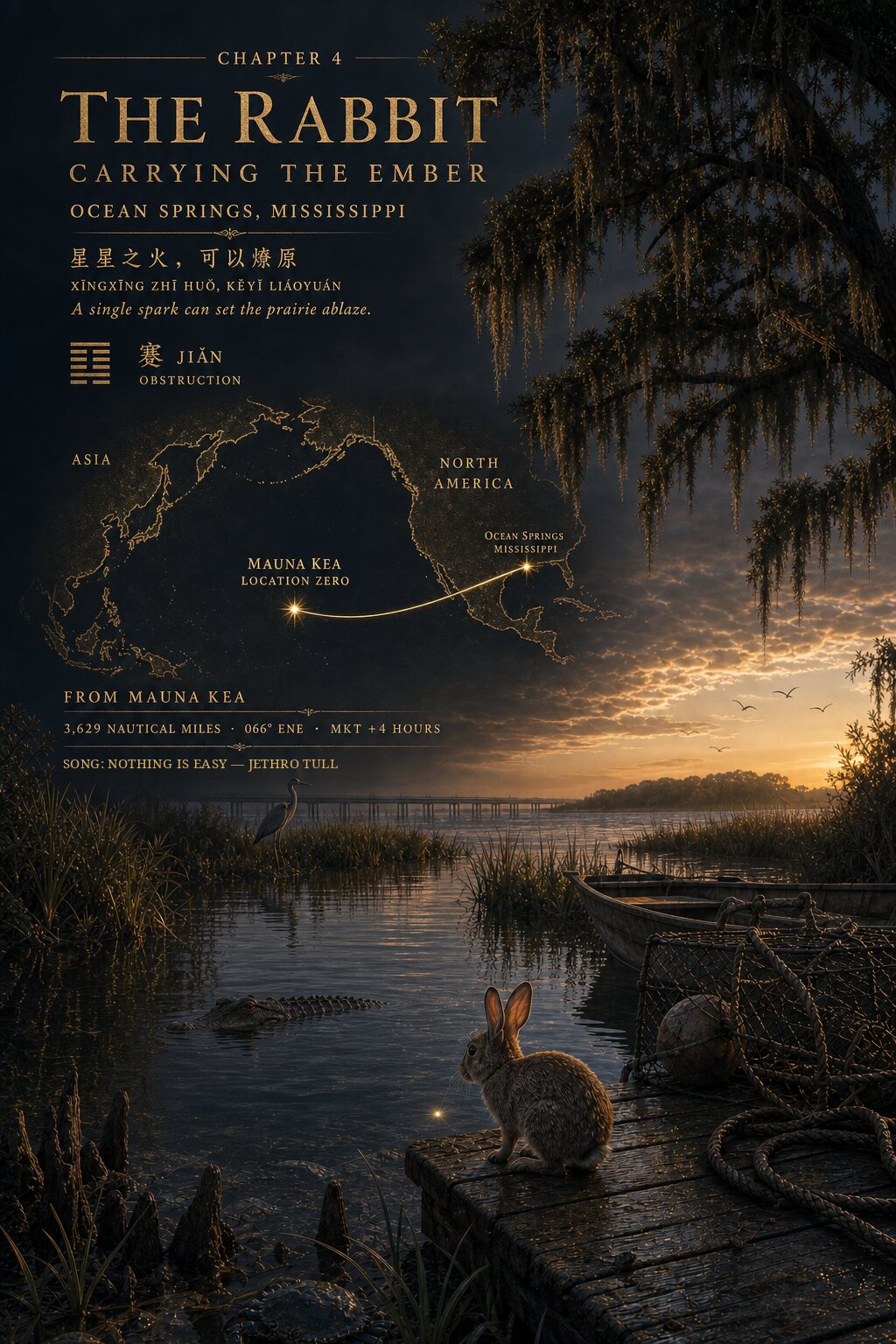
星星之火,可以燎原
Xīng xīng zhī huǒ, kě yǐ liáo yuán
“A single spark can set the prairie ablaze.”
The rabbit does not rule the mountain.
It possesses neither the Tiger’s claws nor the Ox’s strength. Its gifts are alertness, adaptation, and an instinct for openings others overlook.
The rabbit listens.
Its ears detect movement before larger animals realize the earth is trembling. When danger comes, it does not waste time proving its courage. It finds the narrow passage through the briars and carries life safely to the other side.
That kind of courage is quieter than the Tiger’s leap.
It would become essential to me.
In 1983, I crossed the Pacific with the confidence of the Tiger. I traveled with the Duke group, taught in Xuzhou, played ping-pong with high school students, and discovered a world larger than the one I had inherited.
The leap changed me.
The years that followed would teach me how to preserve what the leap had awakened.
In the story of my life, 1983 was the year the Tiger made the leap. In 1989, the Rabbit found the way. The six years between them mattered. Crossing an ocean had opened a world to me; learning how to continue when my plans failed would determine whether I could make a life within it.
Another Chinese Shore
When I left mainland China, I believed I understood something about the Chinese people.
I did.
I simply did not understand how much remained to be learned.
Another door opened in Taiwan.
Many Americans speak about Taiwan and mainland China as though they occupy entirely separate civilizations. Politics encourages that distinction. History complicates it.
I arrived in Taiwan without a political program. I carried curiosity, some Mandarin, and the confidence acquired through my experience on the mainland.
The island moved to a different rhythm.
Bookstores overflowed with works that would have been difficult to obtain in Xuzhou. Markets bustled with commercial energy. Temples stood near modern buildings. Families gathered in public spaces as evening settled over the cities.
Freedom also changed the way I learned. Taiwan gave me room to take initiative, pursue interests that mattered to me, and accept responsibility for my own choices. Instead of encountering Mandarin only as a subject, I had a reason to use it in the course of living. That freedom sharpened my attention and accelerated my Chinese learning.
Taiwan revealed another expression of Chinese civilization—commercially energetic, politically distinct, historically connected with the freedom to speak and worship as one chooses.
The experience discouraged simple conclusions.
Mainland China had shown me a society emerging from isolation and material scarcity. Taiwan showed what Chinese families, entrepreneurs, teachers, and institutions had built under different conditions.
I did not feel compelled to diminish one shore in order to appreciate the other.
That discovery became important.
To understand China would require more than choosing sides and repeating the approved vocabulary of whichever side one had chosen. A civilization could be larger than its current political divisions.
The rabbit has more than one burrow.
Perspective requires more than one window.
Taiwan gave me perspective—not certainty, but the ability to admire strengths without denying differences and to love more than one place without demanding that they become identical.
It also sharpened another possibility.
Perhaps my future did not lie entirely in classrooms. Business might build bridges that education alone could not. A commercial relationship could require people from different systems to trust one another, solve practical problems, and keep promises across borders.
I had no clear plan.
Only a growing conviction that the journey begun in 1983 had not ended.
Washington Was Not My Horizon
In 1984, I interned in Washington, D.C., for Senator Howell Heflin of Alabama. My parents lived in Alabama, and Heflin came from the northwestern part of the state, near Florence. My family connections might have helped me begin a conventional career in the capital. I was grateful to see the machinery of national government at close range, but I was not persuaded that consequential work necessarily had to begin there. The people who had changed my understanding of the world were teachers, students, and families far from those offices.
I came away skeptical of the assumption that a complex country—or a relationship between civilizations—could be managed wholly from the top down. Washington had its responsibilities. So did people who built relationships without waiting for permission. That distinction would matter when the next opening called me back across the Pacific.
History at Two in the Morning
In 1986, I joined the inaugural core faculty of the Tennessee Governor’s School for International Studies at the University of Memphis.
I was the youngest member of a distinguished group entrusted with introducing some of Tennessee’s brightest students to the wider world.
We wanted them to understand that international life was not something occurring only in Washington, New York, London, or Beijing. Tennessee was already connected to the world, whether its citizens recognized the fact or not.
I knew Memphis as a cotton town, and in college I knew something about its jazz bars. I thought I had a fair idea of what went on in that city after dark.
One night—or, more accurately, one morning—we visited the Federal Express hub in Memphis at two o’clock.
While most of Tennessee slept, aircraft arrived from different directions. Packages converged beneath bright industrial lights. Conveyors moved relentlessly. Workers sorted fragments of the world according to destination and sent them outward again.
The scene was exhilarating.
Memphis was not an isolated inland city.
It was a hinge of global commerce.
The world passed through Tennessee every night.
The Governor’s School also took us to Heifer Project headquarters in Arkansas. Years later, I would learn how deeply Heifer’s agricultural work had reached into China, including Sichuan. The connection joined a Tennessee classroom to rural communities across the Pacific before I understood where it might lead.
I met M. Scott Peck, author of The Road Less Traveled, when he came to speak to the students. I remember his observation that they might find it difficult to go home after such an experience. For a month they lived and learned together, with gifted teachers, visiting speakers, and a world opening around them. I understood the difficulty. The program spoiled the teacher too. His work on community, The Different Drum: Community Making and Peace, gives me a way to understand why. Community asks more of us than pleasant agreement. It requires listening through difference, surrendering the need to control every encounter, and doing the difficult work of reconciliation. I would keep encountering that lesson far beyond the classroom.
During my first summer, I found small Chinese-English and English-Chinese dictionaries with red plastic covers that fitted comfortably in the hand. I bought twenty, one for each student. I wanted them to learn badly enough to put the tool directly into their hands.
A student once told me I was not an average teacher. I accepted that as a complement.
I did not want students merely to memorize facts about foreign countries. I wanted them to feel history approaching. I wanted them to understand that China’s reemergence, global transportation, international business, and cultural exchange would shape their lives.
The World Game
One Governor’s School exercise made the problem of global inequality impossible to ignore. Visitors associated with the Buckminster Fuller Institute brought a vast world map, spread across a basketball court, and asked roughly a hundred students to represent the world’s population. As the students took their assigned places, they discovered how unevenly people and resources were distributed. Large groups gathered in the places representing China, India, and Africa. Comparatively few stood for the United States, yet those few were assigned a disproportionate share of the world’s material wealth.
We had already visited the FedEx hub and the Heifer Project, institutions that demonstrated different forms of global connection. The World Game put the moral question beneath both: how could ingenuity and abundance serve people who had so little? The simulation did not settle international economics. It made the unequal starting positions visible. I know what I carried away: a map can show the shape of the world without explaining what we owe to the people standing upon it.
The Catbird Seat
Lamar Alexander deserves a word of gratitude in this story. His Governor’s Schools gave young Tennesseans permission to imagine lives larger than the horizons into which they had been born. International Studies at Memphis felt to me like a final gem in that crown. I was young, surrounded by gifted colleagues and students, and suddenly placed in what some call the catbird seat: a position from which the whole field seemed visible.
I jumped out of it.
Governor’s School did not teach me to remain safely above the field. It helped propel me into it. I ran around the world, returned, departed again, and eventually discovered that education had given me something more durable than employment: permission to connect Tennessee with the world.
Howard Baker embodied another Tennessee possibility. A McCallie alumnus, senator, conciliator, White House chief of staff, and later ambassador to Japan, he demonstrated that seriousness and civility did not require a small imagination. I heard him speak to the Governor’s School in 1987. I remember his smooth Southern drawl and familiarity with the halls of power.
Alexander’s courtship of Japanese investment supplied the practical lesson. Nissan’s arrival in Smyrna helped transform Tennessee in my lifetime. Japan did not diminish Tennessee by investing there. Japanese companies created work, transferred knowledge, strengthened communities, and altered the economic confidence of the state. That history became evidence for a proposition I would later apply to China: cooperation across the Pacific can renew America rather than replace it.
That sense of possibility energized me.
It also made me difficult to contain.
A Market Study and a Market Plan
After graduate school, I believed my combination of China experience, Mandarin, business education, and confidence would make me valuable to an ambitious American company.
I had never applied to Holiday Inn or FedEx. I admired those companies, but they were already established and would continue on their own course. The same instinct that had drawn me away from a career in Washington made me look for an opening where I could help bring something new into being. China was the opening I wanted.
Buckman Laboratories offered that opportunity. I skipped the graduation ceremony in New Orleans, moved to Memphis and stayed with a buddy. Six days after finishing my MBA, I was at work. It was late December 1988. Under ordinary circumstances I felt I could go make coffee with Bob Buckman. That Christmas the chairman was away, and I think my supervisor was, too. The place had what looked to me like acres of laboratories, electron microscopes and a library of its own. I was like a kid in a candy store.
One of the first things I did was sit down with the letters I’d received while I was looking for a job. Roughly twenty companies had written back. I’d heard from Goldman Sachs and some of the big cotton traders. Quite a few of the people who’d taken the trouble to answer me were chief executives. I figured they ought to know where I’d landed.
I wrote to each of them on Buckman Laboratories letterhead. I thanked them for writing, told them I’d joined Buckman as assistant manager of the China Project and invited them to get in touch if I could be of service. A few days earlier I’d been asking these people for a job. Now I was offering to help them.
The letters were in the mail before the chairman knew what I was up to. There’s a Chinese saying that when the tiger is away from the mountain, the monkey calls himself king. That Christmas in Memphis, I was the little monkey with the company stationery.
Buckman required twenty references; six of mine came from Rhodes College professors. After I joined, I read their recommendations in my personnel file at Human Resources and better understood what they saw in me.
A colleague at the Tennessee Governor’s School for International Studies once used a word for me that I doubt turns up in many letters of recommendation. An iconoclast, somebody who takes a swing at a cherished belief. To which I plead guilty!
I come by some of that honestly. My grandfather Carlson was a Lutheran minister. Through him I came to respect Martin Luther’s answer at the Diet of Worms in 1521. Asked to recant, Luther told his questioners what could change his mind. They could convince him from Scripture or by clear reason. Until then, he said, “my conscience is captive to the Word of God.” I’ve asked plenty of Americans to reconsider what they believe about China. They have every right to ask what would change my mind.
Buckman was one of Tennessee’s leading specialty chemical companies, headquartered in Memphis with a business that already reached across continents. I remember the flags outside headquarters: a flag for every country where the company operated. The international reach I had dreamed about was gathered there in front of me.
Bob Buckman gave me a challenge.
“I want a Chinese flag in my front yard.”
He wanted China represented among those flags. To me, that was like waving a red flag in front of a bull. When I left China in 1984, I had wanted to find a technology, a product, some useful thing I could bring back to help the country I had come to love. Now I stood inside a corporation whose specialty chemicals could help Chinese factories improve production. This was the opportunity I had been waiting for.
I could imagine a brilliant career there. I had the language, the experience, and an eagerness that was hard to contain. Buckman had given me an image of where he wanted the company to go. I wanted to help take it there.
Those three months at Buckman gave me the best technical education an MBA could hope to receive. I learned about water treatment, pulp and paper, leather treatment, and metalworking fluids. Pulp and paper was the company’s bread and butter as I came to know it. An industry that most people never saw was becoming visible to me through the problems its factories needed to solve.
This was industrial business. Ordinary shoppers would never see a Buckman product on a store shelf. As I understood the work, the customer was a company running a mill or a factory, and the relationship began with technical knowledge. Buckman’s people went into the plant, examined what was happening, and recommended the treatment it needed. The value lay in knowing which chemical would solve which problem and helping the customer put it to work. That was what I wanted to bring to China.
My employers asked for a market study.
I gave them a two-page market plan.
The distinction says a great deal about me.
A study examines the terrain.
A plan begins moving the troops.
I had been hired to analyze an opportunity, but my instincts were already racing toward executive action. I did not merely want to describe the market. I wanted to direct the company into it.
I moved with great speed toward executive power.
The company did not move with me.
In late March 1989, shortly before the situation reached its conclusion, I attended a reunion of the Duke China program at Duke University.
The previous summer, I had served as a Youth Team Leader at the 1988 Republican National Convention in the New Orleans Superdome. George H. W. Bush and I briefly locked eyes. I clapped and waved him on. Sometimes I wonder what might have happened had I offered him my business card and said, “Ni hao.”
When Bush became president and visited China in February 1989, his return carried special meaning. Before full diplomatic relations, he had led the U.S. Liaison Office in Beijing. Across China, his election offered reason for hope: an old American friend of China had become president. I shared that hope. My own life, however, was about to take a less predictable road.
I spoke again with Arif Dirlik.
By then, our political differences had become clearer. Arif remained a self-described Marxist. I told him that I might be conservative, but I was also a radical conservative.
The description amused me because it was true.
I valued inherited institutions, but I was rarely content to leave them undisturbed. I could be conservative about principles and radical about structures. If a room appeared poorly arranged, I wanted to move the walls.
Arif might have disagreed with many of my views.
He also knew me.
That distinction would soon matter.
On April 1, 1989, my supervisor asked me to come into her office.
When I entered, the head of Human Resources was sitting there.
I knew immediately that something was wrong.
My supervisor told me that things were not working out.
April Fool’s Day is an unfortunate date to lose a promising job. No one announced that the meeting was a joke. The presence of Human Resources removed any ambiguity.
Buckman paid the remaining nine months of my contract. That generosity softened the financial impact but could not protect my pride.
I had deliberately kept my original salary request modest. Looking back, I think that may have made the remaining contract easier to settle. The payout gave me enough financial room to make another choice.
In a strange way, Buckman had blasted me off like a rocket: three months of preparation, then a check. Where I went next was up to me.
I had entered expecting to become important.
Three months later, I was leaving.
Chairman Bob Buckman offered the clearest judgment.
“You’ve done nothing wrong,” he told me. “You just want to run your own show.” I recognized myself in his words. I did want to run my own show, and I was not prepared to pretend otherwise.
I told Bob Buckman that I did not need a Buckman name card to open doors in China. I had been there before I joined his company. The experience, the language, and the confidence to walk into an unfamiliar room belonged to me. Losing the job did not erase them.
Telling my parents was harder. Six days after graduation I had landed the kind of job a mother and father hope their son will find. Now I had to tell them I’d lost it. They were disappointed, and I understood why. I could still tell them what I hoped to do in China. I couldn’t tell them who was going to pay me to do it.
I had not acted dishonestly or refused to work. I had simply entered an established company and begun imagining how I might direct it before the company had decided to entrust me with that authority.
The Rat had found an opening.
The Tiger had leapt.
The young executive had landed inside someone else’s organization and immediately reached for the map.
I knew what I could bring to China. Buckman retained the authority to decide whether that was the work it wanted from me.
I sometimes wonder how Bob could have taught me to do that job. As far as I knew, I was the only person at Buckman who spoke Chinese. I told him it would take more than a name card to do what he had in mind. It has taken me longer to see how much I was asking of him, too. The company did go on to establish a business in China in 2000. I like to think Bob respected what I went on to do. I hope I earned it.
Buckman was behind me. There was no defined path ahead. When I left Buckman, I carried my name. I’d had the letters from the people who answered my job inquiries bound in leather, along with one example of the letter I’d sent them on Buckman stationery. My name was embossed on the cover.
The road ahead had no position description. I would have to find it by walking, accepting correction, and remaining willing to change direction. More than my credentials, the people who remembered me would determine where that road could lead.
The Spark and the Square
While I confronted my professional failure in Memphis, Chinese students were gathering in Beijing.
On April 15, two weeks after I lost my job, Hu Yaobang died. The former Communist Party general secretary had become a focus of hope for reform. Students gathered in Tiananmen Square to mourn him, and mourning grew into demands for political change and an end to corruption. By May, the demonstrations and hunger strikes had drawn the attention of the world. Mikhail Gorbachev’s visit to Beijing brought the Soviet leader to a Chinese capital whose students were asking how far reform might go.
There was no internet in my pocket and no stream of instant updates. News arrived through television, newspapers, photographs, reports, telephone conversations, and fragments.
I consumed every fragment.
These were not anonymous young people in a country I knew only from a map. I had walked Chinese campuses, taught Chinese students, eaten with them, played games with them, and listened to their questions about America.
I recognized their desire to participate more fully in shaping their future.
The phrase heard during that season was 星星之火,可以燎原 (xīng xīng zhī huǒ, kě yǐ liáo yuán):
A single spark can set the prairie ablaze.
The expression had long been associated with Mao Zedong, who used it to answer pessimists about the future of his movement.
But no leader owns fire.
No party can patent the human desire to be heard.
While students occupied the square, I occupied the ruins of my professional plan.
The contrast unsettled me.
I had accumulated credentials intended to prepare me for an important life: international studies, China experience, Mandarin, and an MBA from Tulane University. Yet history was unfolding across the Pacific while I sat in Memphis trying to understand how a promising position had disappeared in three months.
The students forced a question upon China and, from a distance, upon me:
What do you believe strongly enough to act upon?
I must be careful not to insert myself into their courage.
I did not sleep in Tiananmen Square, join a hunger strike, confront soldiers, or place my future at risk. I paid none of their price.
But distance does not prevent an event from changing a person.
Sometimes another person’s courage exposes the compromises within one’s own life.
Then came June 4 and the violent suppression of the demonstrations in and around Beijing.
A spark had met steel.
People throughout the world recoiled.
Many Americans concluded that the hopeful story of engagement with China had ended.
My own path appeared closed as well.
I no longer had Buckman. I had no official position waiting in China and no obvious reason to believe that the future I imagined still had room for me.
Then the telephone rang.
Arif’s Return
The original assistant director for the Duke Study in China Program had withdrawn after the June 4 crackdown.
I could understand the hesitation. After June 4, the danger and uncertainty were real. Yet the withdrawal created an opening I could scarcely have imagined a few months before. Duke could still have canceled the program altogether.
I remain grateful to Duke and to its leadership under President Keith Brodie. To me, continuing the program in that fearful summer took courage. The Study in China program went forward. Arif Dirlik did not walk away from it, and when the chance came, neither did I. Their decision left a place for me at a moment when I badly needed somewhere to begin again.
Duke’s connection to China long preceded my own. The university grew from Methodist Trinity College, with support from tobacco and electric-power wealth. The Duke Endowment’s original holdings included British-American Tobacco and R. J. Reynolds shares. The Dukes’ associate James A. Thomas spent decades managing tobacco operations in China and helped establish Duke’s Far Eastern library collection. Doris Duke made a home in Honolulu. Later, the Methodist thread would reappear through Jean Hawk Troy, born in China to missionary parents, whose work helped connect Chattanooga and Wuxi. These relationships had roots far older than mine.
After losing my job, I had contacted Duke and shared my sad news. I do not remember whether I called Arif directly or spoke first with the program office.
What matters is that Arif remembered me.
The self-described Marxist reached through political difference and professional failure to help the radical conservative.
Duke needed an assistant director.
The telephone call came.
I accepted immediately.
Two defeats in Memphis would eventually lead to two important telephone calls. This was the first.
What had appeared to be a professional collapse became a route back to China.
Looking back, the gamble was larger than I understood while taking it. I had lost a promising corporate future after three months, secured the remaining salary, and then chosen to put my hopes back into China. I was betting on the modern Silk Road before I knew what place I might find along it. Wego was not yet a certainty. The familiar measures of success offered little reassurance. I went because the language, the people, and the possibilities still had a claim on me.
The rabbit had found a passage through the briars.
Returning After June 4
My decision to return did not signify approval of what had happened.
It meant I could not accept the proposition that engagement mattered only when circumstances were comfortable.
China was not an abstraction to me. It did not consist solely of the state, the Communist Party, the army, or the images broadcast on American television.
China contained teachers, students, interpreters, cooks, merchants, railway workers, factory managers, administrators, families, and friends trying to understand what their country was becoming.
To abandon all of them would have been to confuse a civilization with a crisis.
Relationships are tested when the easy narrative collapses.
I returned because the relationship mattered.
The Rabbit does not carry the entire prairie fire. It carries an ember—small enough to protect, alive enough to begin again when conditions change.
That was how I understood my task.
I could not command China’s political future. I could keep open a human passage between China and America.
Carrying the Ember
The Rabbit taught me that courage is not always a charge toward danger.
Sometimes courage means remaining alert after a blow.
Adapting without surrendering purpose.
Finding the narrow route when the obvious road has closed.
Returning to a relationship when fear makes withdrawal respectable.
I have sometimes shown the Tiger’s claws when the Rabbit’s ears would have served me better. I have spoken before listening long enough and leapt when a quieter passage existed.
The difference between force and adaptation became unmistakable in 1989, a hinge in the world’s history as well as my own. In less than seven months, the news had moved from mourning Hu Yaobang in Beijing to crowds crossing the Berlin Wall on November 9. Between those scenes lay the violence of June 4. In the years that followed, much of Eastern Europe and the former Soviet world initially pursued political liberalization, while China chose a different course: it retained one-party rule while deepening economic reform. The events of 1989 had revealed not merely different answers to protest, but diverging paths out of the Cold War.
I was not in Beijing on June 4, and I was not in Berlin when the Wall opened. I was in China, only weeks into the relationship with Wego that had begun in October. My own reversal belonged to another scale, but those dates still stop me. I had begun the year expecting a corporate career in Memphis. By November, I was back in China, with a new commercial future taking shape as the world around us changed. Duke and Arif had helped me return. Ed and Bert offered work that would allow me to stay. The Tiger’s leap in 1983 had made that return imaginable.
In that pivotal year of 1989, the Rabbit became the hero of my story. The light was at its dimmest: Buckman was behind me, China was in crisis, and the obvious road had closed. Yet the Rabbit found the narrow passage. Arif Dirlik trusted me, a telephone call reached Memphis, and two Persian-American traders recognized a use for the man Buckman had released. Six months after parting from Robert Buckman, I stood face to face with Ed and Bert. By serendipity, nerve, and sheer fate, the Rabbit had pulled a Dragon from the proverbial hat.
Table of contents · Next: Chapter 5 · The Dragon: The Wild Wild East

