
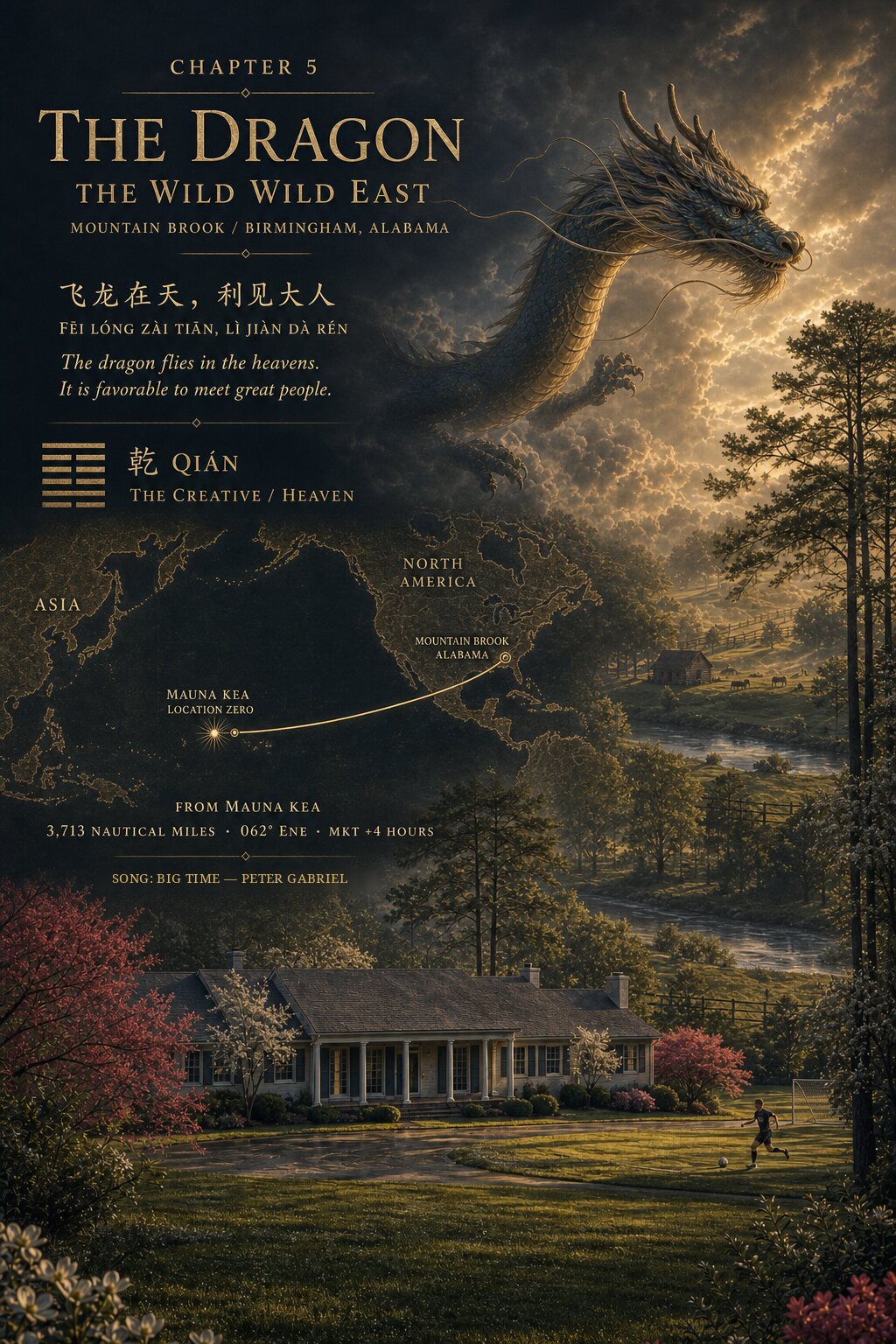
飞龙在天,利见大人
Fēi lóng zài tiān, lì jiàn dà rén
“The dragon flies in the heavens. It is favorable to meet great people.”
The dragon is unlike every other creature in the Chinese zodiac.
The Rat, Ox, Tiger, and Rabbit can be found upon the earth. The dragon exists first in the imagination.
In Western stories, dragons are often monsters to be defeated. They guard treasure, threaten villages, and provide the hero with an enemy worthy of his sword.
In China, the dragon carries a different meaning. It is associated with rain, vitality, transformation, authority, and the mysterious energy by which hidden potential becomes visible power.
When I first went to China in 1983, the dragon’s strength was still largely hidden.
The visible signs of national power had not yet appeared. Most Americans regarded China as a distant nation emerging cautiously from political isolation.
I saw the limitations clearly.
I also sensed the power gathering beneath it.
By the end of the 1980s, the hidden dragon had begun to move.
Factories expanded. Entrepreneurs tested new freedoms. Cities competed for investment. Managers who had once worked inside a planned economy learned the language of international markets with astonishing speed.
China had not yet acquired the skylines, highways, high-speed railways, and global companies that would later astonish the world.
But the dragon was awakening.
Through a remarkable combination of failure, providence, and timing, I arrived close enough to watch it rise.
Ed and Bert
Edward Khalily and Hilbert Eshaghpour were unlike anyone I had previously known.
Ed and Bert were first-generation Americans and Sephardic Persian entrepreneurs with family histories rooted in trade.
That mattered.
To many American companies, China was a newly discovered market, an exotic destination requiring a consultant, a report, and perhaps a cautious exploratory delegation.
To Ed and Bert, trade across cultures was not an academic theory.
It was an inheritance.
Their company was Wegochem, a privately held family business based in Great Neck, New York. Ed founded Wego in 1978. Bert joined him the following year, fresh from Yale with a doctorate in chemistry. When Bert testified before the U.S. International Trade Commission in 2012, he said he had spent his entire professional career at Wego.
Great Neck also put me close to an earlier chapter of my own family. My father, Robert Harrison Edwards, had graduated from the United States Merchant Marine Academy at nearby Kings Point. He had received his appointment through Senator Bankhead of Alabama, although he lived in New York.
His father was an Alabama man practicing medicine in New York, and the family still had plenty of relatives back in Alabama. One of Dad’s aunts went to Senator Bankhead’s office on his behalf. Those family connections helped open the door to the academy. That was pull, and it made a difference in my father’s life.
Here I was, years later, doing business close to where he had prepared to go to sea. Alabama and New York had come together in his story before they came together in mine.
Compared with Buckman, the Wego operation I entered felt like a shoestring enterprise. Its strength lay in people who knew how to trade. In the business I knew then, we stood between the producer and the customer: buying the product, finding its market, and carrying the difficulties between them.
I remember the partnership in its simplest form: Ed bought, and Bert sold. From the purchasing side, I could see why selling mattered so much. A product had to find a customer. But buying and selling depended on each other. The supplier had to deliver what had been promised, and the customer had to want it at a price that made the business work. Their different strengths met in the transaction.
Ed was Edward. I was Edwards. The name I was most curious about was Wego. I especially liked the story of how Ed came by it.
As I remember the story, Ed got his start near Broadway and Wall Street in lower Manhattan. He was already doing brisk business with Iran. An overseas telephone call was expensive if you could get one through at all. An international law firm in the neighborhood let him use its telex machine to send and receive messages.
Each telex machine contained an identifying code known as an answerback. The law firm chose the first two letters from each of two partners’ names. It came out WEGO. When Ed was traveling in China, he would receive telexes from Bert with the name Wego emblazoned across the top. The name stuck. Years later I told Ed and Bert I thought it was brilliant. Even a beginner in English could understand “we go.” I saw God’s hand in the gift of that name.
One trip of Ed’s has stayed with me. He had sourced polyvinyl alcohol through trading companies but wanted to buy direct from the factory. That entailed a bold journey to Sichuan Vinylon Works, which lay deep within China. He packed freeze-dried food and departed by train to Chongqing. Once there, he bought a boat ticket down the Yangtze River to Changhshou. From there, he exited the boat and walked to the factory gates. That bold act of initiative came to symbolize the Wego spirit – a willingness to go to the end of the World to build a business.
By the time we met in 1989, Bert and Ed had developed a wide range of contacts throughout China’s chemical field. Ed began his travels to China in 1980. That reflects the deteriorating situation in Iran with China’s receiving Most Favored Nation status with America in 1979. One door closed in Iran just as China began to open. What impressed me was how quickly Ed went to find out for himself what might be in store for his business. When I lost my job at Buckman, I took a gamble on staying in the China trade. What steadied me was the company I had found. These men were professionals and I wanted to learn from them.
Of all the Americans I had met in China, Ed was the most unusual. To me, he was a modern Marco Polo, a traveler whose curiosity and commercial judgment kept carrying him across cultures. I had grown up reading about such journeys. Through sheer chance, I had befriended a man who made them his working life. Ed and Bert were my Marco Polo team, still doing business in China after the events of 1989 that had made others hesitate. They had a place for someone who was willing to go.
They understood something many larger companies had not yet grasped.
China could not be entered through spreadsheets alone.
The products mattered.
The relationships mattered more.
The Gamble
Meeting Ed and Bert six months after Buckman felt like less like career planning than a collision with fate. I saw instantly how we could work successfully with each other. I quickly gained familiarity with Chinese chemical names and trade terms. What drew me was the excitement of the work and the possibility of being useful.
Caution was never my most developed instinct.
I had recently occupied an enviable position at Buckman Laboratories, one of Tennessee’s leading specialty chemical companies. I had expected that role to place me on a path toward international executive responsibility.
Instead, after three months, I found myself outside the company with nine months of salary, a wounded sense of destiny, and Bob Buckman’s judgment echoing in my mind:
“You’ve done nothing wrong. You just want to run your own show.”
Most sensible people would have responded by seeking a more suitable corporate position and demonstrating that they could remain inside it.
I crossed the Pacific.
During our first week together at the October 1989 Canton Trade Fair, I kept one thing from Ed and Bert: Buckman Laboratories had fired me. I smiled, tried to be helpful, and wrote things down. They were shrewd traders, putting their own money on the line to buy products. If they had smelled a rat during those early days together, they might have decided the relationship would not work. They never did.
The moment of truth came as we were saying goodbye at Guangzhou Airport. My hands were trembling. I had held the secret for a week, and now I felt both shame and pride: shame that I had been fired, and pride in the independence Bob Buckman had recognized. I handed Ed the Buckman brochure I had kept and repeated Bob Buckman’s words, trying not to sound boastful. Ed and Bert had already seen me at work. Now they knew how my last job had ended. I had no guarantee they would hear the story favorably. Wanting to run one’s own show is not ordinarily the first qualification an employer seeks.
“That doesn’t mean you still can’t do it,” Ed told me.
That exchange sealed the deal. Ed was willing to take a chance on the very initiative that had made me difficult to contain. Buckman had given me an opportunity I had not known how to keep. Ed offered another, and this time the work would require me to go where the opportunity was.
Ed and Bert were not building an ordinary organization in an ordinary market.
They needed initiative.
They needed someone who understood China, spoke some Mandarin, knew chemicals and business, could travel independently, and would remain enthusiastic in circumstances that might discourage a more conventional employee.
I ingratiated myself with two of the most capable American chemical traders operating directly through China.
The gamble worked.
I sometimes imagine them on the flight from Hong Kong to New York, looking through the Buckman brochure and fitting it to the man they had just spent the week getting to know. I had let them see my work before telling them about the dismissal. That was the Rabbit in me, relying on discretion to give a new relationship time to grow.
Ed later described me with characteristic accuracy.
“You are very bohemian.”
He was right. My father had grown up in Scarsdale. I had an MBA and a bohemian streak, and I was finding my place alongside two savvy Persian traders.
At our sales table in Great Neck, the world was already in the room: colleagues from Peru, Germany, Iran, Italy, and different American backgrounds. We were doing business beyond the United States as well as within it.
The people around me were first- or second-generation Americans. My own family’s American roots stretched back many generations. Their families had come to America much more recently, while my journey had taken me from the American South to China. We had arrived at the same business from different directions.
I think of the coin I imagined in the preface, divided into WE and GO. Ed and Bert brought the capital, customers, and trading experience. I could help carry their work forward in China with my Mandarin, my American education, and my willingness to stay on the road. Coming from different American histories, we had found a use for one another. I felt I had brought the other half of the coin.
Working at Wego, I began to see New York as America’s counterpart to Hong Kong in China’s trade. Each was a commercial gateway where people with knowledge of other countries brought producers and customers together. That comparison grew out of the work in front of me. International commerce depended on people who could move between languages and cultures, and our office in Great Neck brought that home to me every day.
I remember Ed telling the others that Bob was a diamond and that they were chipping away the flaws.
There were plenty of flaws to work on. Still, I remembered that he saw something worth keeping. My usefulness lay in carrying a conversation from China to New York so that people far apart could act on it. The message had to arrive clearly enough for business to happen.
Ed told me once that he liked the fact that I came from an Air Force family. He figured I understood what it meant to owe loyalty to something bigger than myself. When Ed and Bert spoke of loyalty, they had Wego in mind. My first thought was of my country. I never felt torn between the two. If I gave a Chinese supplier my word, I wanted him to be glad he had dealt with Wego and glad he had dealt with an American. I could do something about both by keeping the one promise.
I had left a promising American corporate position—or, more precisely, watched it disappear—and staked my professional future on the modern Silk Road.
I exchanged the security of an executive office for railway stations, factory visits, hotel rooms, trade-fair negotiations, unreliable telephones, and the uncertain privilege of helping a civilization reconnect with the world economy.
I loved it.
Don’t Sell Us Short
In 1990, my first year in Wego’s high-speed New York merchant culture brought predictable collisions. I was a laid-back Southern WASP by their standards—rambunctious, determined, and not always skilled at disguising either quality. When my position came under pressure, I did not plead. I changed the frame.
I told them that Robert Buckman lived on the same Memphis street as Kemmons Wilson and Fred Smith. Buckman Laboratories understood the pulp-and-paper chemicals central to Wego’s business. Wilson had made Holiday Inn a global language of dependable lodging. Smith had reinvented the movement of time-sensitive goods. Memphis was not a provincial backwater. It was a commercial beachhead.
I was not claiming those men’s achievements as my own. I knew the value of my education, my experience in China, and the connections I had made. I wanted Ed and Bert to understand the ecosystem that had formed me. I was defending Dr. Copper’s teaching, the opportunity Buckman had once seen in me, Memphis, and myself.
Ed Khalily answered with four words I never forgot:
“Don’t sell us short.”
The obvious meaning was: do not underestimate our company. Ed was also reminding me that they had chosen me deliberately. He saw possibilities in me that I had not fully worked out, but I already understood much of what I brought to the table. I knew my own value. In that sense, I felt myself in the catbird seat, even when my manner made the relationship difficult.
Their confidence in me mattered. So did my confidence in myself. The work would require us to make room for both.
The Contract on the Desk
In 1990, my first year, there was a Monday when I understood that my job might be over. I remember being told that things were not working out and that I should go home while they considered what to do. Ed came into my office while my colleague observed our exchange. I had my contract with Wego in front of me.
I pushed the contract back across the desk toward Ed. “It’s not worth the paper it’s written on,” I said. Then I took my Wego business cards from my wallet and laid them on the desk. I set Dr. John Copper’s book beside them and tossed down the magazine with the Buckman Laboratories advertisement on its back cover.
“I could tell within two hours of meeting the two of you that this relationship could work,” I told him. That was why I had been discreet about Buckman during our first days together. I wanted them to judge the work I could do for Wego before judging me by a dismissal elsewhere.
“You can’t fire me. I give you my life.”
And I meant it.
The money for purchases belonged to Wego. Ed and Bert were risking their capital; I was committing my life to the work. I was drawn by the excitement of doing it, more than by the money I might earn. My time, judgment, and reputation were on the line. My commitment went beyond the salary written into that contract.
Across that desk I was making my case to Ed. I’d given him my word. With Bert, whose say in whether I stayed in China carried more weight by then, I did something a little different. I gave him the leather-bound book with my name on the cover. He could read what those executives had written to me when I was still looking for work, then turn to the letter I’d sent back on Buckman stationery. I think that book helped persuade Bert to keep me in China. I’d put into his hands the covenant I’d spoken to Ed.
By Friday, I believed I had won them over. I still treasure that book and the Buckman Laboratories brochure I’d handed Ed at Guangzhou Airport. Those two documents were the thread that held my life together.
Years later I learned that Bert and his wife, Jacqueline Eshaghpour, had endowed a fellowship at Yale for graduate students from China studying the physical or biological sciences. They named it for two of Bert’s teachers, Jui H. Wang and Donald Crothers. I think of Bert holding my book of letters. I had come to him hoping for a chance to stay in China. Somewhere in China now, a young scientist can look toward Yale with the prospect of Bert and Jacqueline’s help.
Ed later told Bert and me that I was the third most important person in the company. I understood the remark as recognition of the work Ed had done building relationships across China and of the responsibility he had given me to carry those relationships forward. His words did not make me a founder. They made clear that he trusted me with a consequential part of the company’s work.
One day much later, in an ordinary conversation, Ed told me, “I understand exactly why Buckman fired you.” What brought it to mind that day, I couldn’t tell you. I just smiled.
Those years have different meanings in my memory. In 1989, I had to find a way through a personal and historical upheaval. In 1990, I had to survive the opportunity I had found and prove that I could earn the trust behind it. In 1991, that preparation would be tested by the urgent work that followed. I could see possibilities quickly; I was learning that other people had to be able to rely on what I did next.
Purchasing Manager and Liaison
My formal title at Wegochem was purchasing manager.
I handled exports, too. In those years I found it much easier to buy from a Chinese factory than to sell American goods to one. The producers I visited were eager for customers abroad. When a rare purchase inquiry arose from China, I passed it along to colleagues in New York.
Most days, though, I had a purchase to make.
A customer needed a chemical. A Chinese factory could produce it. Prices had to be negotiated, samples approved, specifications confirmed, documents prepared, production monitored, and shipments delivered.
Chemicals do not forgive romantic thinking.
Citric acid must meet the required specification.
Sodium alginate must perform as promised.
I did not pass college biology, but trade gave me a practical education in chemistry. I learned the Chinese names for over a hundred chemicals. That gave me an advantage on the telephone. I could call a supplier myself, name exactly what we needed in Mandarin, and understand the answer well enough to ask the next question.
A container must hold the correct material.
A customer cannot manufacture a finished product from cultural goodwill.
Business taught me that trust is performance.
A relationship might begin over tea or at a banquet. It survived through quality, payment, communication, and promises kept.
One payment arrangement I remember was documents against payment, or D/P. The shipping papers, including the stamped bill of lading, could be FedExed from Hong Kong to the Bank of China in New York. As the shipment neared arrival, Wego paid to receive the documents. They allowed the cargo to be released at Long Beach, either to a warehouse or directly to the customer. I also remember letters of credit at thirty or sixty days. Details varied by shipment, but that sequence is how I remember one practical link between a contract and the goods.
Purchasing was the transaction.
Liaison was the vocation.
I operated between people who did not always share the same assumptions about time, contracts, hierarchy, responsibility, or bad news.
An American customer might believe a specification was perfectly clear. A Chinese factory might believe the relationship required flexibility. A delayed shipment could become more than a logistical problem. It could threaten confidence accumulated over years.
My work was to keep the relationship alive long enough for the practical problem to be solved.
I learned to listen to tone, hesitation, silence, and context.
The most important message was not always spoken directly.
“No problem” did not always mean there was no problem.
“Yes” did not always mean agreement.
A banquet could be part celebration, part negotiation, part examination, and part friendship.
The work required me to be confident without arrogance, commercially demanding without contempt, flexible without appearing unreliable, and direct without causing unnecessary loss of face.
In many rooms, I was not merely Bob Edwards.
I was the American.
My hosts did not necessarily distinguish among me, Wegochem, Tennessee, and the United States. My conduct helped shape their understanding of all four.
I had once dreamed of becoming America’s ambassador to China.
No president appointed me.
Commerce did.
China as My Office
After the Canton Fair, Ed and Bert often returned to the United States.
I remained behind.
Someone needed to visit the factories.
Someone had to inspect production, clarify expectations, resolve misunderstandings, and strengthen relationships with suppliers whose names were still largely unknown in the West.
China became my office.
I traveled from Hainan in the tropical south to Heilongjiang in the far northeast, and from Fujian on the coast toward Sichuan in the interior.
The distances were immense.
The roads were not always smooth.
The trains were not always comfortable.
Telephones did not always work.
I remember nights spent at a telex machine, sending messages home. In some cities, my hotel had no telex or fax machine, so I had to go to the telegraph office in the city center. Even getting a message back to America could mean another trip across town.
When I stayed in a hotel that could receive faxes, I’d often wake up and find one from Wego’s New York office under my door. I had written my report the night before. While I slept, somebody had read it and sent back the name of a person to call or a question to take to a factory. I could be halfway around the world and still start my day with an answer from Bert or Ed.
A meeting might lead to a banquet, the banquet to another negotiation, and the negotiation to an overnight train bound for a city most Americans had never heard of.
Flexibility was part of the work. If the telephone failed or a journey changed, I still had to reach the person who could help. The adaptability I had begun learning in three high schools and practiced with the bare necessities in Xuzhou now served a customer waiting on the other side of the Pacific. I could change my route or my expectations of comfort. The obligation to deliver remained.
Looking back, those were the most magical years of my life. I cannot go back to them, but I remember what it meant to be there, doing the work and discovering what I was capable of.
Each province complicated the idea that China could be explained as a single place.
Shanghai impressed me with its elegance.
Nanjing became a second home.
Across my two stays in Nanjing, one in 1983 and another in 1989, I met students from many parts of the world. I remember Europeans, including Swiss students who seemed to speak four or five languages, and African students who had come to China on scholarships. Some spoke Chinese remarkably well.
We became friends. On Friday or Saturday nights, foreign students gathered across town to dance, drink and share stories. Those evenings widened the story I was living: Nanjing was not only a meeting place between China and America, but a home for students carrying many countries and languages with them. I remember the warmth of that community more clearly than any formal lesson.
Nanning, which lies close to Vietnam captured my affection with its warmth.
Ed Khalily had targeted citric acid production factory long before I met him. He understood that Chinese consumers would soon consume Coca-Cola and other soft drinks, and he doubted China was producing enough citric acid to meet the demand he saw coming. His original company, Wego General Trading Company represented Swenson Process Equipment of Harvey, Illinois. Swenson made the evaporators, crystallizers, and dryers that chemical producers needed.
As I remember it, Wego sold three citric acid plants in China. Ed had worked out those sales before I joined the company. Think about it from the Chinese producer’s side. Before you put money into a plant, you want to know who will buy what comes out of it. Ed could tell the producers that Wego would buy their citric acid, and we did. I thought that was pretty clever. Years later, when I made my home in Chattanooga, a city built in part on Coca-Cola bottling, I would think of Ed’s hunch again. My own part in the citric acid business came after those sales.
I recall a visit I made to Nanning to check in on one of the citric acid factories we had sold. I stayed at the Mingyuan Hotel where Mao Zedong had resided during a conference in 1958. One evening I walked out onto the porch. Inside, I had been watching the Gulf War on CNN. Outside, people were setting off firecrackers for Chinese New Year. They looked happy. They had a new year to look forward to. I stood there thinking about the people in Kuwait and what they had to look forward to that night.
I thought of the thumbs-up I had given George Bush in the Superdome. I had meant it. Now I was watching people die on television, and the part my own country was playing hit me in the stomach. I can still feel it. When I try to explain why peace matters to me, I think of the people I could see from that porch, free to look ahead to another year. When I try to say when I began to distrust the neoconservatives, I come back to that hotel porch. Years later, at Governor’s School, I would try to put some of that sorrow into words for a man who taught Arabic.
Industrial cities revealed ambition before their buildings became impressive. Provincial factories taught me how much economic life depended upon people far from the centers foreigners usually visited.
Foreign observers often saw China from Beijing, Shanghai, a famous historical site, a model factory, and an international hotel.
I saw another China.
Managers struggling with new commercial expectations.
Engineers learning international specifications.
Interpreters carrying responsibilities beyond language.
Workers producing materials for customers they would never meet.
Entrepreneurs testing the uncertain boundary between government direction and private initiative.
The farther I traveled, the less comfortable I became with easy explanations.
China was not one story.
The Shanghai Toast
My international travel at that time took me frequently to Shanghai, where I stayed in the same hotel as Russian Aeroflot employees. In August 1991, hard-line officials attempted a coup against Soviet President Mikhail Gorbachev. The failed coup weakened him and accelerated the Soviet Union’s dissolution that December. I soon befriended a slightly confused delegation from Moscow just as these events were unfolding.
I ordered a delicious Chinese dinner and we talked in excited tones about the new possibilities of cooperation. I gave them several International Herald Tribune newspapers that depicted the changes happening in the country they had just left. We toasted U.S.-Russian friendship late into the night and parted as friends.
When I later imagined a more durable friendship between America and Russia, I could return in memory to that Shanghai dinner in 1991. We had shared newspapers, a meal, and the excitement of a future that suddenly seemed open. It was a modest beginning, but it was real.
The Russian people entered my story as people at a table. That is why I do not want them to appear at the far edge of this covenant only as a strategic problem. Russia has a Pacific shore. The friendship I toasted in Shanghai belongs within the same horizon as my friendships in China. The years since have given Americans and Russians reasons for grief, anger, and distrust. They have not removed the need to imagine a relationship our children might be glad to inherit.
Our governments had spent generations preparing us to destroy one another.
Around that table, friendship required only dinner, newspapers and someone willing to make the first toast.
Memphis in the Chinese Directory
In the early 1990s, I remember leafing through the glossy English language Chinese business directory found in nicer hotels. Amid names that were still unfamiliar, two familiar ones leapt from the page: Holiday Inn and FedEx.
They were Memphis names. I had traveled halfway around the world to a country still opening to international commerce, and there, printed in a Chinese directory, were two institutions from the city that had formed me.
The moment compressed geography. Memphis was not merely looking toward China. Parts of Memphis had already arrived. Holiday Inn offered a recognizable room. FedEx offered a dependable promise of movement. One standardized trust for travelers; the other standardized speed for commerce.
I began to see my hometown differently. A city on the Mississippi could become a platform for the world. The directory offered no theory, but it planted an image that would remain with me: Memphis names written into China’s future.
The Canton Fair University
Twice each year, the Canton Fair became a center of our commercial world.
To an outsider, it was an enormous trade exhibition.
To me, it was the greatest university I ever attended.
Delegations arrived from around the world and from every region of China. Factories displayed their products. Buyers searched for suppliers. Business cards changed hands with ceremonial care. Conversations began politely and sometimes became unexpectedly personal.
Tea was poured.
Questions were asked indirectly.
One introduction led to another.
Trust accumulated.
Sometimes a contract followed.
Sometimes it did not.
The relationships remained.
Hotel suites became temporary embassies of commerce. People moved through them throughout the day, carrying samples, price lists, questions, and possibilities.
There were no ambassadors, flags, or formal treaties.
Yet diplomacy occurred in those rooms.
I recall at the end of the Canton Trade Fair, Ed had assembled a stack of 20 to 30 contracts and remarked that is was only paper – but it meant much more. I seldom used the finance, marketing and management skills I learned in graduate school, but I managed to create legible chart of the contracts we had signed. It bega with a contract number, product name, purity, packaging, quantity, shipping details and payment terms. International trade boiled down to those key factors.
Each successful transaction demonstrated that an American company and a Chinese factory could trust one another enough to act.
One reliable shipment led to another.
One supplier opened a province.
One friendship created confidence inside two organizations.
Nothing could appear less dramatic than a purchase order for citric acid.
Yet millions of such exchanges were changing the world.
Much of my own preparation happened in those unglamorous exchanges. A specification clarified, a factory visited, a conversation followed through: each gave me knowledge I could use the next time someone needed help. When the call about nitromethane came, I was ready because of years spent doing that work. I had not known what I was preparing for. The call gave those years an immediate purpose. Opportunity arrived in a moment; the ability to answer it had taken much longer.
Nitromethane: The Door Opened Before the Crisis
In early 1990, I attended a trade exhibition in Chengdu. I remember being the only American in the place, conspicuous and thoroughly delighted by it. A Chinese representative approached me with an unexpected question: would I be interested in buying nitroparaffin? Nitromethane, chemically a member of the nitroparaffin or nitroalkane family, was one of the products that could fall within that commercial language. I took his offer seriously, passed the information to Wego, and signed a contract that we did not execute. At the time there was little demand from our American customers for Chinese nitromethane. Nevertheless, the meeting remained in my memory—and the relationship remained available.
That was part of the sheer pleasure of importing from China. I could arrive at a trade show as the only American there and discover people eager to do business with America. I was someone who could listen, negotiate, and sign a contract. To them, the distant market had acquired a face. To me, the hall in Chengdu was full of possibilities. The business did not begin with the emergency a year later. It began with being there and taking a conversation seriously.
On May 1, 1991, the ANGUS Chemical plant in Sterlington, Louisiana, was struck by a catastrophic explosion. Eight workers died. The tragedy must be remembered first as a loss of human life, not as the opening act of a business success. The disruption also threw customers dependent upon American nitromethane production into a desperate search for alternative supplies.
I was in Guangzhou when Ed Khalily telephoned from New York. He had a gift for language as vivid as his commercial instincts. “I am boiling in three inches of hot oil,” he told me. “You must find nitromethane.” I understood the urgency. The Chinese name for the chemical was 硝基甲烷—xiāo jī jiǎ wán. Once I could say it, I could work the telephone. That was showtime. Wego had spent ten years learning whom to trust in China. Now Ed was on the telephone to me, and I knew whom to call in Shanghai.
I called an old friend at Sinochem in Shanghai. After perhaps a week, he called back with the words I wanted to hear: “I got it.” He had located a source in Kunshan, outside Shanghai, capable of producing and supplying nitromethane. I traveled to Shanghai and invited him and two colleagues to dinner at the Shanghai Hilton. I remember a Japanese restaurant downstairs. I was the host. We ate, drank, laughed, and talked about everything under the sun. Only as the evening wound down did I casually raise the matter we had all come to discuss: “By the way, what about nitromethane?”
He offered, as I remember it, two containers a month, at a price we could accept. The dinner led to a successful business relationship that resulted in Wegochem ultimately acquiring the Kunshan factory. My friendship had produced something tangible.
Luzhou: Outside the Usual Route
But the Shanghai opening was only the beginning. I remembered the supplier I had met in Chengdu the previous year. His facility was associated with Luzhou, a Sichuan city whose industrial landscape included defense-related enterprises, including the world of NORINCO, China North Industries Corporation. That meant the city was closed to foreigners unless they had special permission to visit.
Ed and I strategized. Whom did we know in Sichuan? Wego had cultivated a reputation in China for roughly a decade, and that reservoir of goodwill mattered far more than a new business card or a letter written in haste. Through the company’s trade network, I met with a senior official in Chengdu with the clout to make my visit happen. He made the phone calls that allowed my visit to Luzhou to proceed.
Ed suggested that I bring along a bottle of alcohol, so I bought a bottle of Jack Daniels to provide a Tennessee accent for what would become a very successful business for both companies. I flew from Chengdu to Luzhou. I renewed the acquaintance from the earlier trade exhibition, visited the operation, and negotiated another contract for two containers of nitromethane a month. I returned to Chengdu, went to the business office of an international hotel, and sent the contract by fax to Wego in New York. No explanation. No cover sheet. Only the contract. I can still picture those pages passing through the machine.
As I remember it, a colleague at Wego had come into the office on a Saturday hoping for news. He picked up the fax and understood immediately what it meant. There was no grand speech on my end of the wire. The piece of paper was enough. Of all the business I knew in my years at Wego, nitromethane was the most profitable. Nothing else came close. I could not have done it without Ed, Bert, Sinochem, the Chinese suppliers, and the people who opened the road. Yet I had done my part: I had gone, negotiated, and come home with the contract.
In 1991, I proved what I had meant when I pushed that contract back across Ed’s desk. “I give you my life” had been a promise to put myself into the work. Wego supplied the money to buy nitromethane. My part was to find the source, negotiate the terms, and come back with a contract. The nitromethane business gave my promise a result Ed could see. He had taken a chance on me; I had shown that I could do something consequential. Now the confidence on both sides had a business behind it.
The Anti-Dumping Case and an April–May Echo
After the emergency passed, Chinese nitromethane production and imports expanded. ANGUS resumed production and, in May 1993, petitioned U.S. authorities for anti-dumping relief. The Department of Commerce investigated whether Chinese imports were being sold at less than fair value; the U.S. International Trade Commission, or ITC, separately examined whether those imports injured an American industry. The distinction matters. It was not the International Trade Administration alone that decided whether an injury finding would support duties.
Wego did something that importers sometimes hesitate to do: it participated in the opposition to the requested remedy. The published record of the nitromethane proceedings names Wego Chemical & Mineral Corporation among participants. We relied on lawyers and trade specialists for the legal fight; I was not our company’s attorney or the man who retained the consultant. My contribution lay earlier and at the commercial foundation: the Chinese relationships, sourcing, travel, and contracts that created a business worth defending.
In May 1994, the ITC determined, by a four-to-one vote, that the Chinese imports had not caused or threatened the material injury required for anti-dumping duties. Commerce had reached an affirmative dumping determination, but without an affirmative injury finding the proposed anti-dumping order could not stand. ANGUS contested the decision; federal appellate litigation later sustained the Commission’s result. That was an important victory for the importers, though no single company should claim the entire public decision as its own.
I took considerable satisfaction in that contest. An American manufacturer had challenged the trade we had helped build, and the injury finding ultimately went against it. I felt that I was representing China in a commercial sense: helping Chinese producers compete for American business through an American importing company. The work was international, and I was proud of the part I had played.
Richard Nixon died on April 22, 1994, only a short time before that May determination. I do not know the precise announcement date well enough to claim the events occurred on the same day. But I find an unmistakable symmetry in their proximity. The president who had helped reopen political relations with China departed just as Americans and Chinese were testing whether the commercial relations he had helped make possible could endure a legal challenge. Nixon opened a door in diplomacy. In my small corner of the story, I had spent years walking through doors opened by trust.
Yiddish offers a word that Ed and Bert would have understood: mensch. It describes a decent, reliable person who acts with integrity and comes through when needed. I was not the lawyer who defended the nitromethane business. I was a mensch who helped make the business possible. Those experiences did not make me rich, though I believe they helped generate significant profits for Wego.
For the underlying trade history, see U.S. International Trade Commission, Nitromethane from the People’s Republic of China, Investigation No. 731-TA-650 (Final), Publication 2773 (May 1994); and Angus Chemical Co. v. United States, 140 F.3d 1478 (Fed. Cir. 1998).
Winston Churchill—Yet
Ed Khalily became one of the great mentors of my life.
He was alert, curious, energetic, and perpetually searching for the next possibility. He could enter a room quietly and still alter its atmosphere.
China respected him because he respected China.
That lesson cannot be overstated.
Respect cannot be demanded.
It must be earned.
Ed also possessed a sense of humor strong enough to manage my ambitions.
During one Canton Fair in Guangzhou, I enthusiastically offered another grand suggestion. I no longer remember which proposal inspired his response.
It may have involved candles.
For reasons I still consider defensible, I frequently suggested that Wegochem should import candles. Ed and Bert found the idea reliably amusing. Whatever its commercial merits, my candle campaign gave them another reason to laugh at the purchasing manager who approached every conversation as an opportunity to enlarge the company’s destiny.
On one occasion, Ed listened to me and then delivered his judgment.
“You’re not Winston Churchill…”
He paused.
“…yet.”
Everyone laughed.
Including me.
For years, I remembered the comparison.
Only later did I understand that the most important word was the last one.
Yet.
Only a mentor adds “yet.”
The word corrected my self-importance without extinguishing my ambition. Ed did not tell me I was already the statesman I sometimes imagined myself becoming.
He also did not say growth was impossible.
On other occasions, he told me that I would surprise everyone.
He said, “Anyone who says you are stupid doesn’t know what they are talking about.”
The words mattered.
Professional failure can distort a person’s understanding of himself. A dismissed employee begins wondering whether the institution discovered a defect everyone else had politely overlooked.
Ed saw something different.
He saw that I learned quickly.
He saw that my optimism could be useful.
He saw that the ability to connect people and possibilities did not always fit neatly within a conventional corporate ladder.
He also understood that talent without discipline could become exhausting.
Correction and encouragement arrived together.
Two Logs and a Fire
Ed and Bert taught me something else through their partnership.
Anyone who has built a campfire understands the principle.
One log placed alone may smoke and smolder. Two logs positioned together create a channel through which air can move. The fire rises in the space between them.
Wegochem succeeded because there were two of them.
Their strengths were not identical. Their partnership created energy neither could have produced alone.
The image later helped me understand my own relationship with China.
I did not create China, manage its transformation, or command its institutions. I placed my American life beside it.
Between America and China, Tennessee and Nanjing, individual initiative and civilizational continuity, a current of energy began to move.
China became the other log of my life.
The fire existed in the relationship.
Midwife to a Transformation
I was not an architect of China’s economic awakening.
China’s transformation belonged to the Chinese people who worked, saved, studied, experimented, invested, endured, and built.
But I arrived while new commercial relationships between China and America were still being born.
I sometimes think my role resembled that of a midwife.
I did not conceive the child.
I could not control what it would become.
I helped anxious people understand one another. I translated intentions, steadied fragile relationships, solved misunderstandings, and helped new connections survive long enough to become durable.
The child eventually grew far beyond me.
That is the fate of every midwife and the measure of success.
The China I first encountered accumulated factories, highways, cities, capital, and confidence.
I accumulated relationships, language, experience, memory, and conviction.
Our transformations were not equal in scale, but they occurred beside one another.
I watched the hidden dragon rise.
The dragon also watched me become something I had not known how to name.
Not merely a teacher.
Not merely a businessman.
Not merely a purchasing manager.
A liaison between worlds.
Contracts and Friendships
Those years changed my understanding of business.
Money measures transactions.
Business creates relationships.
The strongest companies I encountered did more than manufacture chemicals or move goods.
They manufactured trust.
A contract could describe obligations, prices, quantities, and deadlines. It could not by itself produce confidence.
Confidence emerged when the material met specifications.
When payment arrived.
When someone admitted a mistake.
When a traveler returned.
When a difficult conversation did not end the relationship.
Contracts expire.
Friendships do not.
The older I became, the more deeply I believed those words summarized what China had taught me.
Governments often treat trade as leverage. Economists measure it through totals and balances. Strategists ask which nation gains power.
Those questions matter.
But beneath the statistics are human beings deciding whether another person can be trusted.
The deepest unit of international order may be no larger than that decision.
This is where relational realism acquired its practical meaning for me. Goodwill could open a conversation; only performance could sustain it. Trust made information travel, allowed a mistake to be admitted before it became a disaster, and gave both sides a reason to try again. The relationship had economic value because it helped people act under uncertainty.
The Dragon in Flight
I had arrived in China as a student, then later as an English teacher earning a few dollars a day.
I returned as a commercial traveler moving among factories, hotel suites, railway stations, trade fairs, and negotiations.
I was proud to walk into those factories for a scrappy outfit in Great Neck. I was a Reagan Republican and a Christian, and I cared a great deal what the people I met made of this particular American. They could judge me by ordinary things. Had I understood what they were trying to tell me? When I went home to New York, would I tell Ed and Bert what the factory could actually deliver? Getting those things right felt like a way to serve my country and the people who had welcomed me into theirs. That was when the work began to feel like a vocation.
I had seen China when the dragon was hidden.
Now I watched it take flight.
Its rise would create wealth, opportunity, disruption, pride, fear, and new forms of rivalry. Power is never uncomplicated. A dragon can bring rain or flood the fields.
But in those early commercial years, the dominant feeling was possibility.
Factories worked through the night.
Young engineers believed immense projects could be completed.
Entrepreneurs accepted risks that more comfortable societies might have avoided.
Cities woke each morning determined to become larger than they had been the day before.
Watching them, I found myself asking whether Tennessee and America could recover the same confidence.
Could we build again?
Could we connect vision with work?
Could commerce become something more than a contest for advantage?
Could relationships created through business survive the political storms that would inevitably come?
I did not yet possess the answers.
I had found people willing to pursue the questions beside me.
The Rabbit had carried the ember through the briars.
Ed and Bert gave it air.
The dragon rose.
And I was grateful to have witnessed its first flight.
Table of contents · Next: Chapter 6 · The Snake: The Skin We Leave Behind

