
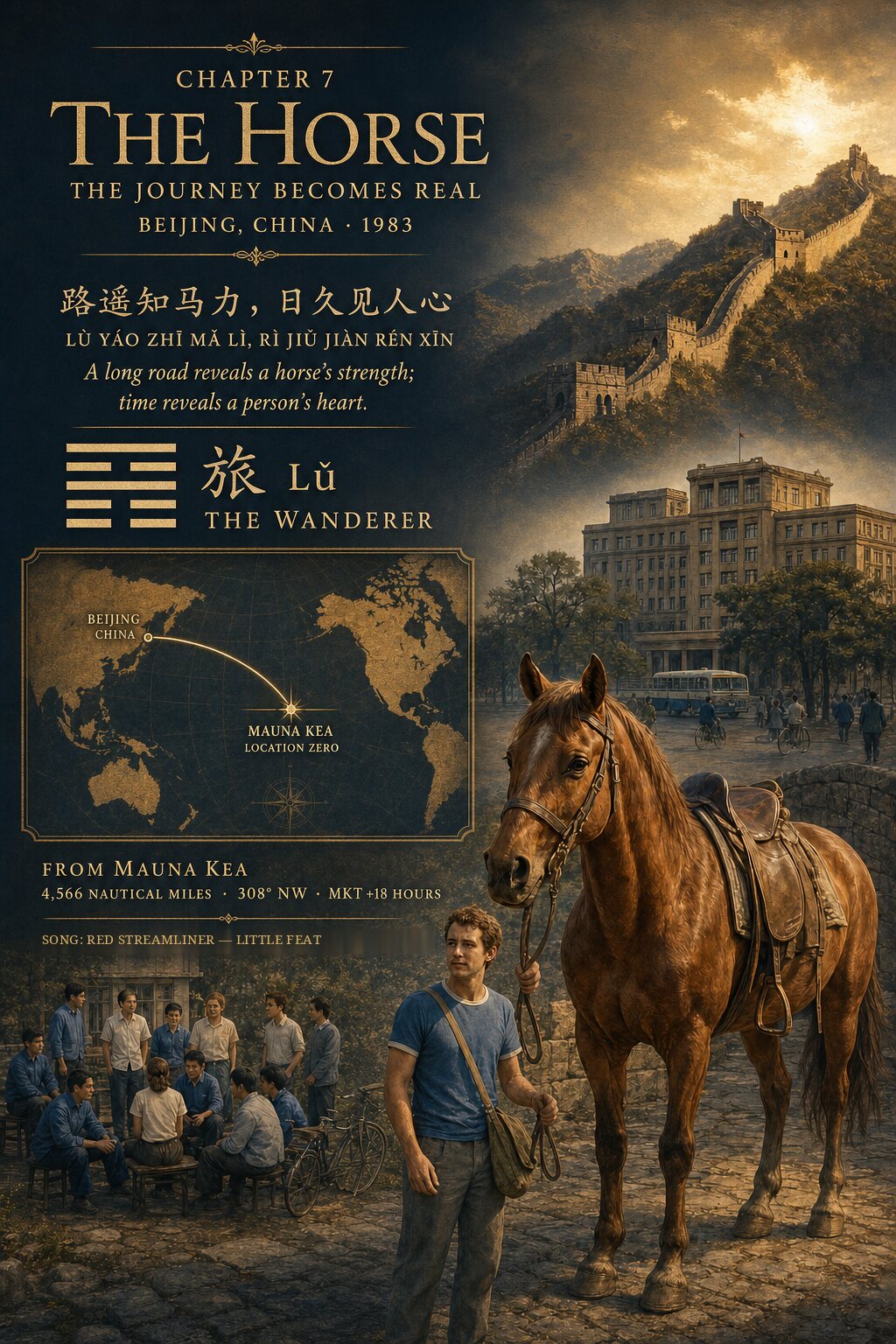
路遥知马力,日久见人心
Lù yáo zhī mǎ lì, rì jiǔ jiàn rén xīn
“A long road reveals the strength of a horse; the passage of time reveals the heart of a person.”
The horse was made for distance.
Its power is visible and earthly: muscle, breath, endurance, and movement. It carries burdens, crosses borders, remembers roads, and responds to the hand that treats it well.
Properly matched with a rider, it travels farther than either could travel alone.
My professional life never resembled a ladder.
It resembled a road.
Sometimes paved.
Sometimes muddy.
Frequently heading in a direction no career counselor would have recommended.
American professional life is usually described vertically. A promising employee enters an organization, earns promotions, supervises larger departments, and eventually reaches the executive floor.
I never mastered that ascent.
Part of the reason is that I kept meeting the people at the top on my way in. At Buckman I could speak directly to Bob Buckman. At Wangs International I worked with Robert and Susan Wang. I had more practice talking to the owners than I ever had earning a promotion. I think I’m a fairly mild-mannered fellow, but put me in an organization and pretty soon I want to effect change.
For a man with an MBA, my conventional management record remained thin. I did not build a corporation or command a corporate army.
Instead, I repeatedly received something difficult to place on an organization chart.
I crossed boundaries.
My value was horizontal rather than vertical.
I did not climb over people.
I traveled between them.
The Long Road Through China
China taught me distance.
I traveled from Hainan to Heilongjiang and from Fujian toward Sichuan. I learned that the line between two cities on a map says almost nothing about the experience of moving between them.
A journey might involve an early morning taxi to a crowded train station, platform, an unfamiliar meal, and a conversation with someone whose name would never appear in an official report.
Those interruptions became part of the education.
The Chinese expression 走马观花 (zǒu mǎ guān huā) describes viewing flowers while riding a horse—seeing quickly and superficially.
Foreigners often experience China that way.
Beijing.
Shanghai.
The Great Wall.
A factory.
A banquet.
A high-speed train.
Then home with an explanation of the entire country.
I traveled widely, but China repeatedly forced me to stop.
A delayed train taught patience.
A provincial factory revealed hierarchy.
A banquet became negotiation through hospitality.
A misunderstanding about specifications became a lesson in translation having little to do with vocabulary.
Expertise sometimes increases certainty.
Experience often destroys it.
China was too large, old, diverse, wounded, ambitious, and contradictory to be understood from horseback at full gallop.
The road demanded repeated return.
千里马 — Qiān lǐ mǎ — The Thousand-Li Horse
Another Chinese expression describes the qiān lǐ mǎ—the exceptional horse capable of traveling a thousand li—and the rare judge who can recognize it.
Exceptional horses may be common.
A person able to recognize one is rare.
I once told Ed Khalily that I was a thoroughbred.” I couldn’t picture myself in a conventional job. I had already shown how poorly I took to sitting in an office at Buckman. Give me a chemical to find in China and somebody to call, and I knew where to start.
The comparison requires caution.
Every difficult employee is tempted to believe he is a misunderstood thoroughbred. Sometimes the horse resisting the harness is not exceptional.
Sometimes it is merely untrained.
Nevertheless, people occasionally recognized a usefulness in me that conventional institutions did not.
Ed and Bert did. They knew the trade, and they gave me room to find my own way to a supplier.
Ed understood that my China experience could take me well beyond an ordinary purchasing position. He needed me to travel, ask questions, and keep going when a lead came to nothing.
He did not need me to become a conventional manager.
He needed me to go.
Arif Dirlik was another.
He disagreed with many of my political convictions but knew that I possessed the courage and adaptability required to return to China during a difficult moment.
Jan recognized something as well.
She saw the restlessness and ambition, but also the continuity beneath them. She understood that the road to China was not a temporary adventure from which I would eventually recover.
It was part of me.
The long road revealed the horse.
It also revealed the people willing to keep traveling beside it.
The Road Eisenhower Imagined
As a child, I encountered President Dwight D. Eisenhower in the halls of Walter Reed Army Medical Center. I could not then have understood that one of his great peacetime ideas would later become part of my own vocation.
In 1956, Eisenhower established the People-to-People Program and launched the modern sister-city movement. He believed that governments alone could not build an enduring peace. Citizens, schools, businesses, civic leaders, and communities also had to create thousands of practical ways for people to know one another across national boundaries.
Only much later could I see the continuity. The former general and president I glimpsed at Walter Reed had imagined a road to peace built through human relationships. Chattanooga’s sister-city work—and my own life between Tennessee and China—would carry me onto that road.
The Road Jean Hawk Troy Helped Build
Long before I appeared before the Chattanooga City Council in 2002, other people had already built the road between Chattanooga and China.
Jean Hawk Troy was born in Suzhou in 1915 to Methodist missionary parents. She attended the Shanghai American School and came to the United States at seventeen. In 1936 she married the Rev. H. Olin Troy, who served the Chattanooga congregation we know today as Brainerd United Methodist Church. Jean and Olin raised three sons, Bill, Jim, and Henry.
Shanghai American School had opened in 1912, primarily to educate the children of American missionaries, while also welcoming children from other American families in China. It offered an American education in the city where those families lived. Jean belonged to a generation for whom China was home and America was also an inheritance.
Jean worked with young people in the church and later led tours to China for the U.S.-China Peoples Friendship Association, which she also served as national president. Of all those journeys, the ones she treasured most were the trips when she got to show each of her boys the country where she grew up.
The Chinese people who knew Jean held her in great affection. She spoke some Chinese, led visitors through a country she loved, and brought an American warmth to those encounters. To me, she was America’s friendly face to China. The friendship she represented reached well beyond Tennessee and Chattanooga.
I remember Jean telling stories of visitors to her family’s home after Sunday church. One of them, if I remember her account correctly, was Madame Sun Yat-sen, Soong Ching-ling. She was one of the Soong sisters and the wife of Sun Yat-sen. Sun himself had been baptized at the American Congregational Church in Hong Kong. Jean’s stories brought the people of modern Chinese history into the familiar setting of a family home. In listening to her, I could hear how personal some of those old connections had been.
In 1982, Troy helped lead a Chattanooga delegation of thirty-four people to Wuxi. Chattanooga Mayor Pat Rose and his successor, Gene Roberts played key roles in the civic story that produced the sister-city agreement. The relationship they established gave Chattanooga a human connection to China before most American cities were thinking seriously about such ties.
On March 18, 1984, Jean led an American friendship delegation to Zhongnanhai in Beijing to meet Premier Zhao Ziyang. Zhao talked about President Reagan’s upcoming visit. Jean told him what she had in mind for Washington, a gathering where Americans could learn more about China. The next morning her meeting with the premier made the front page of People’s Daily. On a group visit to Hangzhou, she met a young man at their hotel seeking opportunities to practice English. When asked to give him an English name, Jean responded with “Jack.” Jack Ma later established Alibaba in 1999, one of China’s largest e-commerce companies and a major participant in the digital economy. Her story eventually appeared in the orbit of Crocodile in the Yangtze, Porter Erisman’s account of Jack Ma and Alibaba’s early years.
In trade alone, the relationship grew beyond anything I could have imagined when I first went to China in 1983. In 2024, total trade between the US and China approached $500 billion dollars with China enjoying a large surplus. Some of that trade goes with me when I take a walk. My phone was made in China, and so were the shoes on my feet.
That same year, the US-China Peoples Friendship Association and the Chinese Embassy in Washington held a reception together to mark the association’s fiftieth anniversary. The work Jean cared about continues. In April 2026 the association held its Washington Seminar online.
If you’d like to carry on the work Jean did, I’d start with Bart Trescott’s From Frenzy to Friendship. With help from his wife, Kitty, Bart gathered the stories of fellow members. He tells how Americans organized visits to China and how they welcomed Chinese students when it was their turn to cross the Pacific.
The Radicals We Almost Leave Out
Anne McCarty belongs near Jean Troy in this story. She was born in 1924 and grew up in Anniston, Alabama. She was my father’s first cousin. Anne became active in the Civil Rights movement together with her husband Carl Braden. Her biographer titled the book about Anne’s life Southern Subversive. Anne’s radical ways compromised her brother’s distinguished naval career and caused family dissension. Her bold stance on the injustices of her era speaks now from the grave.
I would give Grace McCallie Divine Liu a place here beside Jean Troy and Anne Braden. Grace was born in Chattanooga in 1901, fourteen years before Jean was born in Suzhou. Grace’s aunt, also named Grace, helped found Girls Preparatory School. Young Grace went to New York to study singing. There she married Liu Fu-chi, an American-trained Chinese engineer. In 1934 she took their baby daughter to join him in Tianjin, where he would become chief engineer and general manager of the waterworks.
A photograph from 1945 shows Grace and Fu-chi with their three children. Giles Brooks, a Marine from Chattanooga, found the family in Tianjin after the Japanese occupation and sent word home that they had survived. When the Communists took power in 1949, Grace stayed with her family. Fu-chi died in 1955. Grace raised their children and taught English. During the Cultural Revolution she was arrested and accused of spying. Back in Tennessee, her relatives had reason to worry about what it might mean even to receive letters from Communist China. For nearly twenty years, scarcely any word passed between them.
The part that brings tears to my eyes is a letter. After President Nixon’s visit to China in 1972, Grace wrote home. As I remember the story, she addressed the envelope to the headmaster of McCallie School in Chattanooga, Tennessee. No ZIP code. There had been no such thing when she left America. I think about that envelope arriving at the school her uncles had founded. Her family had wondered for years whether she was still alive. Here was a letter from Grace.
In 1974 Grace came back to the United States with her son William. She had spent forty years in China. I know her story through my friend Eleanor McCallie Cooper. Grace was her father’s cousin. Eleanor lived with Grace in Berkeley near the end of her life and helped her put her memories on paper. She and William later wrote Grace in China together.
Jean made the journey to Wuxi possible for people from Chattanooga. Anne challenged segregation in the South, at a cost to her own family. When I think of Grace, I think of what it took for a mother in Tianjin and her kin in Tennessee simply to stay in touch. These women have each given me a different reason to ask what I owe the people on the other side of a divide.
Radicals can be wrong. They can become vain, destructive, or captured by ideology. But civilization also depends upon people willing to say that an accepted cruelty is not inevitable and an unimaginable friendship is not impossible.
Any honest account of my own provocations must acknowledge the women who demonstrated that changing minds sometimes begins by refusing the small room assigned to you.
When I later became president of the Chattanooga chapter of the U.S.-China Peoples Friendship Association in 1998, I was not founding a movement. I was inheriting one. That distinction matters. Covenant is not merely the creation of new relationships. It is the willingness to receive relationships built by others, tend them faithfully, and pass them forward.
Twenty Years of Friendship
In 2002, Chattanooga’s sister-city relationship with Wuxi reached its twentieth anniversary.
Twenty years should have been a cause for celebration.
It might instead have passed with little attention.
International relationships rarely collapse in a single dramatic moment. More often, they fade through neglect. A delegation is postponed. A letter goes unanswered. The people who remember the beginning retire or move away. Photographs remain in an office while the living relationship quietly disappears.
I could feel that danger approaching.
At the time, I served as president of the Sister City Association of Chattanooga.
No official instructed me to appear before the Chattanooga City Council.
No one commissioned a report or placed the Wuxi relationship on the agenda because I had requested it.
I simply knew I had to speak.
The Rat had found another opening.
The Horse carried me through it.
I went before the City Council and addressed its chairman, Ron Littlefield.
I told the Council that 2002 marked the twentieth anniversary of Chattanooga’s relationship with Wuxi. That October, Wuxi would host a sister-city conference, and Chattanooga would be warmly welcomed.
The invitation was an opportunity.
Someone merely had to recognize it and act.
Ron did.
He understood that sister-city relationships could be more than ceremonial exchanges of plaques and photographs. They could connect civic leadership, education, culture, business, and the international identity of a city.
I remember our friend Eleanor McCallie Cooper joining Ron and me on that 2002 visit to Wuxi. She later succeeded me as president of the Sister City Association of Chattanooga. Eleanor remains a friend.
The visit breathed new life into the Wuxi relationship.
Ron later served two terms as mayor of Chattanooga. He remains warmly regarded in Wuxi, and Jan and I still count him as a good friend.
I do not claim that one City Council appearance determined a political career or singlehandedly preserved an international partnership.
But I know what neglect can do.
I also know that no one had told me to speak.
Had I remained silent, the opportunity might have passed.
Sometimes the long road turns because one person recognizes that a relationship is about to lose momentum and gives it another push.
Ron later returned to Wuxi as mayor and brought me along to help interpret. We visited the Wuxi Foreign Language School, where Madam Gao Xiaofang helped carry the educational relationship forward. In 2006, a delegation of educators and students came to Tennessee just as I was beginning my work at St. Andrew’s-Sewanee. The road from a City Council invitation to a classroom had taken years. It depended upon people on both shores returning the welcome.
A mayor’s visit could open a door that a teacher’s letter had not. A teacher then had to help turn the opening into an exchange. Wuxi taught me how public authority and personal relationships could strengthen one another. Neither could do the other’s work alone.
A Fifth Sister City
In 2003, that work widened beyond Wuxi. As president of the Sister City Association of Chattanooga, I brought Mayor Bob Corker together with leaders from Gangneung, South Korea, for the signing of Chattanooga’s fifth sister-city agreement. Gangneung lies on the eastern coast of Korea and is a favorite vacation and honeymoon destination.
Corker would later represent Tennessee in the United States Senate and chair the Senate Foreign Relations Committee. At the time, he was Chattanooga’s mayor, joining Korean civic leaders in a local act of international friendship.
The signing was ceremonial, but it was not merely ceremony. It extended Chattanooga’s civic diplomacy across another part of the Pacific and gave our city a living relationship with the Republic of Korea.
Friendship Requires Maintenance
The word friendship can sound naïve in international affairs.
Strategists prefer harder words.
Interests.
Leverage.
Deterrence.
Power.
Security.
Those concepts matter. Nations cannot build foreign policy upon affection alone.
But interests without relationships become brittle.
Deterrence without communication can create the very conflict it is intended to prevent. A defensive action by one side appears offensive to the other. Each responds to the response until both become trapped inside a machinery of suspicion.
Friendship does not eliminate disagreement.
It prevents disagreement from becoming the only reality.
A sister-city relationship creates a different kind of memory.
I know your city.
I have walked your streets.
Your delegation ate at our table.
Our students met one another.
We worked through an awkward translation.
You welcomed us when no national government required you to do so.
Those memories do not settle geopolitical disputes.
They make caricature more difficult.
The long road proves whether such friendship is real.
The first delegation is easy to celebrate. Speeches are made, gifts exchanged, and photographs taken.
Time asks the harder questions.
Will the relationship survive changes in mayors?
Will schools continue participating after the enthusiastic teacher leaves?
Will businesspeople remain interested when no immediate contract appears?
Will friends continue speaking when national politics becomes hostile?
A ceremony begins a relationship.
Only maintenance makes it durable.
Jan Takes the Reins
The Wuxi relationship also revealed that I was not traveling alone.
Jan became an increasingly important leader in Chattanooga’s connection with China. Her fluency, accounting discipline, cultural knowledge, organizational ability, and practical judgment gave the relationship strength I could not provide by myself.
She joined delegations from Chattanooga to Wuxi and eventually took the reins of the partnership.
The phrase is appropriate.
I often supplied momentum.
Jan supplied direction and control.
A horse needs both spirit and a capable rider.
She also organized the two student groups I took to China in 2007 and 2009.
Those journeys carried our students through Chengdu, a city that defies description. We visited the giant panda research base, the ancient remains at Sanxingdui, and Mount Qingcheng, revered as a cradle of Taoism. They encountered an older and more layered China than headlines could contain. When it was time to leave Chengdu, they did not want to go.
A student journey is built from hundreds of details invisible in the final photograph: passports, forms, payments, transportation, rooms, schedules, meals, contacts, emergencies, expectations, and anxious families.
I could explain why the journey mattered.
Jan helped ensure that it happened.
The students crossed the Pacific because imagination and accounting had finally agreed upon an itinerary.
That partnership corrected one of the recurring illusions of my life.
The visionary is rarely traveling alone.
Someone bought the hay.
Someone checked the saddle.
Someone confirmed the reservation.
Someone knew where the passports were.
The Road Into the Classroom
Teaching gave the long journey another form.
When I introduced young Americans to China, I was not merely presenting information about another country. I was carrying memories from a road most of them had not traveled.
I remembered the China I had encountered before its transformation became obvious to the world.
I remembered factory visits before many Chinese suppliers became global enterprises.
I remembered hotel suites converted into temporary commercial embassies.
I remembered the confidence that had been present before the skylines announced it.
Those memories mattered because public debate often begins in the middle of the story.
Students encounter China as an established power. They see megacities, high-speed rail, global companies, technological ambition, political control, and strategic rivalry.
They did not witness the road by which the present arrived.
An old traveler can help restore sequence.
Sequence does not excuse every action or settle every argument.
It explains how one moment grew from another.
Without sequence, history becomes a collection of accusations.
Teaching Mandarin was therefore strategic preparation in the most human sense. A student learning to listen carefully might one day be the person who could keep a conversation going when a translation failed or a political argument hardened. I could not know which student would need that capacity. My work was to help make it available.
老马识途 — Lǎo mǎ shí tú — The Old Horse Knows the Road
The Chinese say:
老马识途 (lǎo mǎ shí tú): “The old horse knows the road.”
The old horse is not necessarily the fastest.
Age does not guarantee wisdom.
But experience can create a map that exists nowhere on paper.
After more than four decades of engagement with China, I remember routes that public debate has forgotten.
I remember when trust was easier.
I remember when Americans assumed China would become more like us as it became wealthier.
I remember Chinese friends learning the practices of Western commerce without surrendering their understanding of Chinese history.
I remember cooperation that now appears impossible and tensions that once appeared manageable.
The past cannot simply be restored.
China has changed.
America has changed.
The balance of power has changed.
But the road by which we arrived still contains lessons.
The old horse cannot command Washington or Beijing.
It can remember where the trail narrowed.
It can recognize the cliff ahead.
It can warn the younger riders that panic is not a strategy.
The Iron Horse
The Horse eventually became the railway—the iron horse that rearranged geography.
China understood rail with extraordinary clarity.
The slow, crowded trains of my early journeys gave way to history’s most ambitious high-speed network. China did more than improve transportation.
It made national scale usable.
Cities separated by long and difficult journeys became part of connected economic regions. Workers, students, families, knowledge, and investment moved at speeds that altered the meaning of distance.
America had once understood the iron horse just as powerfully.
Railways bound a continent, created cities, opened markets, and placed Chattanooga at a strategic crossroads.
Then much of the United States lost confidence in passenger rail.
We treated it as nostalgia while other countries treated it as infrastructure.
My Chattanooga passenger rail vision emerged from that frustration.
I imagined a route beginning near the foot of Lookout Mountain and the Incline Railway, passing through downtown and the Chattanooga Choo-Choo, connecting with the airport, and continuing toward Enterprise South, Volkswagen, and the industrial corridor.
Such a line would connect more than destinations.
It would join Civil War memory, tourism, neighborhoods, urban life, manufacturing, aviation, and the broader transportation network.
A railway creates relationships among places that otherwise remain separate stories.
The proposal may or may not take the form I imagined.
A serious rail project requires engineering, rights of way, ridership analysis, funding, public consent, environmental review, and patient coalition-building.
The young horse in me saw the route.
The older horse understands that drawing a line on a map is not the same as building a railway.
The vision must accept the harness.
Tennessee’s Larger Road
Tennessee’s global importance has long exceeded its self-image.
Federal Express demonstrated that Memphis could become a nervous system of world commerce.
Chattanooga’s history showed how routes create cities.
Nashville accumulated cultural, economic, and political influence.
East Tennessee possessed scientific, manufacturing, and educational power.
Volkswagen connected Chattanooga to German industry.
Wuxi connected it to China.
The Tennessee Valley connected rivers, energy, agriculture, manufacturing, and communities across state lines.
For much of its modern political history, Tennessee balanced a Democratic west against a Republican east and, from that tension, sent an extraordinary succession of figures onto the national stage: Howard Baker, Lamar Alexander, Bill Brock, Al Gore, Bill Frist, and Bob Corker. Some sought the presidency; others stood close enough to its power to be imagined there. The list, I sometimes thought, did not feel finished.
A state that moves goods, people, knowledge, and capital can exercise influence far beyond its borders.
A state without an international imagination becomes merely a place the world passes through.
I have spent much of my life trying to persuade Tennessee to recognize the road beneath its feet.
Sometimes officials listened.
Sometimes they did not.
The Horse kept moving.
The Cost of Running
The romance of the untamed horse diminishes when someone else must buy the hay.
My freedom to pursue an irregular career was sustained by other people’s steadiness.
My mother supported me through difficult periods.
Jan’s work gave our family stability when my professional path changed again.
Thomas accepted a father whose attention often ranged across China, schools, urban farming, sister cities, civic projects, and visions of peace.
Other people paid costs created by my freedom.
Naming those costs does not erase the value of the journey.
It makes gratitude necessary.
The long road reveals not only the horse’s strength.
It reveals who kept the horse alive.
Continuation Without Rigidity
The Horse’s greatest danger is confusing movement with progress.
A spirited horse may resist guidance simply because guidance feels like confinement. It may bolt through an open gate without asking whether the path beyond it leads anywhere useful.
I have challenged assumptions, spoken before counting the cost, and sometimes treated restraint as cowardice.
Zigging when others zag can become its own form of conformity.
A man who always opposes the room still allows the room to determine his direction.
The mature horseman does not destroy spirit.
He disciplines it.
The important question is not merely whether I was correct.
It is whether my action moved the larger purpose forward.
Going before the City Council moved the Wuxi relationship forward.
Returning to China moved relationships forward.
Taking students across the Pacific moved understanding forward.
Some other acts may have displayed independence without producing comparable movement.
The long road gives a person time to recognize the difference.
What the Road Proved
My relationship with China began in 1983.
It survived 1989.
It continued through commerce, marriage, fatherhood, teaching, civic diplomacy, professional rejection, political deterioration, and repeated changes in both countries.
Distance tested the Horse.
Time revealed the heart.
I did not build the commercial empire I imagined as a young man.
My career did not rise in a straight line.
But perhaps I built roads toward a different kind of commonwealth—roads along which movement does not require conquest and connection does not require sameness.
A sister city.
A student journey.
A factory relationship.
A classroom.
A railway imagined.
A friendship maintained after the officials and photographers went home.
The Horse taught me how to travel.
The long road taught me why.
The Goat would ask what I owed to the ground where I finally stood.
Table of contents · Next: Chapter 8 · The Goat: The Ground We Owe

