
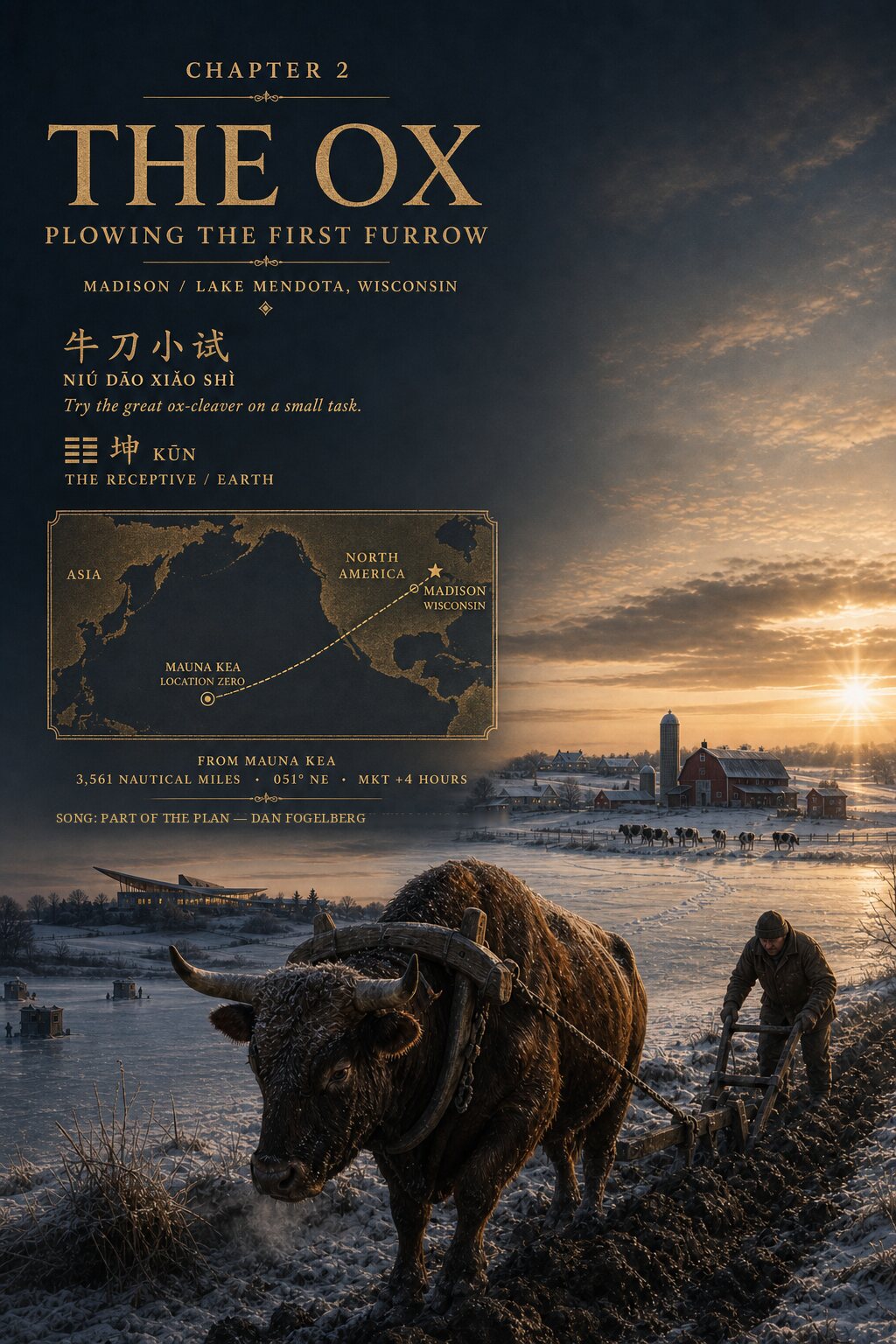
牛刀小试
Niú dāo xiǎo shì
“Try the great ox-cleaver on a small task.”
The Rat finds the opening.
The Ox does the work required to pass through it.
Of all the animals in the Chinese zodiac, the Ox may be the least interested in explaining itself. It does not roar from the mountain, fly through the clouds, or perform for an admiring crowd.
It pulls.
It bears weight.
It turns stubborn earth into a field.
Its strength is patient rather than theatrical. A society may celebrate the general, entrepreneur, politician, or visionary, but every great undertaking rests upon someone who arrived early, lifted what was heavy, repaired what broke, and returned the next morning.
Only later does anyone notice the harvest.
I was born in the Year of the Ox at Holloman Air Force Base outside Alamogordo, New Mexico.
Southern New Mexico placed several symbols near the beginning of my life: desert, mountains, military service, scientific ambition, and the ancient human desire to cross a frontier. Las Cruces—the Crosses—gave that landscape a name that would later seem almost providential.
I left New Mexico on my second birthday, too young to possess a continuous memory of white sand, hard sky, distant mountains, or the disciplined geometry of an Air Force base. Yet the landscape remained part of my origin story. I had been born at the edge of one frontier while my father worked in the scientific world helping humanity prepare for another.
My own life would carry me toward a different frontier.
Before I could cross it, I needed to learn how work turns possibility into reality.
The Builder’s Farm
During my tenth- and eleventh-grade years at Mountain Brook High School in Birmingham, a friend helped me obtain what seemed like the best job a teenage boy could possibly have.
I went to work on the corporate farm of John M. Harbert in Springville, Alabama.
Harbert was widely regarded as Alabama’s wealthiest man. He had built an international construction enterprise whose work reached far beyond the state. To a young man already inclined toward large ambitions, he represented something almost mythic: the builder whose vision could cross borders and alter landscapes.
Yet the world I encountered around him was not an executive abstraction.
It was tractors.
Dump trucks.
Fences.
Cattle.
Horses.
Mud.
And rainbow trout waiting to be fed.
The farm taught with physical clarity. A fence either held or it did not. An animal had to be fed whether the worker felt inspired. Machinery did not respond to rhetoric. A task left unfinished remained unfinished, no matter how persuasive the explanation.
One of my favorite memories came in the evening, when I rode horseback to bring the cows back into their enclosure.
There was something deeply satisfying about that work. The day was ending, but the task was not complete until the cattle were gathered and safely returned. A horse beneath me, cattle ahead of me, and a practical destination waiting at the end: for a boy who would spend much of his life chasing distant possibilities, it was an education in the importance of bringing something home.
I cleared land, built fences and baled hay. The work varied, but its demand remained constant.
Pay attention.
Use the right tool.
Complete what is in front of you.
Return tomorrow.
No one on the farm needed a teenage philosopher. They needed someone willing to work.
That was good for me.
Global Ambition, Muddy Boots
John Harbert embodied a lesson I never forgot: global reach did not require contempt for ordinary work.
A man whose enterprises crossed oceans could remain interested in a tractor, a horse, the condition of a road, or the movement of cattle across a field. Wealth, at its best, did not float above the earth. It organized human effort upon it.
The example enlarged my understanding of ambition.
A visionary could enjoy a trout pond.
A builder could know that a fence line mattered.
A global enterprise was not created by speaking grandly about the world. It emerged through measurements, contracts, machines, payrolls, materials, risks, decisions, and the coordinated labor of thousands of people.
I often wondered why I received that opportunity.
Mountain Brook was Birmingham’s wealthiest enclave. Many families had lived there for generations. Surely other parents might have wanted their sons to acquire the discipline, stories, contacts, and confidence that came with working on Harbert’s farm.
Yet somehow I got the job.
The Rat had found another opening.
The Ox now had to prove that I deserved it.
The Chinese expression Niú dāo xiǎo shì refers to trying a great cleaver, one capable of butchering an ox, on a small task. It describes a modest first demonstration of larger ability.
On Harbert’s farm, I learned the inverse lesson as well.
No task is beneath the person who hopes one day to carry great responsibility.
Great abilities often begin with humble work.
A young man may dream of building an international enterprise. The field still needs a fence.
He may imagine himself directing the movement of goods across oceans. The cattle still need to be brought home.
He may hope to influence the future. The trout still need to be fed.
The Empire I Imagined
Years later, while living in Beijing in 1983, I sometimes imagined becoming a builder on Harbert’s scale.
The dream was not merely about wealth. It was about reach—the ability to see something large and then command the practical means to make it real.
I admired builders because they closed the distance between conception and reality.
A dreamer describes what might exist.
A builder orders the materials.
A dreamer sees a bridge between two shores.
A builder determines whether the ground can hold it.
At twenty-one, I did not always appreciate that distinction. I possessed enthusiasm in industrial quantities. I saw opportunities everywhere and often assumed that seeing them qualified me to direct their development.
The farm had taught me to work, but the young Rat remained alive beside the Ox. I was still searching for openings, eager to move, and sometimes impatient with the slower creatures responsible for carrying the weight.
My professional life would not follow Harbert’s model.
I never founded a major construction company or commanded thousands of employees. For a man who later earned an MBA, my record of conventional management would remain irregular. I often produced plans larger than the institutions willing to employ me.
Sometimes that meant the institutions lacked imagination.
Sometimes it meant I had not yet learned how much patient work was required to earn the authority I wanted.
Both could be true.
Nevertheless, the Harbert example remained inside me as a standard.
Vision should touch the earth.
A proposal should eventually become something another person can use: a road, building, job, school, product, farm, railway, scholarship, or institution.
Otherwise, vision risks becoming decoration.
The Teacher Who Gave Direction
When I was a student at Southwestern at Memphis, I came to know Peyton Nalle Rhodes, a physics professor and former president of the college. In 1984 my alma mater took his name.
Studying Chinese there took some persistence. I had to petition the dean to offer it and find a teacher myself. Other languages had established places in the curriculum; I had to help make room for Chinese.
Professor John Franklin Copper had devoted his scholarly life to modern China and Taiwan long before China became fashionable in American classrooms. He did not treat China as a slogan, a menace, or an exotic backdrop. He insisted that it be studied as a civilization—with history, institutions, arguments, wounds, and ambitions of its own.
His classroom demanded curiosity before judgment. That discipline mattered to a young man whose enthusiasm could outrun his knowledge. Professor Copper did more than give me information. He took my interest seriously enough that I began to take it seriously myself.
I remember reading his letter of recommendation through the envelope. I felt a little guilty about it. I was not a superior student; my grades were lackluster. What surprised me was the confidence he expressed in me.
That confidence reached a part of me a transcript could not measure. Before I had much evidence to offer the world, a teacher who knew me believed I had something worth offering.
Many teachers transmit a subject. A few give a student direction. Professor Copper did both.
Copper taught me to ask who held power and what they might do with it. Robert Glasgow Patterson taught me Chinese religion. He was the son of Presbyterian missionaries and, as I recall, had lived near Nanjing, where I would soon be a student myself. With George Apperson I studied Chinese art. By the time I got to China, I wanted to know what people believed and what they found beautiful, too. That was the kind of liberal arts education my parents valued.
My senior thesis explored Hong Kong’s relationship with China. The British colony of Hong Kong became China’s window to the World. China’s leader Deng Xiaoping implemented four Special Economic Zones to encourage foreign investment and the development of China’s export industries. China launched Foreign Exchange Certificates and Friendship Stores where imported products could be purchased. I examined the success stories of Asia’s Four Dragons – Taiwan, South Korea, Hong Kong and Singapore. I imagined that China could achieve similar success if domestic and global conditions were favorable.
Hong Kong figured in another story on the Rhodes College campus. Richard Halliburton, the Memphis writer and world traveler, sailed from Hong Kong in 1939 bound for San Francisco aboard a Chinese junk called the Sea Dragon. He and his crew disappeared in the Pacific. At the foot of the Richard Halliburton Memorial Tower, the inscription calls him “a modern Icarus” who “flew too near the sun.” My own travels would take me across that ocean in the other direction. I understood the attraction. I also wanted to make it home.
By the time I first stepped onto Chinese soil, the journey had already begun in those classrooms in Memphis. The leap would belong to the Tiger. The patient preparation belonged to the Ox.
An Ox Across the Pacific
When I first encountered China, many Americans saw only what the country lacked.
They measured China against Western wealth and concluded that its future would remain limited.
I saw those things too.
But the Harbert farm had trained my eye differently.
Beneath the visible austerity, I saw millions of people studying, saving, producing, repairing, and preparing. Teachers entered classrooms. Workers arrived at factories.
Families sacrificed for education. Engineers imagined projects for which the country did not yet possess the money or materials.
The world saw a backward nation.
I increasingly saw an Ox beneath the harness.
China’s transformation did not begin when the skylines appeared. It began in years of work that much of the outside world barely noticed. Long before high-speed trains crossed the countryside, someone studied engineering. Before factories supplied global markets, someone learned the customer’s specifications. Before cities rose, someone poured concrete, assembled machinery, kept records, repaired roads, and returned the next morning.
Only later did the world notice the harvest.
China also exposed a growing weakness in my own country. America possessed extraordinary wealth, advanced knowledge, and immense productive capacity. Yet we sometimes spoke as though physical construction belonged to a less sophisticated past.
We celebrated finance, branding, consumption, and the rapid movement of information while permitting factories, railways, bridges, and public infrastructure to decay.
A civilization can become too sophisticated to pull its own plow.
The Ox does not reject intellect or imagination. It insists that both become useful.
Builders in Two Worlds
Many years after Harbert’s farm, I recognized the same builder’s seriousness in members of Jan’s family.
Zhang Benyan built Hi-Lex Chongqing into a major international enterprise. Jan remembered a time when he lived in quarters resembling a broom closet. Later, his company operated on a global scale.
Zhang Longyi, founder of Chongqing Qianneng, became another personal hero. He was energetic, optimistic, and constantly moving forward. Where I often excelled at seeing relationships and articulating possibilities, he committed capital, organized people, built structures, and opened doors.
Dr. Shuang Liu carried that builder’s instinct into science and entrepreneurship. She established Consynance Therapeutics with knowledge she brought from her laboratory. It became an enterprise and a contribution.
Their accomplishments reminded me of what I had first witnessed in Springville.
Vision matters.
But vision becomes consequential only when someone accepts the harness.
The builder cannot remain permanently above the work, admiring the elegance of his own conception. He must confront cost, resistance, error, delay, maintenance, and the endless practical details that separate the imagined structure from the one people can enter.
Those Who Pulled
The Ox also reminds me to name the people who carried weight while I was dreaming.
My father’s discipline created opportunities I inherited without earning.
My mother’s learning, support, and confidence gave my imagination room to expand.
Later, Jan provided another form of steadiness. Her discipline with numbers, schedules, and practical arrangements carried weight while I was still imagining what might be built.
She was not merely providing stability while I built bridges.
She was building them.
Visionaries are tempted to describe their endurance as entirely self-generated. The Ox corrects that vanity.
Someone usually supplies the hay.
Someone keeps the records, earns the steady salary, packs the materials, checks the numbers, confirms the reservations, pays the bill, and makes certain the visionary returns to a functioning household.
My freedom was never achieved alone.
Other people pulled when I was dreaming.
Work Worth Inheriting
The mature lesson of the Ox is not that labor is virtuous simply because it is difficult.
An ox can be harnessed to a noble purpose or an unjust one. Human beings have been worked to exhaustion in service of empires, fortunes, and systems that gave them little in return.
Work must be judged partly by what it builds and who is permitted to inherit the result.
John Harbert’s farm taught me to respect the task directly before me. China taught me what generations of coordinated labor could accomplish. Jan taught me that practical competence is itself a form of leadership.
Together, they corrected the Rat’s temptation to mistake the discovery of an opening for the completion of a journey.
Finding the opening is exhilarating.
Building the road through it is slower.
The Cross and the Ox therefore belong together in my origin story.
I was taught that when others give you opportunities and place their trust in you, you have a responsibility to help others in turn. My faith deepened that conviction. I do not believe my responsibility before God ends with my own conduct. It includes how I respond to the suffering around me.
The Cross teaches that purpose may require sacrifice.
The Ox teaches that sacrifice must become work.
Faith without labor becomes sentiment.
Vision without labor becomes decoration.
Power without service becomes domination.
I did not become John M. Harbert. I did not build the global empire I imagined as a young man.
Instead, I would spend decades attempting to construct something less visible: a network of trustworthy relationships across the Pacific.
Even that dream required roads, classrooms, factories, scholarships, delegations, contracts, family budgets, and countless promises kept when no one was watching.
Even that dream needed an Ox.
The Rat had found the opening.
The Ox prepared the ground.
The Tiger would decide whether I possessed the courage to leap.
Table of contents · Next: Chapter 3 · The Tiger: The First Leap

