
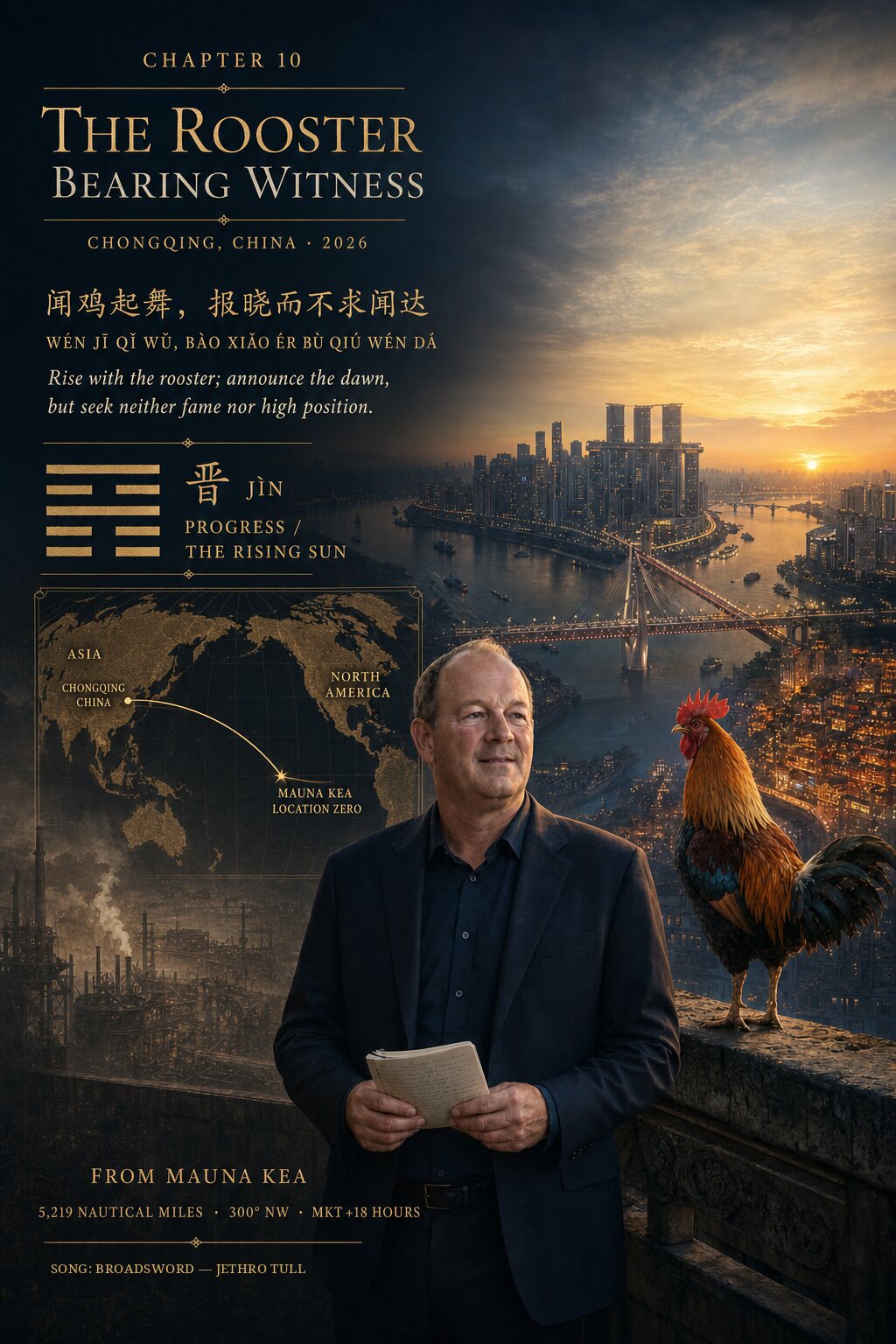
闻鸡起舞
Wén jī qǐ wǔ
“On hearing the rooster, rise and practice the sword.”
The Rooster announces a dawn it did not create.
It does not command the sun.
It senses a change in the darkness, fills its lungs, and tells the sleeping world that morning is approaching.
The call may be welcomed.
It may be ignored.
It may be judged premature, irritating, or unnecessarily loud.
But the Rooster’s vocation is witness.
I have been an early riser in more than one sense.
I recognized China’s approaching importance long before most Americans expected it to become a central world power.
I saw Tennessee’s global potential beneath the lights of the Federal Express hub at two in the morning.
I saw passenger rail not as nostalgia but as infrastructure.
I saw sister cities as civic diplomacy, Mandarin education as strategic preparation, and family relationships as part of world order.
The danger of seeing dawn early is that everyone else experiences you as noise.
Practice Before Proclamation
The expression 闻鸡起舞 (wén jī qǐ wǔ) comes from a story of disciplined men rising at the Rooster’s call to practice martial skills.
The important action is not the crowing.
It is the training.
That distinction is essential for me.
A warning that leads to no preparation is merely an alarm.
A vision that inspires no action is only a picture of a better world.
The Rooster may recognize that morning is coming, but recognition alone does not prepare anyone to meet it. The disciplined person rises, studies, practices, strengthens his judgment, and makes himself useful before the light fully arrives.
For much of my life, I concentrated on sounding the call.
Age has taught me to ask whether the call leads to practice.
Seeing China Early
When I first traveled to China in 1983, most Americans did not imagine that the country would become a central force in the twenty-first century.
China appeared cautious and distant from the commanding heights of world commerce.
I saw something else.
I saw intelligence, discipline, historical memory, and an immense capacity for work.
At the China Institute of Mining and Technology in Xuzhou, students and faculty wanted access to the wider world.
At factories, managers learned international standards.
At the Canton Fair, relationships accumulated before global statistics noticed them.
Across classrooms, factories, trade fairs, trains, and roads, I watched a civilization preparing to move.
I did not predict every feature of China’s rise.
No one did.
I did not foresee the full scale of its cities, manufacturing power, high-speed rail, technology, wealth, environmental costs, political confidence, or strategic rivalry with the United States.
But I knew the country would matter.
I wanted Americans—especially young Americans in Tennessee—to understand that history was approaching.
The Classroom at Dawn
In 1986, at the Tennessee Governor’s School for International Studies, I stood before some of Tennessee’s brightest students and tried to awaken their sense of the world.
I was young enough to share their excitement and old enough to have crossed a horizon most of them knew only through books and television.
I did not want them merely to memorize capitals, political systems, or trade statistics.
I wanted them to feel movement.
The world was becoming more interconnected.
China was opening.
Memphis was becoming a center of global logistics.
International events would not remain safely overseas. They would shape jobs, education, culture, technology, politics, and the choices available to Tennessee families.
I had studied futurists, Herman Kahn among them. When I went to China to teach, I remember finding Alvin Toffler’s Future Shock among the readings available to us. Of all the books I might have expected to find in a Chinese classroom, here was one I already knew.
Decades later, returning to teach international perspectives closed a circle.
The young instructor who had warned that China would matter had become an older Rooster still trying to wake another generation.
The students did not need to accept all my conclusions.
They needed the capacity to see beyond their inherited well.
I still have a photograph from my early teaching days in China. At first the high school students huddled in a corner and the boys kept their distance. Then we got out the ping-pong paddles. By the end of the semester I could stand with my arms around my students’ shoulders for a picture with my little Canon. I treasure that photograph. I remember how much space there had been between us at the start.
Language.
History.
Evidence.
Empathy.
Argument.
And the courage to revise an assumption when experience proved it incomplete.
My uncle Bill, the anthropologist, thought Chinese writing had held the Chinese people back. I loved Bill and respected his judgment. On this point we parted company. Some scholars in China had gone further than he did. In 1918 the linguist Qian Xuantong argued for giving up Chinese characters altogether. They certainly took work to learn. But I could look at a character and often find one part that suggested its meaning and another that gave me a hint of its sound. And when I walk through a modern Chinese airport, I’d like to have Bill beside me. I wonder what he’d make of the place.
I like to picture the alphabet I learned as a boy making its way around the Mediterranean. The Greeks adapted Phoenician letters. The Etruscans learned from the Greeks, and the Romans learned from the Etruscans. Each people found a use for the letters in its own language. In China I think of the great stretch of country across which a written character could travel and be pronounced differently when it arrived. I also think of the families along the Min River who had to agree on where the water would go. A port and a river valley gave neighbors different reasons to learn from one another.
There was a harder side to a common script. After unifying the empire in 221 BC, Qin Shi Huang standardized writing. In 213 BC he also ordered books burned, including works that Confucian scholars prized. His dynasty was gone by 206 BC. The writing outlived the government that tried to dictate what people could read.
My contact with Muslim Arabic teachers and students at Governor’s School also challenged me. I offered an apology for the harm my nation had done to theirs. I was moved to tears, ashamed both of that harm and of things I had once believed. Those were people before me, and I could no longer keep the consequences of national actions at a comfortable distance.
Arabic-speaking communities were not a single religious world. I also knew Emil Ayoub, a Jordanian agronomist who had taught Arabic at Covenant College and ministered at Dalton Arabic Church in nearby Georgia. These relationships strengthened my hope that Jews, Christians, and Muslims can honor their distinct traditions while working together for peace, with compassion, respect, and regard for the dignity of every human life.
Education is dawn work.
A teacher prepares students for a world that is visible only in outline.
He may never know whether they use what he gave them.
He sounds the call and trusts that someone will rise.
The Friendly Face That Was Not Selected
My 2016 proposal to represent Tennessee in China was an attempt to turn decades of preparation into official public service.
I wanted to become Tennessee’s friendly face in China.
I believed my Mandarin, business travel, factory relationships, teaching, civic diplomacy, and knowledge of Tennessee placed me in a rare position.
The proposal was detailed because I had spent years thinking about the opportunity.
I was not selected.
The door remained closed.
The rejection forced me to separate office from vocation.
Tennessee did not need to employ me for me to remain a Tennessean committed to international exchange.
No governor needed to appoint me before I could encourage language study, support sister cities, welcome visitors, maintain friendships, and advocate for a wider horizon.
No agency commissioned the Covenant.
That absence removed both limits and excuses.
Official authority can amplify a voice.
It can also convince the person holding office that the title created the calling.
Rejection clarified that the work came first.
The title, if it ever arrived, would be secondary.
The Rooster does not require appointment as Minister of Sunrise.
It calls because morning is coming.
The Freedom to Crow
My public routine became another form of Rooster work.
I rose early.
I read.
I searched for articles, photographs, historical connections, human-interest stories, and arguments worth sharing.
I posted frequently.
I enjoyed the sharp sentence an ordinary employee might fear to publish.
Having lost or left enough institutional positions, I possessed a freedom that many salaried people did not.
I was not waiting for permission from an employer, political party, donor, or communications department.
That independence has value.
Public life needs people willing to ask questions before institutions approve them.
It needs dissenting voices, inconvenient memories, imaginative proposals, and citizens who resist the machinery of automatic agreement.
But the Rooster can become intoxicated by its own voice.
Crowing is not sunrise.
Volume is not courage.
Repetition is not proof.
The fact that a statement provokes a reaction does not make the statement useful.
A sentry must distinguish an intruder from movement in the bushes.
A public commentator must distinguish insight from the pleasure of provocation.
I have not always made that distinction successfully.
Hayek and the Limits of Central Knowledge
F. A. Hayek helped shape my youthful confidence in markets. His central insight about dispersed knowledge remained useful long after I had moved beyond the political arguments in which I first encountered it. No single office, however intelligent its occupants, possesses all the local knowledge held by workers, families, entrepreneurs, teachers, and communities. Their decisions, discoveries, and corrections matter because much of what a society needs to know cannot be assembled in advance by a central planner.
China complicated this conviction without displacing it. I had seen initiative flourish amid institutions that remained politically centralized; I had also seen how regulation, hierarchy, and personal relationships could enable or obstruct practical work. Hayek did not supply a simple formula for evaluating every Chinese institution. He supplied a warning against the arrogance of complete knowledge—a warning useful in Washington, Beijing, and any international organization bearing my proposed name. If the Covenant becomes a plan announced from above rather than an architecture responsive to local experience, it will repeat the error it was meant to correct.
Thomas Sowell also belongs among the intellectual influences I acknowledge. To my mind, he stands foremost among the thinkers of my era. Milton Friedman belongs in that company of influences too, alongside Hayek. The proposals I make here are my own, and I take responsibility for their consequences as well as their appeal.
Reconsidering the Postal Service
Here is one proposal likely to start an argument. I would begin a gradual phaseout of the United States Postal Service. As Americans move more correspondence and payments online, I believe we should reconsider the institutions built to carry them on paper. I see FedEx, a private, taxpaying delivery business, as particularly well placed to take on this work. It advertises Home Delivery service to every American residential address. To me, that reach makes a practical alternative worth pursuing. Every institution should be able to explain why its present form remains the best way to do its work.
I keep coming back to the candor of my student in Xuzhou. To me, the willingness to acknowledge failure and change course was the honest impulse in China’s reforms under Deng Xiaoping. Americans must be willing to reform honestly too. The Postal Service is one example; the same demand belongs in education. Institutions should answer to the people they serve, and we should be willing to change them when their results no longer justify their arrangements. Seeking truth from facts asks us to examine our own country as searchingly as we examine another.
Reading the Other Side
The disciplined Rooster practices before announcing.
For a public voice, practice means reading beyond sources that confirm what one already believes.
Checking claims.
Acknowledging uncertainty.
Understanding the strongest version of the opposing argument.
Asking whether a post contributes to understanding or merely feeds the machinery of outrage.
The internet rewards speed, certainty, anger, and tribal affirmation.
Wisdom often requires delay.
The clever response appears immediately.
The responsible one may arrive tomorrow.
My instinct has often favored the immediate line.
The Snake taught me that truth requires timing.
The Monkey taught me that cleverness can become appetite.
The Rooster adds another correction:
Before sounding the alarm, make certain you are awake.
Witness Rather Than Certainty
For many years, I assumed my task was to discover answers.
I read history.
I traveled.
I taught.
I traded.
I listened.
I crossed the Pacific so many times that it gradually ceased to feel like the edge of the world.
Only later did I understand that my work was not to invent an entirely new truth.
It was to bear witness to a pattern I had repeatedly observed.
A lifetime is a poor foundation for absolute certainty.
It is an excellent foundation for testimony.
I cannot claim to possess every answer about America, China, Tennessee, diplomacy, trade, education, or peace.
I can describe what I have seen.
I have seen friendships outlast political disagreements.
I have seen trade create understanding where suspicion once flourished.
I have seen students become teachers.
Strangers become family.
A five-hundred-dollar check become an act of international solidarity.
A sister-city relationship regains life because someone accepted an invitation.
An immigrant chemist create an industry.
A Turkish Marxist rescue a radical conservative.
Persian-American traders recognize value in a young man an American corporation had dismissed.
A woman from Chengdu build a life in Chattanooga and become a bridge-builder more practical than the man who first explained China to her.
Those experiences left me with a conviction.
The future will belong not only to those who possess the greatest power.
It will also be shaped by those who build the deepest trust.
Memphis and the Grand Slam
Before I could sound any dawn for the Pacific, I had to understand the city that taught me to recognize world-changing ideas.
Memphis has surprised the world repeatedly. In 1916, Clarence Saunders opened Piggly Wiggly and turned self-service grocery shopping—open shelves, baskets, marked prices, and a central checkout—into the architecture of the modern supermarket. In 1952, Kemmons Wilson opened the first Holiday Inn and began building a trusted international hotel chain. In 1973, Fred Smith’s Federal Express began overnight operations and created a new express-delivery industry.
The city’s cultural reach was just as great. Memphis did not invent every note of the blues, and no single place can own the whole birth of rock ’n’ roll. But the blues found one of its great urban homes there, and at Sun Studio the meeting of blues, gospel, country, and rhythm and blues helped send rock ’n’ roll—and Elvis Presley—around the world.
The musical connection was personal before it became an argument about Memphis. My mother's work with the Shoals Symphony had shown me one way a community could sustain its cultural life. The recording heritage of Muscle Shoals showed how music made in a relatively small place could travel far beyond it. In Xuzhou, when my students told me about Elvis, I encountered the other end of that journey. An American sound had crossed the Pacific before I did.
I also remember receiving a phone call from and meeting Kemmons Wilson in 1995. After establishing Holiday Inn, he created Wilson Inn, Wilson Air and later a developed a corn kernel equivalent to M&M’s that we called W & W’s. When I visit Memphis, I often stay at the Holiday Inn on University of Memphis campus that includes the Kemmons Wilson School of Hospitality at a large museum on the second floor describing his brilliant career.
Retail. Hospitality. Logistics. Music.
These were not local curiosities. They changed how people shopped, traveled, moved goods, and heard themselves. They touched nearly every corner of the world.
I began calling the next possibility Memphis’s grand slam. The phrase is deliberately ambitious. If Saunders, Wilson, Smith, and the city’s musicians could each alter global life, what idea might place Memphis once again at the center of American progress and the world economy?
The Fourth Act
My answer begins with a historical contention. Germany, Japan, Taiwan, and ultimately China followed very different political paths after war or poverty. Yet manufacturing and exports were central to each economic ascent. They learned to make products the world wanted and to sell those products beyond their borders.
Why should an American renaissance be fundamentally different? I do not think it will be. The question is how to facilitate it.
Memphis already possesses one of the hardest pieces: a global logistics network. FedEx employs more than half a million people around the world. Reading Sun Tzu’s Art of War and observing Ed Khalily taught me to think of strategy as a sequence of advantages. In that spirit, I sometimes picture those FedEx employees and logistics assets as commercial soldiers for American capitalism—not soldiers who destroy, but people who connect factories to customers, promises to performance, and American communities to markets across the globe.
By 2026, Memphis also hosted the vast Colossus computing operation associated with xAI. That fact does not by itself create an industrial renaissance. It does suggest that a city known for moving physical goods can also become a center of computational power.
The opportunity is to join the two.
Artificial intelligence can help a small American manufacturer describe, price, advertise, support, and sell its products in nearly every language of the world. It can identify customers a family-owned factory could never afford to locate through a traditional sales force. It can translate manuals, tailor marketing, forecast demand, and reduce the friction that keeps smaller firms confined to domestic markets.
FedEx can move those products to the customers AI helps find.
The challenge is no longer merely moving boxes. It is creating American products worthy of moving—and giving their makers access to the world.
When I try to put a name to that hope, I find myself thinking of WeGo USA. In Memphis, the reach of FedEx, the computing power of xAI and the skills of people in West Tennessee, North Mississippi and East Arkansas could help a small manufacturer find a customer overseas, arrange financing and deliver what it promised.
The roadmap is practical enough to debate:
Revitalize advanced manufacturing.
Use AI to help smaller manufacturers reach global customers in their own languages.
Use Memphis logistics to reduce the friction of exporting.
Train a workforce fluent in production, technology, trade, and culture.
Build commercial relationships across the Pacific strong enough to survive political strain.
Memphis changed the world by allowing shoppers to choose for themselves, families to trust the road, packages to cross the country overnight, and music born from suffering to become a universal language. Its fourth act could be to help American makers reach the world again.
That is not nostalgia. It is a strategic thesis.
TN-TIGER
My effort to turn vision into practice produced an acronym:
TN-TIGER.
T for Trade, Travel, and Tourism.
I for Investment, Industry, and Infrastructure.
G for Government and Governance.
E for Education and Exchange.
R for Railways.
The acronym gathered many of my Tennessee ambitions into one memorable form.
But an acronym is not a program.
Each letter requires work.
Trade needs products, customers, financing, transportation, and trustworthy partners.
Travel and tourism require routes, hospitality, interpretation, and reasons to return.
Investment requires sites, skills, capital, public consent, and confidence.
Industry requires workers, energy, suppliers, engineering, and markets.
Infrastructure requires funding, maintenance, patience, and political agreement.
Government requires authority and accountability.
Governance requires transparency and trust.
Education requires teachers, students, curriculum, and continuity.
Exchange requires reciprocity.
Railways require engineering, rights of way, ridership, and money.
The Rooster can announce TN-TIGER.
The Ox must build it.
The Edwards Thesis and Relational Realism
After decades of work across cultures, I could state more clearly what the classrooms, factories, city visits, and family tables had been teaching me. The Edwards Thesis is a proposition about international order: trustworthy relationships across civilizational boundaries create a capacity for cooperation that military and economic measures alone do not capture. A single friendship can achieve remarkable things, but a dense web of relationships is harder to sever. Their durability matters because an acquaintance who disappears at the first disagreement cannot carry much weight in a crisis.
I use relational realism to name the discipline that follows. Nations have interests, institutions, weapons, and reasons to protect themselves. Relationships belong inside that account of reality. Someone who answers a telephone call, understands an unfamiliar warning, or can tell a partner an unwelcome truth adds a practical capacity that was absent before. My claim is not that friendship defeats every conflict. It is that we weaken our account of power when we leave that capacity out.
This places my argument in conversation with constructivism in international relations. In his 1992 essay, “Anarchy Is What States Make of It,” Alexander Wendt examines how interaction helps form identities and interests. States do not simply encounter one another as fixed enemies or friends; repeated practices help shape those expectations. That insight illuminates something I had witnessed on a smaller scale: people sometimes revise what they believe about another society because someone from it has become dependable.
Constructivism helped me understand a phrase I had heard repeatedly in China: mutual benefit. Nations need not cease pursuing their own interests. Through repeated cooperation, however, they may learn to define those interests less narrowly. The alternative to the law of the jungle is not sentimental idealism, but cooperative self-interest. America need not surrender its strength, but it must move beyond the assumption that leadership always means “my way or the highway.”
The connection has limits. A household is not a state, and a friendship cannot order an army to stand down. Political institutions decide which relationships matter, whose advice reaches a leader, and whether a promise becomes policy. Relational realism, as I use it here, asks how the human connections I have described can be sustained through institutions and joined to responsible judgment about power. I am not claiming to have invented the phrase or to have proved a new school of thought. I am offering a lifetime’s observations as a proposition others can examine.
There are hard tests. Trade can create dependence that one side exploits. Close relationships can conceal corruption or silence criticism. Warm memories can survive while governments move toward war. A useful covenant must protect candor and independence as carefully as contact. Its success should be judged by whether people can communicate, correct errors, and carry out agreed work under strain. When the next crisis comes, which calls still get answered—and what can those conversations accomplish?
Preparation for Peace
Nations prepare for conflict because the machinery already exists. Budgets are written, commands established, weapons designed, exercises scheduled, and scenarios rehearsed. People build entire careers around anticipating danger.
Some of that preparation is necessary. Peace without the ability to resist aggression may become an invitation to it. But preparation for war can also become a self-perpetuating system. Each side interprets the other’s defensive measures as evidence of offensive intention. One expansion justifies another, and institutions acquire a stake in the continuation of fear.
Peace requires preparation of its own: interpreters, trusted communication channels, historical knowledge, protocols for accidents, joint disaster exercises, scientific relationships, city partnerships, and officials willing to speak privately when public opinion rewards silence or hostility.
The people who prevent a crisis may labor for years before anyone notices their value. When they succeed, the catastrophe does not occur, and its absence can make their work appear unnecessary. The Rooster understands this invisible preparation. It calls before sunrise because waiting for daylight may be too late.
Ideas Too Hot to Hold
Preparation for peace should not produce a timid imagination. It should give us permission to ask questions large enough to interrupt the future being prepared by militarists.
I am a radical pacifist. I do not mean that I am indifferent to danger or incapable of recognizing evil. I mean that human beings possess a higher calling than permanent preparation to kill one another. Swords into plowshares is not merely a metaphor. It is an infrastructure program.
Imagine the United States gradually reducing its overseas military network as enforceable peace arrangements take its place. Imagine directing part of the resulting peace dividend toward roads, bridges, passenger rail, ports, schools, hospitals, water systems, housing, energy, and scientific research. Every verifiable reduction in military danger should produce a measurable increase in human security.
America does not need to be conquered to be diminished. It can weaken itself by neglecting the physical foundations of national life while spending fortunes to defend them. Peace must come home as repaired infrastructure, capable institutions, productive work, and communities confident enough to imagine a future.
Four projects have followed me home. Together they form an American spine for the larger vision: memory, mobility, commerce, and civilization.
The first is Missionary Ridge National Park—not another monument to the romance of battle, but a national landscape of memory, emancipation, reconciliation, and peace. A pacifist living beneath a Civil War battlefield should not flee the contradiction. He should ask whether courage can finally be measured by the wars a people prevents.
The second is Chattanooga passenger rail. A railway joins neighborhoods, workers, visitors, universities, airports, industries, and cities. Chattanooga’s position between New Orleans and New York is more than a line on a map. It could become part of an American corridor restored.
The third is Memphis as the export center for America. The Mississippi Valley should not be treated as a forgotten interior. Memphis taught the world to shop, sleep on the road, move packages overnight, and hear music born from suffering. With logistics, artificial intelligence, trade finance, multilingual marketing, and renewed manufacturing, it could help American producers reach the world.
The fourth looks toward Vladivostok, Siberia, and the Bering Strait. Could Americans and Russians who once aimed nuclear arsenals at one another someday build the physical hinge between continents? Could ports, railways, ferries, or tunnels reconnect the Americas and Eurasia through projects requiring cooperation across generations? The proposal may sound outlandish. That is part of its purpose. Today’s enmities do not possess eternal authority.
I have long proposed one possible beginning: a ninety-nine-year American lease on land near Vladivostok, negotiated openly by the United States and Russia. Such an agreement would need clear limits, enforceable terms, and the consent of the people whose lives and land it would affect.
The site would not become an American military colony. It would become a construction yard for a continental project, where American and Russian workers, engineers, builders, investors, farmers, and families could assemble the knowledge and material needed to connect Alaska, Siberia, and the wider Eurasian continent.
Roads and railways could extend westward toward Lake Baikal and across Russia, while improved ports, ferries, and perhaps one day a bridge or tunnel could approach the Bering Strait from both sides. I call this Manifest Destiny 2.0 only to reverse the older idea: no people displaced, no sovereignty extinguished, no wilderness declared empty, and no army advancing behind the surveyors. Its destination would be connection rather than conquest.
I would like Americans and Russians to become the best of friends. I know how far that wish reaches beyond the trust now available, and how much conduct would have to change to make it credible. Still, I want to give the wish a direction: across the Bering Strait, along Russia’s Pacific coast toward Vladivostok, and into work that people on both sides can recognize as useful. The dinner in Shanghai gave me a human beginning. A continental connection would ask whether nations could learn to keep faith on a larger scale.
Other divisions also demand imagination. Could Koreans prepare patiently for a future in which families, roads, railways, and memories are reconnected? Could China and Taiwan preserve peace without requiring either population to disappear into the other’s story? Could Hawaii become a center of Pacific memory, mediation, ocean science, and peace while Native Hawaiians exercise genuine authority over their land, culture, and future?
That reasoning leads me to a specific proposal: a Four Power Summit bringing the United States, Russia, China, and Iran into sustained negotiations to reduce the danger of war. Their differences are the reason to convene them. The Pacific Covenant supplies the wider purpose; the summit would ask governments capable of doing immense harm to accept concrete obligations for preventing it. I return to that proposal at the table toward which this story has been moving.
These are not secretly negotiated terms, predictions, or settlements for an American to impose with a map. No people may be traded across a table without their consent. The answers must belong to those whose lives would be changed. My purpose is to keep open the imaginative ground on which better answers might someday appear.
Humanity cannot escape a future prepared entirely by militarists unless someone first describes a future they did not prepare.
Two Awakened Giants
For decades, I watched the future gather around the Pacific. That future is no longer hidden. China has risen, and the danger is that America and China will greet the new era with weapons pointed toward one another.
Both countries possess pride, historical grievances, immense resources, competing interests, and political systems that often interpret the other through suspicion. Neither can wish those differences away. The alternative to war is not sentimentality. It is disciplined imagination: institutions capable of containing conflict, communication resilient enough to survive anger, trade protected from dangerous dependence, security arrangements that do not require humiliation, and relationships deep enough to keep fear from becoming the only reality.
The Covenant does not ask either civilization to fall asleep. It asks both to awaken to the possibility that strength may be demonstrated by what they build together.
Latin America at the Table
The question of whose voice is heard also brings me to Latin America. I have offered ideas for the United States and Russia, for Korea, for China and Taiwan, and for Hawaii. Yet ten of the twenty-two nations in the proposed opening table are Spanish-speaking Latin American countries: Mexico, Guatemala, El Salvador, Nicaragua, Costa Rica, Panama, Colombia, Ecuador, Peru, and Chile. Nearly half the table cannot remain a list of names while the larger powers occupy the conversation.
I know Latin America far less well than I know China. I cannot presume to speak for its Spanish-speaking peoples, for Portuguese-speaking Brazil, or for the many Indigenous peoples whose histories precede the modern boundaries. I approach them with affection, curiosity, and sadness at the injuries left by conquest and colonial rule. An American invitation must leave room for memories of America that differ sharply from my own. Listening is part of the work I am asking others to undertake, and it must begin with me.
My hope is that these ten Latin American nations would find a common voice on the interests they share. Speaking together, they might carry more weight in negotiations with China, the United States, and multinational corporations. They could seek stronger protection for their fisheries, their economies, and the environment, and insist that companies operating in their countries answer to clear, enforceable terms. Each nation would retain its own judgment and sovereignty. Cooperation would give their people a stronger voice in decisions affecting their livelihoods and the waters and land they depend upon.
Fisheries offer a practical place to begin. For Ecuador and the Galápagos, and for coastal communities throughout the region, the question concerns a living ocean and the people who depend upon it. Could the participating nations coordinate marine research, share information about fishing activity, and agree on standards that protect ecosystems and coastal livelihoods? Could they approach negotiations with distant-water fishing nations together, rather than leave each coastal country to bargain alone?
Such cooperation should be able to address Chinese fleets plainly, and to apply the same standards to fleets from every other country, including our own. Friendship with China must allow a firm conversation about conduct. If the Pacific is a shared ecological trust, the people closest to an injured coast must have a meaningful role in deciding how that trust is protected. Fishing communities, scientists, and Indigenous peoples should help shape the work from its beginning.
That is one contribution I can imagine; Latin Americans will have others I have not thought to ask about. They should help write the agenda and lead institutions within the Covenant. Their participation should be audible in its languages and visible in its decisions. A Spanish edition of this book would be an invitation to that conversation, subject to the care of translators and readers who understand the societies I hope to reach.
Brazil belongs in the wider invitation even though it is not among the twenty-two nations in this initial Pacific table. The same welcome extends throughout Latin America and the Caribbean. An opening map should help people find one another. It should never become a reason to close the door on a willing neighbor.
A Covenant Beyond the Ocean
Pacific Covenant begins with an ocean, but Pacific is not just a body of water. It is also the possibility of peace that gave the project its name. If we can create a useful practice of cooperation here, I hope it will interest people whose homelands lie beyond these shores. India and the nations of Africa belong within that larger horizon, with experiences and purposes of their own.
I think of a table of nations, something of the hope carried by King Arthur’s Round Table: a place where the arrangement itself challenges the assumption that one person must always sit at the head. The modern work would be much harder than the legend. Nations differ enormously in size and power. A small country must be able to question a great one, and a people without a powerful state must still be heard. The table would earn its meaning through such encounters.
Nor should a religious boundary decide who may approach it. Christians, Jews, Muslims, Hindus, Buddhists, people of other traditions, and people with no religious faith can bring distinct reasons for protecting life and keeping a promise. I do not ask them to abandon those differences. I ask whether we can recognize obligations to one another that remain when our explanations of the world diverge.
This is the grand design I can offer from one life: begin where relationships already exist, make their obligations durable, and let the circle widen. The Americas coming closer together, families reunited across old divisions, and nations learning to build friendship are hopes to be worked on by the people concerned. Their freedom to shape the result is part of the peace I seek.
The Limits of Witness
The Rooster does not create morning. That truth protects the witness from vanity. I did not create China’s rise, Tennessee’s strategic location, or the human need for trust; I spent a lifetime noticing the connections among them.
My responsibility is to speak honestly, correct myself when evidence requires it, and leave the fence to do the work.
The Dawn Belongs to Everyone
If these pages accomplish anything, I hope they encourage one more conversation, one more student to learn a language, one more city to maintain a friendship, and one more institution to prepare for cooperation as seriously as it prepares for conflict.
The Rooster does not force the dawn.
It announces that light is possible.
Then it turns toward the practice yard.
The Rooster sounded the dawn. The Dog would ask whether I could remain after the first light faded.

