
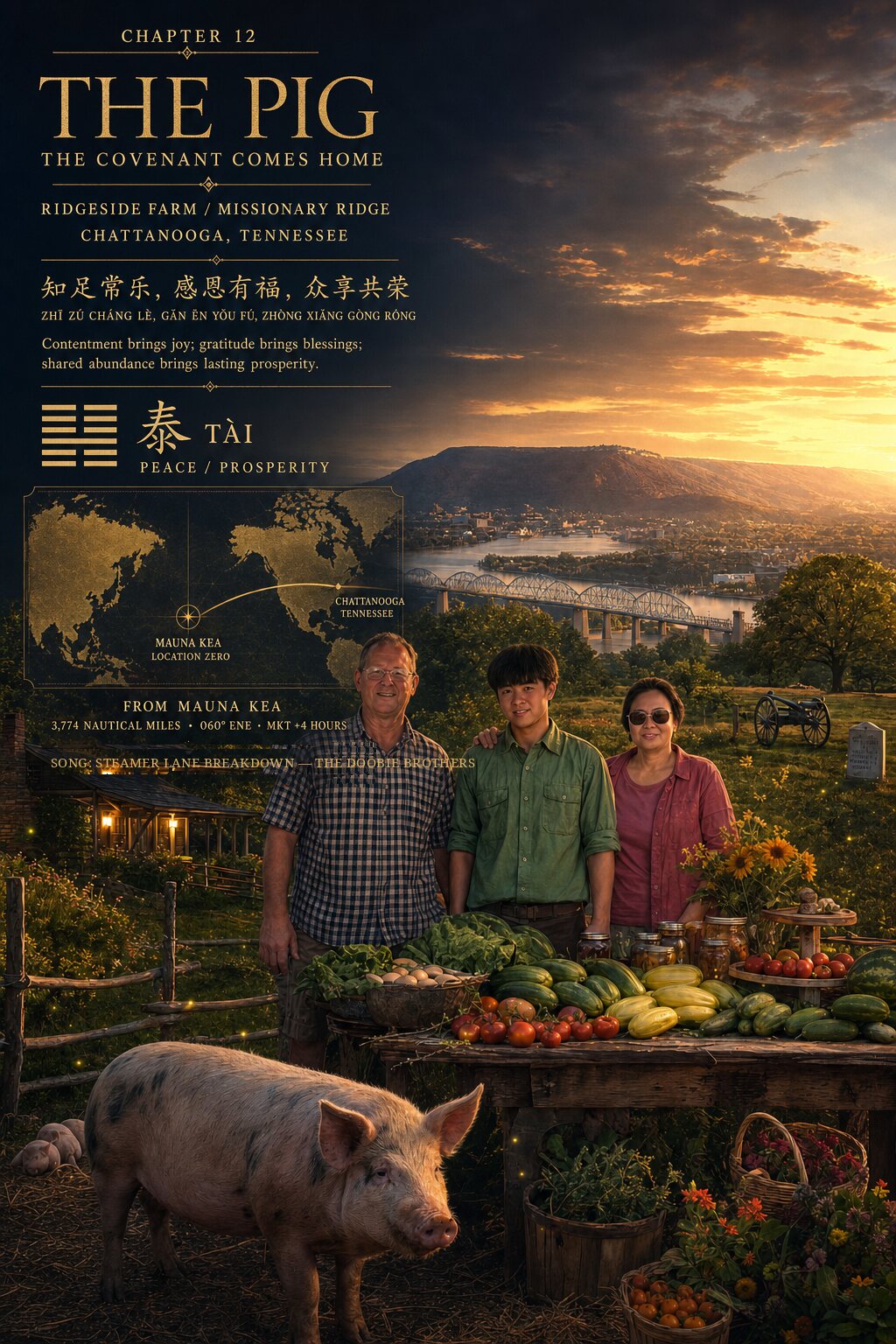
家和万事兴
Jiā hé wàn shì xīng
“When harmony dwells in the home, all affairs may prosper.”
The Pig arrives last in the Chinese zodiac.
It does not finish with the Dragon’s glory, the Tiger’s authority, or the Horse’s speed.
The cycle ends with an animal associated with appetite, earth, domestic life, fertility, generosity, comfort, and abundance.
That ending contains wisdom.
A life may begin with hunger for distinction and end by asking what is enough.
For much of my life, I measured success as many young men do.
The next opportunity.
The next journey.
The next accomplishment.
The next horizon.
There is nothing inherently wrong with ambition.
Without it, I might never have crossed the Pacific, learned Mandarin, entered China’s commercial frontier, or imagined that Tennessee could play a larger role in the world.
But time has a gentle way of changing our arithmetic.
The older I became, the more clearly I understood that the greatest gifts in my life had never appeared on a résumé.
They had names.
Two Civilizations at Home
I did not marry an abstraction called China.
I married Jan.
She was intelligent, shy in some settings, formidable in others, practical, disciplined, and descended from people who had survived immense historical change.
Through her, China ceased to be a civilization I could study and then leave by boarding an airplane.
It entered the household budget.
The dinner table.
Family obligations.
Humor.
Argument.
Travel.
Language.
Parenting.
The future.
Jan and I did not become identical.
We remained different—sometimes sharply so.
She could be cautious where I was expansive.
She was grounded where I was looking toward the horizon.
She understood that a plan must eventually confront a spreadsheet.
I understood that a spreadsheet occasionally deserves a larger dream.
A household needs imagination and ballast.
Harmony does not mean the absence of disagreement.
It means the relationship remains larger than the disagreement.
That principle would eventually shape my understanding of covenant.
Living between worlds had begun long before our marriage, in a family that moved with my father’s work and taught me to find my footing in unfamiliar places. China enlarged that habit; Jan made it lifelong. Wuxi, Chattanooga, Chengdu, and the family in Tennessee were no longer separate destinations. An obligation in one place could arrive at our table in another. We learned to make a home large enough to hold those connections, even when I was slow to carry my share of their weight.
Jan brought an intellectual upbringing and considerable academic ability of her own to our marriage. She had attended Shishi High School in Chengdu. As I understood it, her entrance-examination performance had earned her that place. Long before I knew her, she had already shown the intelligence and discipline I would come to rely upon.
Shishi means “stone chamber,” recalling the stone building in its early history. The school traces its origins to around 141 BC, during the Han dynasty, a little more than a century after the Dujiangyan irrigation works were begun around 256 BC. Cambridge has described it as possibly the oldest school in the world still teaching on its original site. That long educational inheritance gave another dimension to my respect for Jan’s schooling. Here was a tradition of learning reaching back more than two thousand years, connected to someone sharing my daily life.
Meritocracy is part of what I admire in the Confucian regard for education: the ideal that ability, learning, and effort should help determine who receives an opportunity. Jan’s education gave it a personal meaning for me, and her later work in America gave me further reasons to respect her capabilities.
China’s imperial examinations developed centuries after Confucius. They made mastery of Confucian texts a route to recognized status and government service. Access to the schooling needed to compete was unequal, but the possibility of advancement through learning was an ideal I respected.
The familiar ordering of the four occupations placed scholars first, followed by farmers, artisans, and merchants. It expressed a hierarchy of esteem rather than a reliable measure of wealth or power. I had spent much of my life as a trader, the calling placed last in that old ordering. That made the esteem accorded to scholarship especially interesting to me. Jan’s own achievement deserved its place in our story.
Fathers and History
Through Jan, I entered a Chinese family shaped by endurance, scholarship, enterprise, and political history.
Jan’s biological father followed a different path. As a young man, he attended university and fought on the Chinese side of the Korean War. At ninety-seven, he remained alive and well in Guiyang, Guizhou Province.
He went fishing most days.
He possessed a sunny disposition.
The contrast between the two men reminded me that no family—and no civilization—can be reduced to one story.
One father carried the weight of political persecution and rehabilitation.
Another carried his fishing gear into old age with an undiminished capacity for enjoyment.
History enters families unevenly.
So does happiness.
A Child, Not a Symbol
The temptation of a visionary father is to turn a child into evidence.
Thomas could easily have become a symbol of East and West, China and America, or the future of the Pacific.
His life demonstrates that civilizations can meet within a family.
But his life belongs to him.
He does not carry an obligation to reconcile two great powers simply because they meet in his ancestry.
He never became the problem child I had been.
He grew into a fine young man—steadier, less eager to battle institutions, and apparently more comfortable inhabiting two worlds without dramatizing the boundary between them.
Perhaps Jan’s discipline provided ballast.
A parent’s greatest success may be a child who does not need to reenact the parent’s conflicts.
Thomas became himself.
That is abundance.
The Household’s Hidden Budget
Grand visions are often narrated as though the visionary lives alone.
He does not.
Every public dream has a hidden budget.
Someone waits.
Worries.
Earns.
Saves.
Forgives.
Drives.
Cooks.
Translates.
Checks the reservations.
Organizes the papers.
Listens while the visionary explains, once again, why the next idea matters.
My unconventional career did not always provide the stability I hoped to give my family.
That admission is not self-condemnation.
I worked, earned money, taught students, supported civic projects, conducted international business, and created relationships with lasting value.
But my career did not follow the steady upward path my education and ambition once led me to expect.
Jan lived with that uncertainty.
More importantly, she responded to it.
Jan’s Work
Jan majored in Accounting at the University of Tennessee at Chattanooga and soon found employment in the city.
After Thomas was born and I was laid off from Synair in 2002, she accepted a position with an irrigation company.
The job brought her into daily contact with Americans from all walks of life and deepened her command of English.
Later, Jan sought a more challenging job and found a position with URS, a major engineering and construction firm involved in flue gas desulfurization work at Tennessee Valley Authority power plants.
Her skill with numbers and spreadsheets quickly became evident.
She rose until she was the highest-paid woman in her office.
At times, my modest salary at St. Andrew’s-Sewanee fell below hers.
That fact should not be hidden.
It honors her competence.
Jan did not merely keep the household functioning while I pursued public work.
She developed a successful career of her own.
She also organized the student groups I took to China in 2007 and 2009. She handled the practical details without which the journeys would have remained ideas.
After the Wenchuan earthquake, she raised funds and awareness.
She joined Chattanooga delegations to Wuxi.
She eventually took the reins of that relationship.
I once imagined that my experience qualified me to guide Jan through America.
In time, I understood how often she was guiding me.
The Pig in Wuxi
During a conversation in Wuxi, I acknowledged to a friend that despite my bridge-building ambitions, I had not provided for Jan and Thomas with the consistency I had hoped to achieve.
My friend answered with a Chinese proverb.
The traditional saying is:
嫁鸡随鸡,嫁狗随狗 (jià jī suí jī, jià gǒu suí gǒu): “Marry a chicken and follow the chicken; marry a dog and follow the dog.”
The expression arose from an older social order that expected a wife to remain with her husband regardless of his qualities or failures.
I would not offer that history as a rule for modern women.
My friend adapted it more personally and humorously.
If Jan married a Pig, she stayed with the Pig.
I understood the joke.
More importantly, I understood the gift beneath it.
Jan did not remain because an old proverb commanded her.
She remained because she repeatedly chose the marriage.
She stayed through professional changes, financial uncertainty, ambitious plans, public controversy, disappointment, and reinvention.
She let me enjoy retirement without demanding that I stop imagining.
That choice is among the greatest forms of wealth I have received.
What Abundance Means
The Pig is easily mocked because it lives close to appetite and mud.
Yet the Pig also represents a household made sufficient.
Food stored.
Children fed.
Winter survived.
Guests welcomed.
Prosperity shared rather than merely displayed.
As a young man, I imagined wealth as domain.
John M. Harbert’s enterprises crossed borders.
Robert and Susan Wang built an immense importing operation.
Ed Gomberg created an industry.
Zhang Benyan rose from cramped quarters to international enterprise.
Zhang Longyi built structures and opened doors.
Shuang Liu transformed scientific knowledge into a company.
I admired them because they closed the distance between vision and reality.
I once expected to build something comparable.
My life produced a different balance sheet.
The Positions I Did Not Hold
I did not become a corporate chairman.
I did not become governor.
Ambassador.
Cabinet secretary.
University president.
Official architect of the Pacific century.
Secretary General of a Chattanooga United Nations.
Some of those ambitions were serious.
Others contained enough Monkey to make me smile.
The offices did not arrive.
The life did.
I taught in China when few Americans were there.
I traveled the Wild Wild East.
I met Ed and Bert.
I helped chemicals cross the Pacific.
I married Jan.
I became Thomas’s father.
I entered a Chinese family that called me its own.
I taught young people.
Supported a school after an earthquake.
Helped sustain the Wuxi relationship.
Preserved stories connected to Missionary Ridge.
Advocated for railways and international education.
Developed a theory that may help someone think differently about peace.
That is not failure.
It is not the success I scripted at twenty-one.
It is abundance in another form.
The Vase of Gold
I have sometimes described my career through the image of a vase filled with gold coins. A person reaches inside, closes his fist around the treasure, and discovers he cannot withdraw his hand. The very grip that promises possession becomes the obstacle to freedom. The lesson is not that money is evil. It is that creating value, collecting value, and knowing what is enough are different accomplishments.
At Wego, at Synair, and later in international education, I believe I helped others realize substantial financial opportunities. I did not retain a comparable fortune for myself. I have wondered whether I negotiated poorly, reached too quickly toward the next horizon, or simply cared more about the voyage than the division of its proceeds. The honest answer probably contains some of each.
What I can say is that the satisfaction was real. I had helped strangers become partners and sent useful products across oceans. I had brought students into classrooms and put people together who otherwise might never have met. The hand that emerges empty of coins need not be empty of experience. Still, wisdom asks that generosity not become an excuse for neglecting one’s family or failing to bargain fairly for one’s own work.
Contentment Without Surrender
Another Chinese expression says:
知足常乐 (zhī zú cháng lè): “Knowing what is enough brings lasting happiness.”
Contentment does not require abandoning the mission.
It means pursuing the mission without demanding that history reimburse the ego.
The Covenant cannot become compensation for an irregular career.
It cannot serve as the final stage upon which every employer, school, institution, or official who overlooked me is proven foolish.
A peace proposal built as personal vindication will interpret criticism as betrayal.
The better motive is stewardship.
I have accumulated experiences that may be useful.
My task is to arrange them honestly, submit them to scrutiny, and offer them without insisting that the world crown me for carrying them.
People at Rhodes College, Duke, Tulane, Buckman, Wego, Governor’s School, Sister Cities, and institutions in China once placed great hope in me. I remember that trust with gratitude and a sense of responsibility. Studying in China in the early years of renewed exchange took me onto a road I could not have mapped in advance. Through the disappointments and turns that followed, I kept going.
In the Analects, Confucius describes himself as “a transmitter and not a maker.” I find that a useful description of the work still before me. The wisdom I value came through parents, teachers, students, colleagues, and friends on both sides of the Pacific. I can try to carry it faithfully and make it useful to someone else.
The Pig teaches release from the need for triumph.
That release makes covenant possible.
A covenant is not a conquest.
It does not require one party to win the relationship.
A Porch Above the Water
When I ask what I personally want from the years ahead, I see a porch on the eastern shore of Smith Lake in the Bankhead National Forest. From our A-frame I can look over at the log cabin my great-grandfather Eli built. Across the water, the other shore is only a quarter of a mile away. Some days it feels as far away as China.
Eli came home from Chickamauga after being shot through the mouth. In the 1870s he built his cabin in Morris, north of Birmingham in Jefferson County, along what is now Highway 31. My grandfather was born in it. Around 1976, one of Dad’s second cousins said he could have the cabin for a hundred dollars if he’d move it. Dad paid the hundred, had the cabin taken apart and kept the logs in a field on his first cousin’s farm while he looked for the right spot on the lake.
Dad put a lot of time into finding that spot. We lived in Mountain Brook then. Two years after we moved there, he lost his job and found another one in Florence. As it happened, we could get to the lake from our new home in about the same time it took us from the old one. And the place where Dad had Eli’s cabin put back together, beside the A-frame where we watch the sun go down, was in Winston County.
Geography is destiny. If you want to understand why people here once called this place the Free State of Winston, start with the ground. Imagine trying to lay out a cotton plantation on these rocky hills. Most families raised what they could eat. There were people held in slavery in Winston County, though far fewer than in Alabama’s cotton country.
In January 1861, Winston County sent a young schoolteacher named Christopher Sheats to the state convention in Montgomery. He was one of thirty-nine delegates who voted against leaving the Union. After the ordinance passed, he still refused to sign it. At Looney’s Tavern, people from these hills asked both sides to let them stay out of the war. Winston remained part of Alabama, but the name stuck. Sheats later spent months in Confederate custody for his loyalty to the Union.
How much of that stand was principle and how much was geography? I give the land its due. I also think of Martin Luther when I picture that schoolteacher faced with a document he couldn’t in conscience sign. Eli fought for the Confederacy. I find something redeeming in the fact that the cabin he built, the one his grandson cared enough to save, stands today in the Free State of Winston.
If I had the Tennessee flag in front of me at a city council meeting, I’d point to the three stars. East, Middle and West Tennessee each get one. I went to college in Memphis and made my home in Chattanooga. You can learn something about the old politics of my state just driving between the two. West Tennessee’s fertile lowlands sustained cotton plantations worked by enslaved people. Many small farmers in the eastern hills had little stake in that economy. Those differences helped shape the state’s divided loyalties during the Civil War and the old pattern of Democratic strength in the west and Republican strength in the east.
What I love about our flag is the white ring around the stars. You can still see all three. My mother introduced me to Tolkien, so of course I think of The Fellowship of the Ring. An elf and a dwarf set out with every reason to distrust each other. Somewhere along the road they become friends. If a mayor or a president gave me a few minutes, I’d like to talk about how that happens. It’s what I went to China in 1983 to find out for myself. When I picture those three stars over Chattanooga, that’s the promise I want our city to keep at Missionary Ridge. A visitor ought to feel as welcome at the third stop as at the first two.
Smith Lake and I are the same age. In 1961 Alabama Power completed the dam on the Sipsey Fork, and the water rose over Clear Creek Falls. Years later I flew home from Hong Kong, where the sidewalk moved so fast I could hardly stop to look in a shop window. Back in Chattanooga, wide awake on China time, I drove down to the lake. Around midnight I backed the Jet Ski into the water with my Jeep and rode toward Duncan Bridge. On an island with a white sand beach, I had the place to myself. I looked up at the moon and thought, Twenty-four hours ago I was in Hong Kong. I felt so free, so American, standing there in Alabama.
I would like to bring the old cabin closer to the lake and build a replica cabin behind it using pine timber from Ridgeside Farm. That remains a hope. I imagine sitting there with Jan, watching the sunset and looking at something I helped rebuild.
Survive, return, build. I used to hear those words and think of Eli coming home from Chickamauga. Sitting here, I think of Dad, too. He looked at a cabin somebody wanted hauled away and saw the house where his father had been born. Because he went to the trouble, I can still walk over and put my hand on one of Eli’s logs. When I go home to the old church on Missionary Ridge, I think about the trouble somebody will have to take for that building to be here another generation. Some of that work is mine.
The cabin is on Smith Lake now. The Edwards family cemetery is back in the Morris–Gardendale area. That’s where I want to be buried. For now I’d like a little more time on that porch with Jan.
As a boy beside the bayou, I wondered what lay beyond the water. Eventually I imagined the far shore of the Pacific and went to find it. Now I can imagine another kind of arrival: time to enjoy the water, beside a cabin my family has carried forward.
The Family Table
I have described the Pacific Covenant in terms of nations, institutions, trade, education, diplomacy, and security.
At its heart stands a simpler image.
A family table.
Not a conference table where rivals negotiate from prepared positions.
A table where every guest is welcomed with dignity.
Where differences are not erased.
Where stories are exchanged before conclusions are announced.
Where disagreement does not automatically end belonging.
Jan and I have lived that principle imperfectly.
America and China would live it more imperfectly still. Nations possess armies, pride, competing interests, historical wounds, and millions of voices.
But the household reveals a fundamental possibility.
Two civilizations can remain distinct without leaving.
They can argue without turning every disagreement into final rupture.
They can create something—a child, company, classroom, scholarship, city partnership, scientific project, railway, or common institution—that belongs wholly to neither side and genuinely to both.
Harmony does not mean silence.
A healthy household contains correction.
Jan speaks.
The wandering husband listens—eventually.
The son grows beyond both.
What the House Kept
Looking back, I no longer remember life primarily through titles.
I remember conversations.
Meals around crowded tables.
Factory visits that became friendships.
Students laughing as they defeated me at ping-pong.
A wise man beating me at chess after I taught him the rules.
Ed and Bert laughing about candles.
Susan Wang offering to send me home.
A five-hundred-dollar check that brought me to tears.
Professor Zhan’s joy when his name appeared on a computer screen.
My father at the microscope.
Jan bringing mapo tofu to my table.
The telephone call to Ed after Thomas was born.
The City Council meeting that reopened the road to Wuxi.
The horse-drawn carriage leaving Second Presbyterian Church.
Those moments became extraordinary because they were shared.
Plans changed.
Careers evolved.
Governments rose and fell.
Economies flourished and struggled.
Love remained.
Friendship remained.
Gratitude remained.
Those are the true measures of abundance.
The Zodiac Comes Home
I once imagined returning from China with an empire beneath my command.
Instead, I returned with relationships no empire could manufacture.
Jan stayed.
Thomas grew.
China became part of the family.
America remained home.
The Pacific remained open.
I did not bring home the empire I imagined.
I brought home a covenant.

