
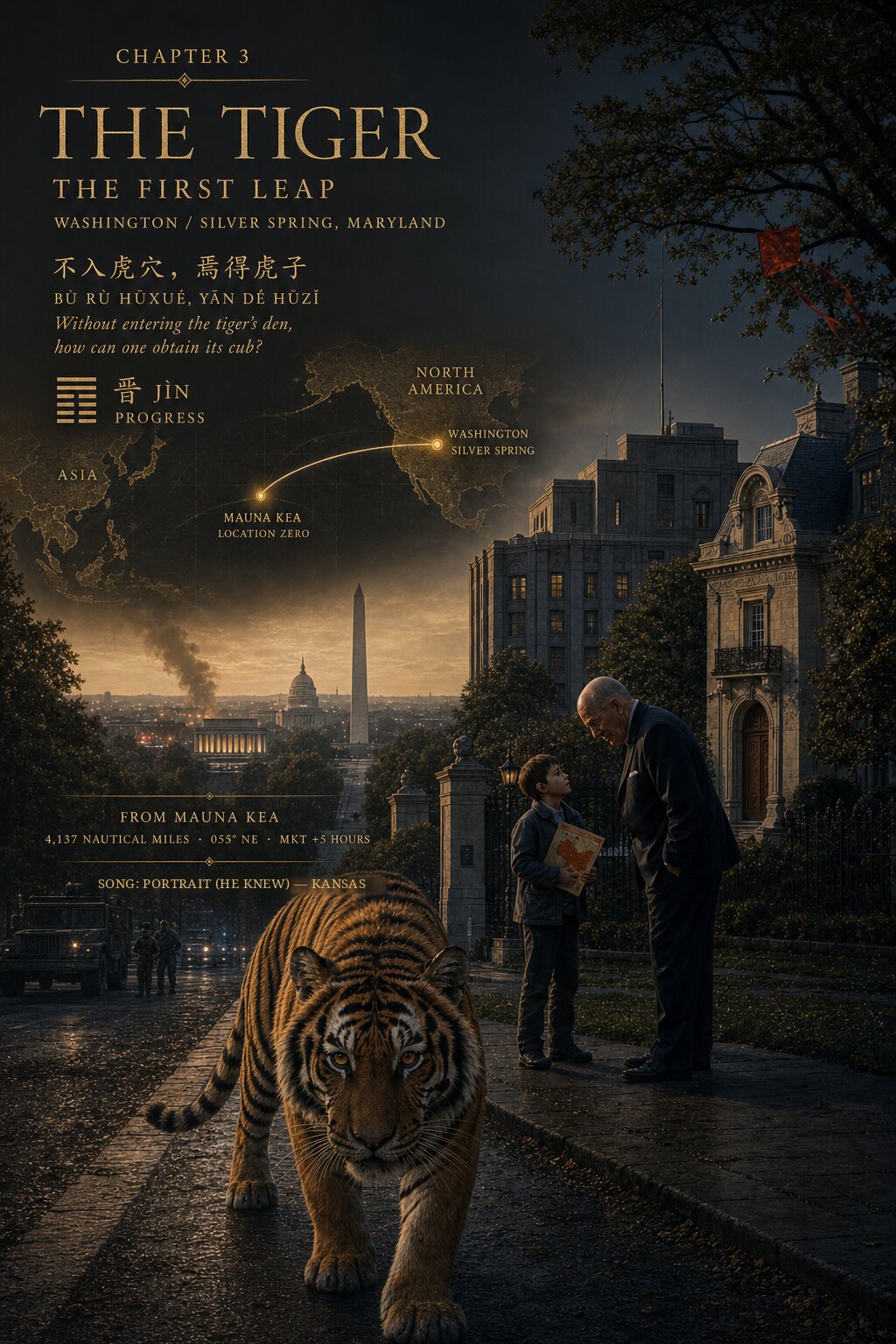
不入虎穴,焉得虎子
Bù rù hǔ xué, yān dé hǔ zǐ
“How can one catch the tiger’s cub without entering its den?”
The Rat finds the opening.
The Ox prepares the ground.
Then comes the moment when preparation is no longer enough.
The Tiger must leap.
Every life contains decisions that quietly divide time into before and after. We seldom recognize them fully while they are happening. At the moment of choice, we see only uncertainty, inconvenience, excitement, and the next practical step.
Only later do we understand that an entire life turned upon it.
For me, that moment came in late June 1983. I was just twenty-one years old and ready to set out on my first voyage to the fabled Middle Kingdom I had long admired from afar.
A few weeks before that departure, Malcolm Forbes spoke at my college commencement on June 4, 1983. The publisher of Forbes magazine, he was a flamboyant champion of capitalism. His magazine called itself “The Capitalist Tool,” a name he also gave his private Boeing 727. I remember him describing how modern airplanes, communications, and international hotels had brought the world to our doorstep. For a young Reagan Republican preparing to enter Communist China, his message carried a special force. The world he described was one we could reach and experience for ourselves. Within weeks, I was on my way to China.
An Unlikely Expedition
In 1983, China remained mysterious to most Americans. People knew Mao, communism, Nixon’s visit, the Great Wall, and perhaps the pandas. Few Americans had walked Chinese streets. Fewer still imagined building a life around the country.
To me, however, the decision felt strangely natural.
I was not running away from America.
I was running toward curiosity.
Nor was I making the journey alone. I joined a Duke University program consisting of eighteen students and one professor, Arif Dirlik.
I had good teachers, but the best luck I ever had may have been the year I was born. I came of age just as Duke was beginning to take students to China. I’d wanted to go on the inaugural trip in 1982. I had played three years of varsity soccer at Rhodes, and it was a big part of my life until I hurt my knee. After surgery, my doctors advised me to stay home, and I hated missing that first group. A year later I could go, with my degree in hand. For all my talk of the Tiger making that leap across the Pacific, some days I think I was the mouse that got through.
There was a small family echo in that connection. My mother’s aunt in Whittier, California, had worked on Richard Nixon’s congressional campaign. Nixon later opened the presidential door to China; he had also graduated from Duke’s law school. I never met him. But the university carrying me across the Pacific and a story from my mother’s family now belonged to the same unfolding history.
In retrospect, the group sometimes reminds me of Gilligan’s Island: an improbable collection of personalities setting out together on an amazing journey, not entirely certain what awaited us beyond the familiar shore.
Our voyage lasted considerably longer than three hours.
Professor Dirlik was himself a bridge between worlds. He had grown up in Istanbul, Turkey, and described himself as a Marxist. I would later describe myself to him as a radical conservative.
That combination should perhaps have made friendship impossible.
It did not.
Arif knew me well enough to distinguish political difference from human worth. He understood that curiosity could cross ideological lines and that serious people need not agree in order to recognize something valuable in one another.
My recollection is that Arif liked me even when he strongly disliked the politics I admired, including George Bush. I could be enthusiastic, argumentative, and conspicuously American. He did not need to share my political loyalties to take an interest in my future. That difference between agreement and affection became one of the most useful lessons I carried out of the program.
Years later, after a professional defeat threatened to close my route back to China, Arif would help reopen it.
In 1983, however, that chapter remained unwritten.
We were simply eighteen students, one professor, and a vast country beginning to open itself to the world.
The Professor’s Question
At the final meeting of our Duke study group in Nanjing in December 1983, Arif Dirlik posed a question that I have remembered for more than forty years. There were eighteen students in our group. When we began, he observed, I had been the most conservative among them—a Reagan Republican. Yet I was the one preparing to go farther into China rather than return immediately to America. How could that be?
I answered with a Chinese word I had come to cherish: 习惯, xíguàn. I had become accustomed to China. At first, the shops seemed full of goods I did not want to buy, and I could scarcely manage chopsticks. Six months later, the streets, food, rhythms, language, and above all the people no longer felt alien. I did not mean I had become a Communist. I still admired Ronald Reagan, believed deeply in free enterprise, and valued the arguments of F. A. Hayek. But I had learned that one could remain fully American while making a genuine home in another civilization.
Arif was a Marxist, and I was certainly not. Yet he recognized that my choice was not an ideological performance. In 1984 he visited me at the mining institute in Xuzhou; the photograph from that visit still reminds me how an intellectual disagreement can mature into a durable friendship. Five years later, after my dismissal in Memphis, Arif helped me find my way back into China. He told me he had done all he could. It was enough. His question in Nanjing had anticipated the deeper lesson: belonging need not require agreement.
The China That No Longer Exists
The China that greeted us has largely disappeared.
Millions of bicycles flowed through the streets like schools of fish. Buildings were often plain, communications limited, and foreign visitors conspicuous. Factory whistles helped mark the rhythm of the day. Trains moved slowly and carried entire worlds within their crowded compartments.
The country was materially poor but psychologically alive.
We spent six months studying and traveling in Beijing and Nanjing. Each city offered a different window.
Beijing carried the weight of political authority and imperial memory, but I met it from a bicycle. At street level, a great capital became a place a young American had to learn his way through. The bicycles, plain buildings, and conspicuousness of foreigners belonged to the same discovery. History was present in the city, and so was the unfamiliar business of getting through a day.
On July 4, 1983, at the U.S. Embassy, I watched the U.S. Marines present the colors. Nearby, Chinese PLA soldiers, looking disheveled by comparison, watched them intently. The contrast stayed with me, as did my pride at seeing the American flag presented so crisply so far from home.
I remember hot dogs there, too. That ordinary taste of home belongs beside the ceremonial memory: a young American celebrating the Fourth of July in Beijing, discovering that going abroad did not require leaving his affection for his own country behind.
Nanjing, the Southern Capital, carried its own layers of history, education, commerce, suffering, and renewal. It had been China’s capital in the early Ming dynasty and, centuries later, the seat of the Nationalist government. It would later become the setting for the most consequential encounter of my professional life.
The university where I studied belonged to that history of encounters. Nanjing University traces its modern founding to a Chinese institution established in 1902, but another important part of its inheritance came from Jinling University, known in English as the University of Nanking. That institution grew from American missionary schools, including one founded by Methodists in 1888. Its arts and sciences faculties joined Nanjing University in 1952. The connection between American education, Christian service, and Chinese learning had a history on that campus long before I arrived.
I remember the drab Nanjing dormitory, the cold rooms, and fans that ran only intermittently. Such details remain when a grand description of a country begins to fade. China was becoming a place where I lived, with ordinary discomforts as well as discoveries. The distance between reading about another civilization and inhabiting a room within it was considerable. I was beginning to cross it.
During a trip to Xi’an, I saw older women whose feet had been bound in childhood. A custom I had known from history books was still visible in the lives of people standing before me—a sight a visitor to China today would be far less likely to encounter.
At first, everything demanded interpretation.
A meal required interpretation.
A gesture required interpretation.
A pause in conversation could require more interpretation than the words preceding it.
I had studied China from a distance. Now China was studying me in return.
Upon my arrival, I was given the Chinese name Ài Déhuá (爱德华). It is the standard Chinese rendering of Edward, but the characters were explained to me as “Love, Virtue, China.” The name delighted me. It seemed less like a transliteration than a blessing—and, in retrospect, a prophecy. It was also the Chinese name for two men named Ed who would later shape my life: Ed Khalily, who helped open China’s commercial frontier to me, and Ed Gomberg, who brought me to Chattanooga. The name given to me upon entering China would echo through the friendships that helped determine my future.
Foreigners attracted attention. People looked openly, never out of hostility but from curiosity. A young American walking through a Chinese city in 1983 could feel both important and absurdly visible.
I had imagined that crossing the Pacific would make me worldly.
Instead, it made me aware of how little I knew.
That was the first gift of the journey.
The frog had climbed far enough to discover that the sky was larger than the circle above the well. The Tiger had entered unfamiliar terrain and learned that courage does not confer understanding.
It merely makes understanding possible.
Reagan, Deng, and the Practical Test
The American president I admired and the Chinese leader reshaping the country inhabited very different political traditions. Ronald Reagan believed that free people and private initiative could accomplish what distant planners could not. Deng Xiaoping confronted the failures of a rigid economic order and encouraged an experimental approach associated with 实事求是, shí shì qiú shì—seeking truth from facts. Their governing systems were not equivalent, and their differences mattered. Yet both, in their own ways, were asking what actually enabled ordinary people to produce, build, trade, and improve their lives.
What I witnessed in China persuaded me that broad labels explained less than lived consequences. Markets were opening without erasing the Chinese state's authority. A country I had been taught to classify by ideology was showing me the force of human initiative. That lesson neither converted me to Chinese politics nor diminished my confidence in America. It gave me a better question than whether a society sounded like my own: what was changing for the people inside it?
Beyond the Familiar Route
After six months in Beijing and Nanjing with the Duke group, I faced another decision.
I could return home satisfied. I had already traveled farther than most Americans of my generation. I had studied in two of China’s great cities and acquired stories sufficient for a lifetime of dinner-table conversation.
But the Rat had found another opening.
The Tiger wanted to go farther.
I accepted a position at the China Institute of Mining and Technology in Xuzhou.
Xuzhou was far from the familiar path of foreign visitors. It was a closed city, a place where an American could not disappear into an international hotel or expatriate community.
That isolation attracted me.
I had not crossed the Pacific merely to stand at the edge of China and observe it safely. I wanted to enter the daily life of a place most Americans would never see.
The decision felt empowering.
I never feared for a moment.
That may have been courage.
It may also have been youth.
At twenty-two, the distinction is not always visible.
The Tiger does not eliminate fear by argument. It gathers itself and moves.
In my case, exhilaration left little room for fear to enter.
The Luxurious Apartment
The China Institute of Mining and Technology treated me generously.
My salary amounted to only a few dollars a day, but by local standards I was given remarkable accommodations, including an apartment I regarded as luxurious. My administrators and faculty students occasionally met there for class.
The arrangement revealed the contradictions of being a foreign teacher in China during that period.
By American standards, I possessed little.
By local standards, I enjoyed privilege.
Living with what I would once have considered the bare necessities taught me how few of my familiar comforts were actually necessary. I had already learned, through three high schools, that a new place would not arrange itself around me. In Xuzhou, that lesson became a way of getting through the day. I could adjust my expectations, use what was available, and ask for help. My hosts were generous; flexibility helped me receive that generosity without expecting it to look like life at home.
I had arrived imagining myself as an adventurous young teacher. To many of the people around me, I was also a representative of a wealthy, powerful, and largely unknown country.
I had to learn that even an unofficial visitor carries a flag other people can see.
The apartment was on the ground floor, among homes occupied by senior administrators. One afternoon a little girl, perhaps six or seven, came in. She raised her hands, snapped her fingers, and began to dance.
“Xianggang tiaowu,” she announced. Hong Kong dancing.
It was 1984. In that little room on a campus in a closed Chinese city, a child was showing an American how the world had already found its way into her imagination.
My principal students were administrators and faculty members. They were educated adults with responsibilities, experience, and questions extending far beyond English grammar.
Some of those students were in their sixties or seventies. I was twenty-two, teaching people as much as half a century older than I was. They remembered a China I could know only through study and conversation, including the years before 1949. I was their English teacher, but their experience reached far beyond my own.
What especially stayed with me was the warmth with which they remembered American missionaries. They spoke of schools, hospitals, and churches, and of people whose service they regarded as altruistic. Those were the memories they shared with me. Hearing them helped me understand why the work of missionary families, such as those of my professor Robert Glasgow Patterson and, later, my friend Jean Hawk Troy, could leave such durable affection. More than forty years later, I value those conversations all the more. I was young enough to hear their stories, and I have lived long enough to pass on something of what they told me.
Once a week, I taught college students.
Once a week, I taught students at the affiliated high school.
That high school class became one of the great pleasures of my time in Xuzhou.
Ping-Pong Diplomacy
We played ping-pong on classroom desks and on concrete tables outside.
The equipment may have been modest. The competition was not.
I am ashamed to admit how often the students beat me.
Perhaps “ashamed” is not quite the right word. I was competitive enough to want to win, but sensible enough to understand the comedy. The young American teacher had crossed the Pacific carrying confidence, education, and dreams of international significance.
Then a Chinese teenager handed him a paddle and corrected the balance of power.
Those games taught something no formal lecture could have conveyed.
Human relationships often begin in play.
A student who might hesitate to challenge the foreign teacher in class could defeat him decisively across a ping-pong table. Laughter loosened the hierarchy. Competition created equality. A missed shot communicated more efficiently than a carefully prepared speech.
I had expected to teach English.
My students were teaching me how friendship begins.
Laughter, I discovered, translates remarkably well.
The Wise Student
Another student taught me the same lesson through chess.
He was older and carried himself with a wisdom I recognized even when I could not fully explain it. I taught him the rules of Western chess.
Then he beat me.
I had provided the rules and assumed that knowledge gave me an advantage. He understood the game quickly enough to discover possibilities inside those rules that I had failed to anticipate.
The experience became a small parable of my encounter with China.
I arrived possessing information China wanted. I spoke English, knew America, and could explain institutions, customs, and ideas that had long been difficult for my students to access.
But giving someone the rules does not make one the master of every game.
My students listened, adapted, questioned, and often surprised me. China was learning from the West, but it was not becoming intellectually dependent upon the West.
It could learn the rules and then make its own moves.
The wise student’s victory was not humiliating.
It was clarifying.
I was not in China to preside over an awakening.
I was there to participate in an exchange.
The Cat King in Xuzhou
The college students had their own ways of surprising me. We were close in age, facing one another across a classroom, each side curious about the other. In one student’s notebook I found the familiar saying attributed to Thomas Edison: “Genius is one percent inspiration and ninety-nine percent perspiration.” The English had been carefully written out.
During a break one day, two young women in my class came up to me and told me they wanted to live a modern life. More than forty years later, I still think about those two. I suspect they got their wish, along with a billion of their fellow Chinese. I’d love to hear what a modern life turned out to be for each of them.
My students also knew Elvis Presley. I learned his Chinese nickname from them: Mao Wang, the Cat King. There I was, a young man from Memphis, discovering that someone in Xuzhou already knew the King.
America had arrived before me. My students were showing me which pieces they had kept.
My favorite student at the School of Mining once told me that China had gone backwards for thirty years. I remember the candor of that judgment. Here was a middle-aged Chinese teacher willing to look hard at his country’s recent past.
China’s reform and opening had begun in 1978. To me, Deng Xiaoping’s call to seek truth from facts meant being honest about what had failed and willing to change it. My student’s remark gave that principle a human voice.
Beyond the Campus Gates
Sometimes I rode my bicycle toward town and turned off into the countryside. After six months with the Duke group, I had enough Chinese and enough confidence to find my own way. A few miles from the university, I entered villages where people had never seen a foreigner.
No one had arranged the visit. No one had dressed the village for my arrival. I got off my bicycle and looked into courtyards with stone tables and old stoneware that seemed as though it might have been there for generations. Wood smoke drifted from cooking fires. Red couplets remained bright against the weathered surroundings.
I remember one visit on a Sunday, when people seemed to have time to gather. The women had strong arms from work, and they laughed freely. Children crowded around. Here was the great-grandson of a man who had survived Chickamauga, standing in a Chinese village with a camera, trying to make himself understood.
I had never felt farther from home. Yet I encountered no hostility. The villagers had little materially, but they possessed enormous dignity. They welcomed me as I was.
I took photographs, had color prints made, and returned to give them to the people in the pictures. The first visit had made me a curiosity. Coming back with the photographs gave us something to share.
The university knew I was going out. When I rode through the gates again, I could hear that the foreigner had returned.
Madame Zhang Wen Shu, head of the Foreign Affairs Office at the China Institute of Mining and Technology in Xuzhou, had hired me and treated me with such kindness that I thought of her as my China mother. She also had responsibilities. My unauthorized bicycle excursions put her in an awkward position.
“You are not going out into the countryside on your bicycle, are you?” she would ask.
“No, no. I would never do that.”
I shook my head, but my smile told another story. I understood that she had to ask. I also understood the kindness in the way she asked. She could have forbidden me outright. Instead, we found a way through the conversation.
I remember her as a person trying to look after a young foreigner whose curiosity had taken him beyond the approved route. The rules were real. So was the warmth between us.
America in My Luggage
During quiet evenings, I sometimes returned to a biography of George Washington.
An American living in communist China during the year 1984 might have been expected to spend free time reading about Chinese history or spy novels. Instead, I found myself thinking about America’s first president.
Washington interested me because he understood restraint. He surrendered military power, later relinquished the presidency, and helped establish the principle that leadership should not become permanent personal possession.
Reading about Washington in China sharpened questions that belonged to both civilizations.
What makes a good leader?
How should power be exercised?
When does authority become domination?
What responsibility accompanies freedom?
Those questions did not belong exclusively to America or China.
They belonged to humanity.
My attachment to China was never based on a desire to cease being American. Crossing the Pacific did not empty my luggage of everything my parents had taught me.
I carried my father’s integrity.
My mother’s imagination.
John’s persistence.
The family stories of survival, service, medicine, and work.
I carried Washington, Lincoln, the American South, Tennessee rivers, and the conviction that every person possesses a dignity no government grants.
China did not require me to abandon those inheritances.
It required me to examine them.
Distance has a remarkable effect upon home. It reveals both what deserves gratitude and what familiarity has prevented us from questioning.
The farther I traveled into China, the more thoughtfully American I became.
At the China Institute of Mining and Technology, I watched Ronald Reagan’s 1984 visit to China with students gathered around my color television. Seeing him standing proudly in Tiananmen Square stirred that pride again. To me, Reagan embodied the American spirit. His presence suggested confidence and the possibility of a better relationship between our nations.
I still have the letter from the China Institute of Mining and Technology in Xuzhou. It is dated November 24, 1984. “Imagine how happy we were when we got your letter. It reminded us of those days you stayed with us.” I remember Madame Zhang Wen Shu among the people who signed it.
They remembered my patience, tolerance and kindness. What I treasure is the invitation that followed. “Therefore we all wish that we could meet again both in China and in The United States.” We had known one another in their country. They could already picture a visit in mine.
They had followed our election. “President Reagan won the election. We hope that he won’t back out his promise to develop further cooperation and deeper friendship with China.” Then came news of a colleague on his honeymoon and thanks for the books and pictures I had sent. “Good-bye, Bob. Please write to us whenever you have time.” They signed off, “Yours ever,” and there, under those two words, are their names.
Qufu
That year the Institute also took me and other teachers into Shandong, to Qufu, the hometown of Confucius, and nearby Mount Tai. I remember seeing the effort to preserve that inheritance after the Cultural Revolution. China’s past had survived more than I could yet understand.
Looking back, I recognize a kinship between the Confucian regard for learning, family responsibility, and trustworthy conduct and the Christian values I carried from home. The traditions were distinct, but I could hear them speaking to some of the same obligations.
What especially interested me was family responsibility understood as a promise carried through daily life: between parent and child, among siblings, and between spouses. Through my Chinese family and the people I came to know, those obligations became something I could see being practiced, rather than merely a teaching I had read about.
Much of what drew me toward Confucius had first reached me through people. A teacher’s patience. A family’s dignity. An official’s kindness toward an inconvenient young man. Qufu gave a name and a place to questions I was already learning to ask.
The Same Human Hopes
One day, while walking across campus, I found myself considering the people I had come to know.
Parents hoped their children would succeed.
Students worried about examinations.
Teachers cared whether their work mattered.
Young people dreamed about the future.
Families laughed, argued, sacrificed, remembered, and hoped.
The political system differed.
History differed.
Language differed.
The basic human desires were familiar.
That realization permanently changed the way I understood international affairs.
Governments negotiate.
People live.
A nation may be represented by its leaders, laws, military power, and economic statistics. But a civilization is carried through ordinary lives: meals, classrooms, courtships, jokes, ambitions, disappointments, and families trying to secure a future for their children.
Once a foreign country contains people you know, it can never again be reduced entirely to a headline.
This did not mean differences were imaginary.
China and America were not interchangeable. Their histories, institutions, assumptions, and understandings of order sometimes diverged profoundly.
But difference no longer implied distance beyond human recognition.
I knew their names.
They knew mine.
Learning the Pace of Trust
China also required patience.
Nothing seemed to happen at the pace an energetic young American preferred.
Trains moved according to their own rhythm.
Meetings unfolded deliberately.
Relationships matured gradually.
The most important answer might not arrive during the first conversation—or the fifth.
At first, I found that pace frustrating.
Then I discovered its wisdom.
Trust grows slowly.
Anything worth building usually does.
That lesson would later shape my business career more deeply than many of the principles I learned in graduate school. A contract could be signed quickly. Confidence required repetition.
The first visit created curiosity.
The second created recognition.
Later visits created familiarity.
Only time revealed whether a promise would be kept.
The Tiger in me preferred the leap.
China taught me the landing mattered too.
The Journey Home
In June 1984, my contract was ending and my airplane ticket was about to expire. My faculty students loaded into a bus to take me to the railway station. These were older men and women who had welcomed me as their teacher. One would accompany me to Shanghai.
I carried a stack of Chinese currency, wages I had scarcely found a way to spend. But what I remember most clearly is the rain beginning at the station.
One of my favorite students said, “The gods are crying.”
“I will return,” I told him.
And I did.
By the time my work in Xuzhou ended, something irreversible had happened.
I had crossed the Pacific believing I was setting out on an extraordinary adventure. I returned knowing that China had become part of the direction of my life.
The frog could never again believe that the circle above the well was the whole sky.
Nor could he look down upon those who remained within their own wells.
The proper response to discovering a larger world is not superiority.
It is gratitude.
When I boarded the airplane home, I may have believed that my Chinese adventure had reached its conclusion.
If so, I could not have been more mistaken.
China had entered my imagination too deeply to remain a youthful episode. It would call me back as a student, teacher, businessman, husband, father, and friend.
I did not know that Arif Dirlik would one day help rescue me from professional defeat.
I did not know that Nanjing would lead me to Ed Khalily and Bert Eshaghpour.
I did not know that a woman from Chengdu would bring mapo tofu to my table in Chattanooga and eventually become my wife.
I knew only that the world was larger than I had imagined and that I wanted to continue exploring it.
The Tiger is remembered for courage.
Courage is often confused with fearlessness. My own experience suggests another definition.
Courage is taking the next faithful step before the destination becomes visible.
In 1983, I took that step.
The Rat had found the opening.
The Ox had taught me to work.
The Tiger crossed the Pacific.
The journey had begun.
Table of contents · Next: Chapter 4 · The Rabbit: Carrying the Ember

