
画蛇添足
Huà shé tiān zú
“Draw a snake, then add feet.”
The snake is among the most misunderstood creatures in the world.
In the biblical imagination, it enters the garden as temptation. In the American imagination, it hides beneath a rock and strikes without warning.
Chinese tradition sees other possibilities.
The snake is intuitive, intelligent, patient, and economical in movement. It lives close enough to the earth to sense vibrations larger creatures miss. It survives by knowing when to remain still, when to move, and when to shed the skin that has become too tight.
I have spent much of my life shedding identities.
Student became teacher.
Teacher became businessman.
Purchasing manager became China liaison.
Employee became civic advocate.
Husband became father.
Classroom instructor became the author of a covenant.
Every discarded skin once fit me.
None could contain me forever.
When the Frontier Changed
Wegochem gave my life a tangible commercial structure.
The work suited me.
China was still a commercial frontier. Communications were difficult, systems informal, and relationships essential. An American who could travel independently, speak some Mandarin, understand business, and remain comfortable amid ambiguity possessed unusual value.
But frontiers change.
China became more sophisticated. Communications improved. Supply chains became formal. Chinese managers gained international experience. Larger companies established their own offices and procedures.
The very development I had anticipated reduced the need for some of the improvisational work I performed.
The frontier became an industry.
That is one of progress’s quieter ironies.
A person may succeed in helping build a road and then discover that the completed road allows traffic to pass without him.
On one of my last visits to Wego headquarters in Great Neck, I took my leather-bound book of letters down from Bert’s credenze. When I lent it to him, I was asking him to keep me in China. By the time I reclaimed it, we had secured the nitromethane Ed had called for.
There was one more thing I wanted to take home. I went to the files and looked under B for Buckman. There was the brochure Buckman Laboratories had first sent me, the one I’d put in Ed’s hands at Guangzhou Airport. Whatever the business earned, those were the two things I carried out of the office. I still have the brochure. I still have the book I lent Bert. It was my covenant.
The merchant’s skin no longer contained the whole man.
I needed to shed again.
苦中有乐 — Kǔ zhōng yǒu lè — Within Bitterness, Happiness
The first closed door appeared before my first long stay in China. During my junior year at Rhodes, I underwent ACL reconstruction and suffered complications. My doctors advised me not to join Duke’s 1982 study program in China.
I was devastated. China already felt like the road I was meant to take, and the injury seemed to have blocked it at the moment it opened.
Only later did the reversal become visible. I’d stayed at Rhodes long enough to finish my degree. When my semester with Duke ended, I could stay in China and teach in Xuzhou. The interruption changed the terms of the journey.
The pattern repeated. Buckman did not become the future I expected; Wego did. The June 1989 crackdown closed one form of China work and opened another through international trade. I do not believe every tragedy conceals a blessing. Some losses remain losses. But my life taught me that the meaning of a disappointment may arrive years after the event.
Sometimes within bitterness there is happiness.
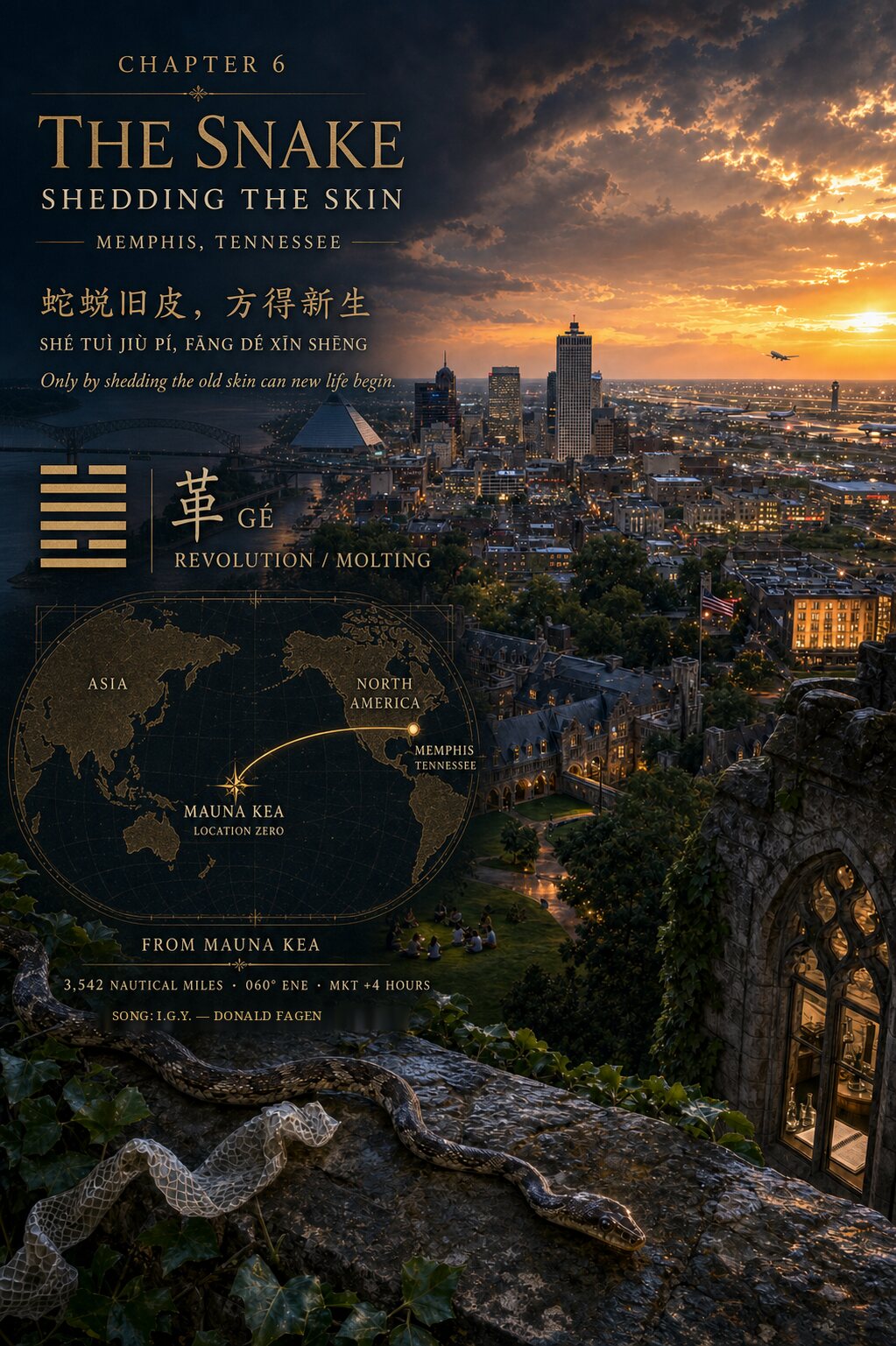
The Snake sheds a skin because the life inside it has continued to grow.
Three Weeks with the Wangs
In 1995, another remarkable opportunity appeared in Memphis.
Wangs International—known today as Creative Co-Op—had been founded by Robert and Susan Wang, immigrants from Taiwan who had built an extraordinary home-décor enterprise.
At the time, as I remember it, the company operated from a warehouse of roughly one million square feet and had become an important home-décor supplier to Walmart.
The scale impressed me.
The founders’ offices told a quieter story about the scale around them. They were near the front of a very large facility, but their own spaces were plain. Susan worked at what I remember as a cubicle; Robert’s office was simple too. Nothing about them suggested that the size of their enterprise had made them reach for grand surroundings. Their manner brought back a lesson I had first encountered at the mining institute in Xuzhou: beyond the necessities, very little is necessary. I had the sense that Robert could sleep in an airport or accept whatever conditions the work required. What I saw was determination, not self-display.
The work itself was anything but small. Faxes went back and forth with China as the teams settled colors, product specifications, and design ideas. The Wangs now call their company Creative Co-op, and that phrase fit what I saw: they were coordinating production while thinking carefully about what American customers would want. Susan was remarkably perceptive. She could listen to a meeting, summarize its substance, and bring everyone back to the decision that mattered. Her unpretentious manner concealed no lack of authority; it made her intelligence and effectiveness all the more striking.
At Wang’s, a day’s stack of faxes could be half an inch thick. All that paper, just to settle the details of the things somebody would take home from Walmart. I wish the shopper could have seen that stack.
After I came home from China, and later from Taiwan, I’d go out for Chinese food and often find a local waiter or waitress waiting tables. One day it struck me that the people who’d had to learn a new language and figure out how to run a business in this country were the ones signing the paychecks. I’d gone in for lunch, and there was somebody making a living because those owners had opened their doors. I imagine other immigrants had similar stories of building America by providing employment.
I remember a workforce of roughly six hundred people in the United States. Containers, pallets, forklifts, and conveyors made the warehouse a visible meeting point between Asian production and American demand. Behind the goods were factory workers overseas as well as the people receiving, handling, and selling them here. When I speak about trade, those are among the people I have in mind.
Robert Wang possessed vision and audacity. Susan possessed the authority to decide whether a new employee belonged inside that vision.
She hired me.
For three weeks, I worked directly with the two founders.
“You are a maverick,” Susan told me. She recognized the independence before we discovered how poorly it fitted the position. I was grateful that she had been willing to give me a place close enough to the founders to find out.
Three weeks is not long enough to build a career, but it is sufficient time to reveal a pattern.
I entered with enthusiasm.
I saw China.
I saw international expansion.
I saw possibilities.
I told Susan that she could send me to China.
She replied that she could send me home.
And she did.
The line was painful.
It was also excellent.
Susan let me go and provided a modest severance, though nothing as generous as Buckman’s payment of my remaining contract.
In three weeks, I spent more direct time with Robert and Susan Wang than I had spent with Bob Buckman during three months at Buckman Laboratories.
The ending did not erase my admiration.
I spent many hours with Robert and Susan and came to know them beyond the brief fact of my employment. I have remained in touch and remember them with affection and respect. Their products also found their way into home-décor stores in Chattanooga. The commercial connections I had admired in Memphis continued into the city that became my home.
The Wangs had created an enterprise of astonishing scale. Robert later endowed an international MBA program at the University of Memphis, where he and Susan had studied. Their work connected Asia, Memphis, American retail, design, logistics, and entrepreneurship.
They were precisely the kind of people I admired.
They also concluded that their company did not need what I was offering.
Both truths deserve to remain in the story.
A memoir becomes dishonest when every rejection proves the institution foolish and every failure reveals the hero to have been secretly correct.
Sometimes the institution does not understand the unusual person before it.
Sometimes the unusual person has not understood what the institution actually needs.
Sometimes both are true.
Drawing Feet on the Snake
The story behind 画蛇添足 (huà shé tiān zú) tells of men competing to draw a snake.
One man finished first. With time remaining, he decided to display his superiority by adding feet.
In doing so, he ruined the drawing and lost the contest.
I recognize myself in that story.
I have often seen something important before others recognized it. Once the essential idea was complete, however, I did not always put down the brush.
I added another argument.
Another historical comparison.
Another proposal.
Another provocative sentence.
Another department the institution might create.
Another wall the organization might move.
Sometimes the added detail enlarged the vision.
Sometimes it gave the snake feet.
Buckman asked for a market study.
I supplied a market plan.
An institution hired me for one purpose.
I soon identified five related opportunities and felt compelled to explain them all.
A school might ask me to teach Mandarin. Before long, I would be thinking about how it should understand China, international education, economic development, cultural exchange, and the future of the Pacific.
I did not enter organizations intending to disrupt them.
I entered with enthusiasm and gratitude.
I could see what they might become and wanted to help them arrive there.
But institutions do not always experience unsolicited vision as a gift.
Sometimes they experience it as pressure.
My strengths and weaknesses often emerged from the same source.
I was not content merely to inhabit the room.
I wanted to move the walls.
The Edward Who Brought Me to Chattanooga
Another man named Edward redirected my life.
Ed Gomberg had immigrated to the United States from St. Petersburg, Russia. He became an accomplished polyurethane chemist and entrepreneur and founded Synair Corporation.
Synair brought me to Chattanooga.
The company’s original product was a two-component urethane rubber injected into tires to prevent flats. It was called TyrFil.
Ed Gomberg had created an industry.
His technical imagination later moved in an artistic direction. Because he was himself an artist, he developed products such as Por-A-Mold and Por-A-Kast, which allowed molds and castings to be produced for creative and architectural work.
Por-A-Mold urethane rubber was used in constructing elements of Ross’s Landing near the Tennessee Aquarium.
That connection delighted me.
A Russian immigrant’s chemistry had helped shape a public space in Chattanooga—a city where my own ideas about history, international friendship, and civic possibility would eventually take root.
Ed Khalily had opened China’s commercial frontier to me.
Ed Gomberg brought me to Chattanooga.
There is a debt I want to name. The men who gave me another chance after Buckman were Jewish. When my time with the Wangs ended, it was a Jewish man from Russia who helped me find my footing again. I have told those stories in terms of jobs and cities. What I remember with gratitude is who reached out when I needed work.
The repeated name seemed almost like a private joke played by Providence.
Stan Townsend gave that move a human face. He hired me at Synair and helped make Chattanooga more than a new address; he gave me a place from which to begin understanding the city and its possibilities.
I also came to appreciate Bart Walter and James Wines, whose imaginations helped transform Chattanooga and reinforced a lesson that had followed me from China: places are not finished. They can be remade when vision is joined to practical work.
Together with Stan Townsend, they helped me see Chattanooga as a city capable of transformation. That mattered to a man who had spent much of his life imagining bridges between what exists and what might yet be built.
My work at Synair gave me another professional identity and another opportunity to connect chemistry, commerce, and international experience.
Living in Chattanooga gave me another way to think about the factory I had visited in Nanning. Citric acid gives many soft drinks their tartness. Here was a city where people understood how much work went into putting a drink in somebody’s hand. In 1899, two Chattanoogans, Benjamin Thomas and Joseph Whitehead, secured the rights to bottle Coca-Cola across most of the United States. With John Lupton’s help, they opened the first plant under that agreement right here in town.
Coca-Cola had returned to mainland China in 1979, four years before I arrived as a student. By the time I visited Nanning for Wego, I could tell you a little about what happened in a citric acid factory. Only after I made Chattanooga my home did it occur to me how small the distance was between that work and a bottle on a Tennessee grocery shelf.
An Export Manager’s Pacific Market
As Export Manager at Synair, I learned the satisfaction of creating and maintaining jobs for Americans by selling abroad. I developed accounts, trained customers and traveled around the Pacific Rim: New Zealand, Australia, Indonesia, Singapore, Malaysia, Thailand, the Philippines, Guam, Saipan, South Korea, Taiwan, Hong Kong, China, Japan and Hawaii.
Importing from China had been a great adventure. Exporting for Synair was, in an important way, even more satisfying. I could connect a customer’s success abroad with work being done by Americans at home. The pleasure of finding a market now included the satisfaction of helping an American manufacturer reach it. I had enjoyed arriving in China as an American able to buy. I also loved arriving with something made in America to sell.
The direction mattered to me. China had given me opportunities to discover what I could do; exporting gave me another way to bring that experience home. Both kinds of trade depended on people wanting to do business together. I had been fortunate enough to work from each side of that exchange.
Years later, when I began drawing lines outward from Mauna Kea and imagining a Pacific Covenant, I was not simply connecting names on a map. I had traveled those routes. I had entered the factories, hotels, airports and offices. I had depended upon people across political and cultural boundaries, and they had depended upon me.
The Pacific had already become a commonwealth in my working life long before I found the language to describe what it might become for the world.
Shoe City in Zhongshan
In the late 1990s, I travelled frequently through Macau, the former Portuguese port, crossed into China’s Zhuhai Special Economic Zone, and went on to Zhongshan to visit Pou Chen, a Synair customer. They called the place Xiéchéng, Shoe City. Football fields were about the only measure I could think of to describe the size of those factory floors.
I’d seen what Robert and Susan Wang, two people from Taiwan, had built in Memphis. The family who built Pou Chen’s Shoe City had started out making rubber shoes in Taiwan in 1969. In 1988 their company opened its first mainland production line. A 1997 report put their shoe-factory workforce at about 140,000 and described the family business as the largest maker of sports shoes in the world. I saw only one part of that business. What I remember is how hard the people on those lines worked. When I hear China called the workshop of the world, those are the people I think of.
Our customer made shoes for all major brands. The Converse lines were a small part of the operation. Converse was struggling then, and as I understood it, that helped bring the business our way. The manufacturer bought our polyurethane for those lines. We shipped many containers to feed their strong demand.
Synair’s longtime controller told me Pou Chen/Converse was the most profitable account in the company’s history. I was proud of how I’d handled it. What pleased me was knowing there was work at both ends. Somebody in Chattanooga made the polyurethane, and somebody in Zhongshan used it to make shoes.
At Wego, I had helped find urgent supplies when a market was disrupted. At Synair, I helped an American manufacturer reach production lines on the other side of the Pacific. The direction of trade changed; the underlying craft did not. Find the right people. Learn what they need. Keep the relationship alive. Send a product that performs. Every successful container was another small demonstration that exchange can be mutual rather than predatory.
Looking back, I spent five or six years with both Wego and Synair The shoe business eventually tapered off, and Synair went through a restructuring. Then, in 2002, I was laid off.
Another skin split.
By then, losing a position was no longer merely a professional event. I was a husband and father. Uncertainty no longer belonged to me alone.
That changed its weight.
麻婆豆腐 — Má pó dòu fu — Mapo Tofu
Synair was what brought me to Chattanooga. By the time the job ended, I had a reason of my own to stay. That part of the story goes back to a meal I ordered six years earlier.
In 1996, I went to Nagoya Restaurant in Chattanooga and ordered one of my favorite dishes: mapo tofu, the spicy Sichuan dish I associated with Chengdu.
The young woman who brought it to my table was from Chengdu.
Her Chinese name is 詹暢 or Zhān Chàng. Her English name Jan sounds much like her surname Zhān.
Our first encounter did not immediately become a romance. I returned to Nagoya perhaps a month later.
She was still there.
This time, I asked for her telephone number.
Our first date was a performance of Jesus Christ Superstar.
Taking Jan to a musical about a misunderstood savior may have encouraged an already dangerous tendency in me to imagine myself in heroic terms.
Jan was more practical.
I had a pleasant downtown apartment.
She lived in an upstairs bedroom in someone else’s house.
Affection and practicality are not enemies. Most enduring relationships contain both.
Before long, we were living together.
We married at Second Presbyterian Church in Chattanooga. After the ceremony, we rode with two attendants in a horse-drawn carriage to Renaissance Commons in the Bluff View Art District, where a large gathering of family and friends awaited us.
The restless traveler had become a husband.
That required a different kind of transformation.
Before Jan, China had been adventure, vocation, commerce, and imagination.
Through Jan, it entered the household.
China appeared in meals, language, family obligations, holidays, disagreements, telephone calls, travel, budgeting, and plans for the future.
I had spent years explaining China to Americans.
Marriage required me to stop explaining long enough to listen.
International Relations at Home
Marriage taught me what books, factories, and trade fairs could not.
Cultures do not meet only at conferences.
They meet in kitchens.
They meet in decisions about money, family, work, privacy, obligation, and how much explanation a disagreement requires.
Jan and I remained distinct.
She was practical where I was visionary.
She was disciplined where I was improvisational.
She understood numbers with a remarkable clarity.
I could return from a conversation carrying an idea for transforming Chattanooga’s relationship with the Pacific.
Jan could determine what the idea would cost.
Neither gift was sufficient alone.
Marriage invited the Tiger, Rat, and Dragon in me to share a house with someone who could see where the floor actually stood. I trusted Jan’s clear sight. Her steadiness did not diminish my imagination; it gave it somewhere solid to stand.
The Snake does not become a different creature when it sheds.
It becomes more completely what it already was.
Marriage did not remove my curiosity or ambition. It required them to grow beyond the skin of the solitary adventurer.
Grief and Birth
On March 24, 2000, my father died.
The man who had taught me dignity without preaching, who had searched through his microscope for patterns invisible to others, was gone.
Five months later, on August 24, our son Robert Thomas Edwards was born at Erlanger Hospital in Chattanooga.
I was ecstatic.
It was the happiest day of my life.
Grief and joy rarely consult one another before entering a family. One generation had departed. Another arrived close to the third anniversary of the marriage that joined two civilizations inside our home.
I called Ed Khalily and shared the news.
The commercial mentor who had watched me learn the modern Silk Road now heard that I had become a father.
Thomas was born in the Year of the Dragon.
He belonged naturally to two worlds I had spent years crossing between. He did not need to board an airplane to stand upon the bridge.
He was born there.
The businessman’s skin could no longer contain me.
Beneath it, the husband and father had been waiting.
Returning to the Classroom
Teaching had always remained beneath my other professional identities.
Teaching was the first job of my life, and it became the work I returned to after years in import and export. That arc feels right to me: I began in a classroom, traveled through business, and came back to teaching. The road between those classrooms and factories gave me stories to bring back to students.
I wanted Chinese to feel like a door into a new world—almost like forbidden fruit to students accustomed to choosing Spanish, French, German, or Latin. We learned the language, but we also made dumplings, practiced calligraphy, and explored the culture. I was not always a disciplined classroom manager; we could be loud, and we had a lot of fun. I had to make teaching materials myself, too, first at the copy machine and later as homemade flashcards.
Again and again, I have found myself in a room where I was the only person speaking a foreign language. A few words of Chinese could open a conversation that otherwise would not have happened. Language is a tool; tools can open doors, windows, and minds.
One memory from my years as a Mandarin teacher brings that home. I took students on a bus to a Chinese buffet, where they learned to use chopsticks, order drinks, and conduct simple conversations in Chinese. Words practiced in class now had an immediate use across a table. I wanted them to discover that they could begin with the Chinese they already knew. A bus ride and a meal could give them a small version of the confidence I had first found by going to China.
After being laid off in 2002, I spent four years trying to find a place to teach Chinese while working toward a master’s in education. I returned to Governor’s School in 2003. It was a welcome opening in a period that often felt like wandering in the wilderness. Altogether, I would teach there for five summers, returning long after those first three summers in the 1980s.
In 2006, I helped establish the first Mandarin Chinese program in the Chattanooga area at St. Andrew’s-Sewanee School.
St. Andrew’s-Sewanee stood in an idyllic setting atop the Cumberland Plateau, near Sewanee: The University of the South. The mountain already held a China story. Clement Chen, born in Shanghai, came to Sewanee in the late 1940s and studied there for two years before completing his architectural education at Rensselaer Polytechnic Institute. He became a prominent international architect, designed Holiday Inn properties, and later helped carry modern hotel architecture back to China through Beijing’s Jianguo Hotel. His gift helped fund Clement Chen Hall, the vice-chancellor’s residence. When Madam Gao Xiaofang and a delegation from the Wuxi Foreign Language School later visited the mountain, they toured the hall and discovered that my Mandarin classroom was not Sewanee’s first bridge to China.
The university dedicated Clement Chen Hall on November 17, 1990. I believe Kemmons Wilson, the founder of Holiday Inn, was there for the dedication. There was even a Holiday Inn up on Monteagle Mountain. Someone driving between Chattanooga and Nashville could stop there for the night and have no idea how close they were to the house bearing the name of an architect who had designed hotels for the chain.
I can understand why an architect would thank the school he attended before he studied architecture. Sir John Templeton grew up in Winchester, just down the mountain. He chose a motto for his foundation that I would gladly have hung in my Mandarin classroom. “How little we know, how eager to learn.”
The school took a genuine leap into the future.
At the time, few American secondary schools—especially outside major cities—treated Mandarin as an essential part of education. China’s growing importance was visible, but educational institutions had not fully adjusted.
I wanted students to do more than memorize vocabulary.
Language carries a civilization’s assumptions within it. Each character, tonal distinction, proverb, and form of address reminds the learner that meaning has been organized differently by other people over thousands of years.
To learn Chinese is to discover that America is not the whole world.
The frog gains a foothold.
Perhaps I asked too much of a language class.
But I have never believed education should be small.
The Students Who Kept the Door Open
South Korean students enrolled in my Mandarin class at St. Andrew’s-Sewanee in numbers large enough to keep the program—and me—employed. They deserve a permanent word of thanks. At a moment when many American students chose Spanish, French, or Latin, these Korean students recognized that Chinese would be one of the consequential languages of their century.
Every language offers a civilization. My regret is not that Americans studied Spanish, French, or Latin. It is that too few American institutions treated Mandarin as preparation for the world already arriving.
While traveling for Wegochem in northeast China in the early 1990s, I occasionally crossed paths with people I understood to be North Korean officials. I did not pretend those encounters dissolved the Korean conflict. They did something smaller and indispensable: they gave human faces to a country Americans usually encountered through missiles, uniforms, and official warnings.
In one American mountaintop school, South Korean students preserved a Mandarin classroom. In northeast China, North Korean officials became people I had actually met. Long before the Covenant acquired a proposed table, my life had placed fragments of the Korean Peninsula around one.
Language education is peace infrastructure. A student who learns to hear another civilization from within has acquired something no weapons system can provide.
St. Andrew’s-Sewanee eventually declined to renew my contract in 2009.
I did not receive an explanation I considered adequate. I suspected that my public opinions and unconventional temperament may have contributed.
Suspicion is not proof.
A serious memoir must acknowledge what the disappointed employee cannot know.
The school had taken a risk by offering Mandarin. After my departure, I helped connect it with Hanban, an organization affiliated with China’s Ministry of Education, so that another Mandarin teacher could continue the work.
Even then, I tried to keep the bridge standing.
Part of me could not resist wondering whether the school might have been wiser to keep me.
The Monkey will have more to say about that instinct.
The Value of an International Student
The same commercial instinct followed me into education. At St. Andrew’s-Sewanee and later McCallie, I saw that international relationships could also enrich a school’s intellectual life and finances. I helped attract Chinese boarding students, whose annual tuition and boarding charges could approach $50,000 each. The point is that students arrived as people, bringing language, families, ambition, and another civilization into the daily life of an American campus.
I sometimes joked that everything I touched turned to gold. The claim was exaggerated, but it expressed a real pattern I believed I saw: I could identify opportunities across cultural boundaries and help institutions benefit from them. Schools, of course, are not merely marketplaces. Their return was also educational. An American student meeting a Chinese classmate might learn more about the Pacific in a dormitory conversation than through a semester of lectures.
Other Classrooms, Other Endings
McCallie School employed me for four years as a Mandarin instructor at their middle school.
Its campus stood near our home and Ridgeside Farm. Ted Turner, one of my heroes, had attended McCallie. His creation of CNN helped transform how the world witnessed history, including the events surrounding the fall of the Berlin Wall.
Like Sewanee, McCallie had a connection to China long before I arrived to teach Mandarin. Park and Spencer McCallie opened the school on Missionary Ridge in 1905. Their niece Grace McCallie Divine Liu would make her home in Tianjin and teach English at Nankai University. Decades later, here I was on her uncles’ campus teaching Chinese to boys from Tennessee.
My own time there did not end as I hoped.
Once again, I was cut loose.
Later, I taught English as a Second Language in Hamilton County public schools, including Howard High School.
Those classrooms introduced me to students whose families had come from Guatemala and other parts of Latin America.
My political views on illegal immigration remained firm.
My human relationships complicated every abstraction.
A student sitting before me was not a statistic, slogan, or policy argument. He or she was a young person trying to learn English, understand a new society, and imagine a future.
I enjoyed explaining what it meant to become American—not because America demanded the erasure of every previous identity, but because citizenship carries history, rights, responsibilities, and the possibility of belonging.
China had taught me to distinguish governments from people.
The Central American students in Chattanooga required me to apply the same lesson at home.
Consistency is one of the hardest tests of conviction.
Wisdom and Innocence
Jesus advised his followers to be wise as serpents and innocent as doves.
I understood the dove more naturally than the serpent.
Despite my reputation for provocation, I have often been innocent about institutional power.
I assumed candor would be respected because I respected candor.
I believed strong performance would protect unconventional expression.
I thought people who praised creativity wanted to be challenged by it.
That was not always wise.
The serpent understands timing, concealment, patience, and economy. It does not announce every destination. It does not strike every time it is disturbed. It conserves motion for the moment when movement matters.
Freedom of speech has value.
It does not remove consequences.
The serpent asks not only, “Am I entitled to say this?”
It asks, “What outcome do I seek, and will these words advance it?”
I did not always ask the second question soon enough.
Shedding Without Disappearing
A snake that cannot shed its skin dies inside it. A person can remain trapped just as surely inside an old title, grievance, humiliation, or definition of success.
Some skins were taken because institutions failed to appreciate what I offered; others may have been lost because I did not adapt wisely enough. Both can be true. Vision needed patience, courage needed strategy, and words needed restraint. Still, I kept moving.
The story of the Snake is not a story of becoming someone else.
It is the story of discovering what remains after every temporary identity has fallen away.
The jobs changed.
The calling remained.
China.
Teaching.
Family.
Tennessee.
The bridge between civilizations.
Different garments worn by the same traveler.
The Snake taught me to shed.
The Horse would teach me to continue.
Table of contents · Next: Chapter 7 · The Horse: The Long Road Proves the Heart

