
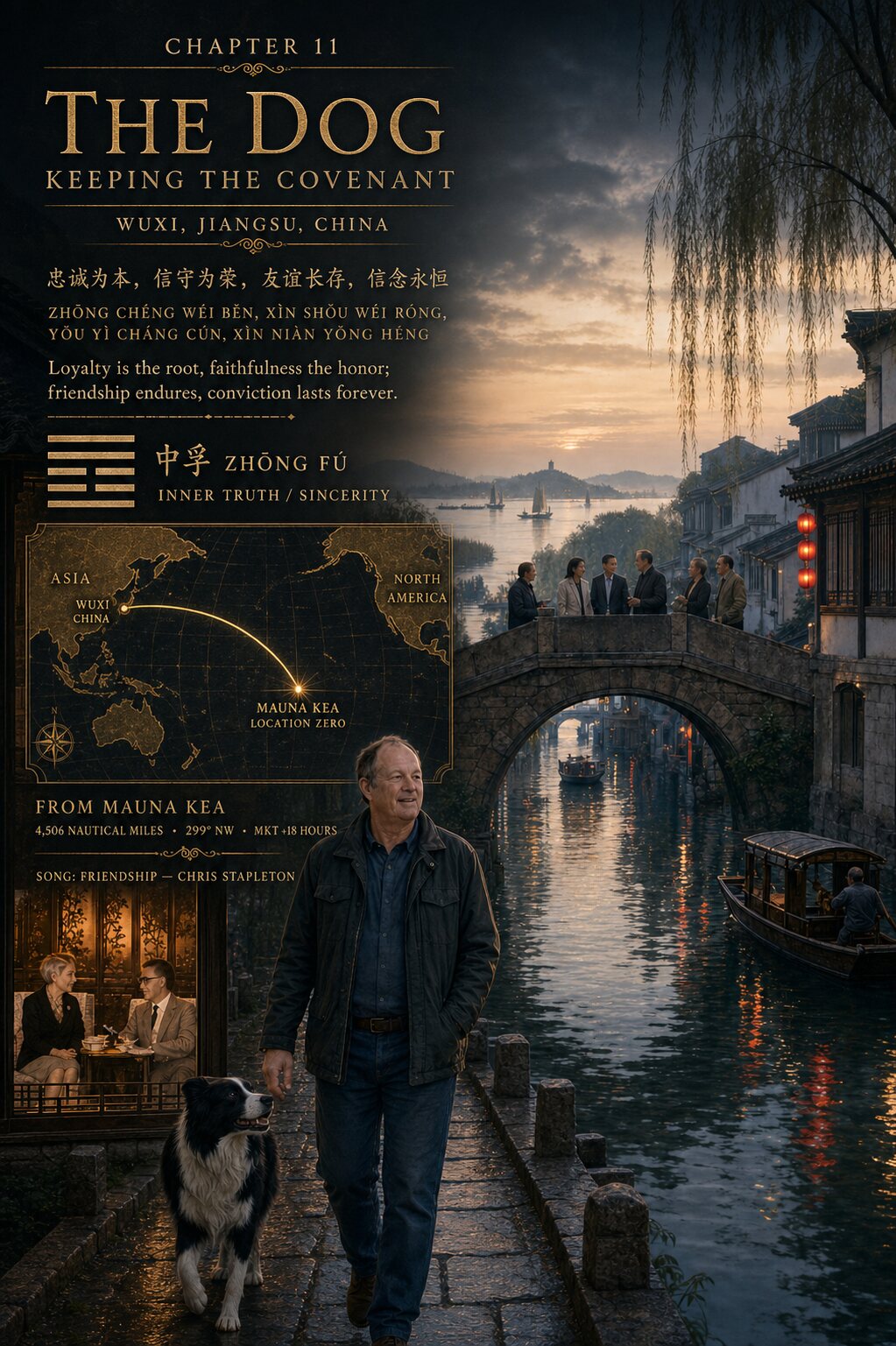
狗不嫌家贫
Gǒu bù xián jiā pín
“A dog does not despise a poor home.”
The Dog is not remembered for brilliance.
Nor for strength.
Nor for beauty.
It is remembered because it stays.
That is a rarer virtue than we often admit.
Anyone can be enthusiastic at the beginning of a journey.
The first day is full of possibility.
The first success creates confidence.
The first dream carries us forward almost without effort.
The real question comes later.
Will you remain when the road becomes ordinary?
When the applause ends?
When the institution chooses someone else?
When friendship becomes politically inconvenient?
When the fire burns low and no one is watching the door?
The Dog stays.
The Vigil
The world celebrates the leap.
The Dog notices the vigil.
My life contained moments of excitement, access, adventure, and the feeling that history had opened a private door.
Then came other seasons.
Jobs ended.
Contracts were not renewed.
The corporate ascent failed to materialize.
Official positions I imagined remained in the hands of others.
Proposals received less enthusiasm than I believed they deserved.
At such moments, a person discovers whether he loved the mission or merely the recognition he expected the mission to bring.
Holding on rarely looks heroic.
It may mean teaching another class.
Maintaining another friendship.
Renewing a scholarship.
Answering another message.
Returning to the same civic relationship after the officials who signed the original agreement have retired.
Writing another proposal after respectable people declined to accept the previous one.
The Tiger makes a dramatic entrance.
The Dog remains after the banquet ends.
The Turtle’s Faithfulness
My earliest understanding of fidelity began with family.
My brother John lived with cerebral palsy, but disability never became the whole of his identity.
John was the turtle to my hare.
I moved rapidly, changed direction, crossed oceans, entered institutions enthusiastically, and occasionally departed them sooner than expected.
John continued.
He completed college.
He graduated from Alabama Law School.
He served the federal government for thirty-five years.
Then he retired.
His life demonstrated the Dog’s virtue as surely as it demonstrated the turtle’s endurance.
Steady service rarely attracts the attention given to dramatic achievement. Yet institutions, families, and nations depend upon people willing to perform necessary work over decades.
John remained.
His example also reinforced something our father had taught without speeches.
Human worth does not depend upon speed, title, physical ability, wealth, or applause.
A family is judged partly by whether every member is permitted dignity.
A civilization should be judged the same way.
Power does not create moral worth.
Strength does not confer the right to humiliate.
The vulnerable place an obligation upon the strong.
Holding On to China
China changed dramatically during the years I knew it.
America changed as well.
Governments came and went.
Policies shifted.
Economies expanded and contracted.
Public opinion rose and fell.
The China of bicycles and limited foreign exchange became a manufacturing and technological power.
The America that once encouraged engagement increasingly viewed China through the language of strategic rivalry.
China’s confidence hardened.
American suspicion deepened.
Each country acquired new reasons to distrust the other.
Beneath those changes, friendships remained.
Students became colleagues.
Business associates became extended family.
Young teachers grew older.
Children became parents.
Years became decades almost without our noticing.
That is how covenants are formed.
Not through one dramatic promise.
Through countless ordinary acts of keeping one’s word.
Returning When Return Was Difficult
My return to China after June 4, 1989 had already taught me that engagement matters most when the easy narrative collapses.
The same principle guided later years as political relations between America and China faced renewed strain.
A friend does not remain only while the friendship is fashionable.
Political disagreement may require candor.
It does not automatically require departure.
Again and again, I returned to China—not because every visit was easy or every conversation comfortable, but because relationships, once formed, deserve tending.
I joined two Fulbright programs for Mandarin teachers in China. We explored minority communities in and around Kunming and Lijiang, encounters that deepened my familiarity with a country whose cultural life extends far beyond its largest cities.
My wife’s roots in China made this familiarity part of family life. As I write, Jan and Thomas are visiting northwest China and reporting economic vitality and good relations between Han people and other ethnic groups where they have traveled. Their reports encourage me and add another lived perspective to the country I have continued to know.
A gardener returns to the orchard.
A shepherd returns to the flock.
A faithful Dog returns to the familiar door.
Loyalty Is Not Blindness
A Dog can remain devoted to a bad master.
A patriot can defend his country’s mistakes because admission feels like betrayal.
A friend of China can minimize wrongdoing by the Chinese state.
An American can magnify every fault of that state because hostility has become proof of loyalty.
Neither response is trustworthy.
My fidelity to China cannot require approval of everything done by the Chinese state.
My fidelity to America cannot require pretending that American power has always been exercised wisely.
Real loyalty is capable of grief.
It criticizes without seeking destruction.
It defends without becoming blind.
The faithful friend may say what flattering acquaintances will not. A Dog may love the household and still bark when danger approaches.
But the warning must arise from concern for the household—not appetite for domination, attention, or fear.
Loyalty says:
I will tell you the truth because the relationship matters.
I will not use your failure as an excuse to stop recognizing your humanity.
The Watchdog
The Dog is also a sentry.
It hears movement at the edge of the property and raises the alarm.
For decades, I have warned that America’s failure to understand China could become catastrophic.
Contempt can become self-fulfilling.
Military machinery creates institutional and economic interests invested in its continued expansion.
Two proud nuclear powers cannot organize their relationship indefinitely around escalating suspicion without increasing the possibility of disaster.
Some people find the barking irritating.
The household may prefer sleep.
But a watchdog also has responsibilities.
It can bark at shadows.
It can mistake the wind for an intruder.
It can become so enamored of its own vigilance that every sound confirms the danger it expects.
The responsible sentry must distinguish threat from movement in the bushes.
That requires evidence, humility, and correction.
The Poor Home
A dog does not despise a poor home.
Poverty in this proverb is not only material.
A household may become poor in confidence, courage, imagination, generosity, or moral authority.
The faithful do not abandon it merely because it has disappointed them.
I have been disappointed in America.
I have watched public debate narrow, international understanding weaken, infrastructure decay, and fear replace some of the optimism that once characterized the country’s engagement with the world.
Yet disappointment is not abandonment.
I remain American.
My criticism arises because I believe America can do better.
The same is true of Tennessee.
I have believed that the state failed to recognize important opportunities in China, international education, passenger rail, investment, and civic diplomacy.
I responded not by ceasing to care but by drawing larger plans.
The Dog does not leave the poor house.
It guards it while imagining repairs.
Tennessee and Wuxi
Wuxi gave that fidelity a landscape. Known as the Pearl of Taihu Lake, it is shaped by water: Taihu, the Grand Canal, and the gardens whose prized limestone forms are known as Taihu rocks. Its canal traffic helped create commercial wealth long before modern industry arrived.
That history makes the sister-city relationship more than ceremonial. Wuxi understands how transport, trade, industry, and beauty can inhabit the same city.
One day, its wealth and experience might help bless Chattanooga and Tennessee through investment, employment, or even the railway connection I have long imagined.
A bridge requires maintenance.
Someone must inspect it after the ribbon-cutting.
Remembering After the News Cameras Leave
The same principle appeared after the Wenchuan earthquake: Jan’s fundraising, the James Yen school visits, and Montana Rhoton’s gift became meaningful because concern continued after the first emotional response.
The Dog remains after the news cameras leave.
“Hold On”
Rudyard Kipling’s If— contains a line that has remained with me:
“Except the Will which says to them: ‘Hold on!’”
There are seasons when enthusiasm is gone.
The heart, nerve, and sinew no longer supply the force they once did.
Only commitment remains.
Those seasons taught me more than the moments of easy momentum.
Holding on did not mean clinging to every job, title, grievance, or version of myself.
The Snake had already taught the necessity of shedding.
The Dog’s faithfulness is a calling.
A relationship.
A promise.
A person.
The job may end.
The duty remains.
The institution may reject the proposal.
The vision must still answer to truth.
The administration may change.
The friendship deserves another conversation.
Those Who Held On to Me
Fidelity in my life did not flow in one direction.
My mother supported me when ambition exceeded income.
Jan remained through professional uncertainty, elaborate plans, political controversy, reinvention, and the recurring distance between my vision of the future and the bills arriving in the present.
Her loyalty was not passive.
She worked.
She mastered accounting, built a career, organized student journeys, raised funds, joined delegations, and developed her own authority within the Wuxi relationship.
Thomas grew into an ambitious young man without repeating his father’s turmoil.
Chinese relatives claimed me as family.
Ed Khalily recognized value when my professional direction was uncertain.
Arif Dirlik remembered me after Buckman.
Students remembered that I had tried to show them a larger world.
Ron Littlefield acted upon the Wuxi opportunity and remained a friend.
No person holds on entirely through willpower.
Even the most determined traveler depends upon food, shelter, forgiveness, opportunity, and someone who does not close the door.
I was sustained by a pack.
The Danger of Becoming Feral
The lone Dog can become feral.
Independence without relationship decays into grievance.
A person may begin by resisting conformity and end by distrusting everyone who questions him.
Repeated rejection can produce wisdom.
It can also produce a private mythology in which every institution is cowardly and every critic proves the hero’s importance.
I know that temptation.
The mission requires other people.
A covenant cannot be created by one person because covenant is relationship by definition.
I may identify a path, articulate a principle, tell stories, and continue barking until someone listens.
But the Covenant cannot remain my private possession.
That is why this book is called A Pacific Covenant rather than The Pacific Covenant. The indefinite article is not hesitation. It is hospitality. I am proposing one architecture, not claiming ownership of the only possible design. If a student, mayor, engineer, philanthropist, religious leader, businessperson, oligarch or national leader sees the potential in these pages and builds something larger, the idea has not been stolen. It has escaped.
I ask only that those who adopt it preserve its moral center: peace before domination, relationship before caricature, consent before coercion, and construction in place of war.
It must belong to people, cities, institutions, and nations willing to enter it together.
It must be corrected by those it intends to serve.
Otherwise, it is merely another lone Dog circling its territory.
Trust Has a Memory
The Dog understands the deepest principle of the Covenant instinctively.
It does not love humanity in the abstract.
It loves particular people.
It remembers footsteps.
Voices.
Scents.
The person who promised to return.
World peace must also be anchored in particular recognition.
I know you.
I remember what you did.
You corrected the shipment.
You welcomed my student.
Your family fed me.
Your child played with mine.
You came after the earthquake.
You kept your word when breaking it would have been easier.
You returned.
That is how trust acquires memory.
Theories matter.
Institutions matter.
Treaties matter.
But none can substitute entirely for the confidence created when one human being discovers that another is dependable.
Love as Evidence
At summer camp, we sang that Christians would be known by their love.
The idea is simple enough for children and severe enough to judge civilizations.
It does not say people will know us by our declarations, institutions, doctrinal victories, wealth, weapons, or claims of greatness.
Love becomes visible through conduct.
Patience testifies.
Generosity testifies.
Truth spoken without cruelty testifies.
Returning after disappointment testifies.
Remaining connected when political relations grow strained testifies.
The principle applies beyond religion.
They will know we are friends by whether we remain.
They will know we are trustworthy by whether we keep our word after the banquet ends, the contract expires, the administration changes, and the crowd goes home.
The Dog does not deliver a grand speech about loyalty.
It lies down beside the door.
The Future We May Never Enter
I am older now.
I have not lost the scent.
It runs through Tennessee and across the Pacific.
Through Memphis, Chattanooga, Xuzhou, Nanjing, Wuxi, Dujiangyan, Chongqing, Hawaii, and places I may never see.
The Dog guards a future it may never inhabit.
That is not failure.
A person plants trees whose shade he may never enter, preserves relationships for officials not yet elected, and teaches words another generation will need. Faithfulness does not demand certainty before acting.
Remain
What have I pursued?
Not Chinese victory.
Not American surrender.
Not friendship that ignores power, injustice, or danger.
I have pursued another possibility: a world order less dependent upon domination and more deeply supported by trustworthy relationships, trade, education, infrastructure, cultural reciprocity, family ties, and reciprocal security.
People may reject the Covenant.
They may call it impractical, grandiose, mistimed, or insufficiently aligned with strategic consensus.
They are entitled to examine it.
I hope they understand the motive.
I spent four decades with China because I love America and Humanity.
I did it because I wanted Americans and Chinese to encounter one another before fear made encounter impossible.
Hold on to the family story.
Hold on to the scholarship.
Hold on to the language.
Hold on to the memory of China before wealth altered the balance.
Hold on to the best of America before fear made generosity appear foolish.
Hold on to Jan, Thomas, old friends, and the possibility that civilizations can remain different without becoming permanent enemies.
Hold on not because persistence guarantees victory.
Hold on because surrender would betray the life already lived.
The Rooster announced the dawn.
The Dog remained beside the door.
The Pig would finally ask what kind of wealth the household had gathered while I was watching the horizon.
Table of contents · Next: Chapter 12 · The Pig: The House Love Kept

