
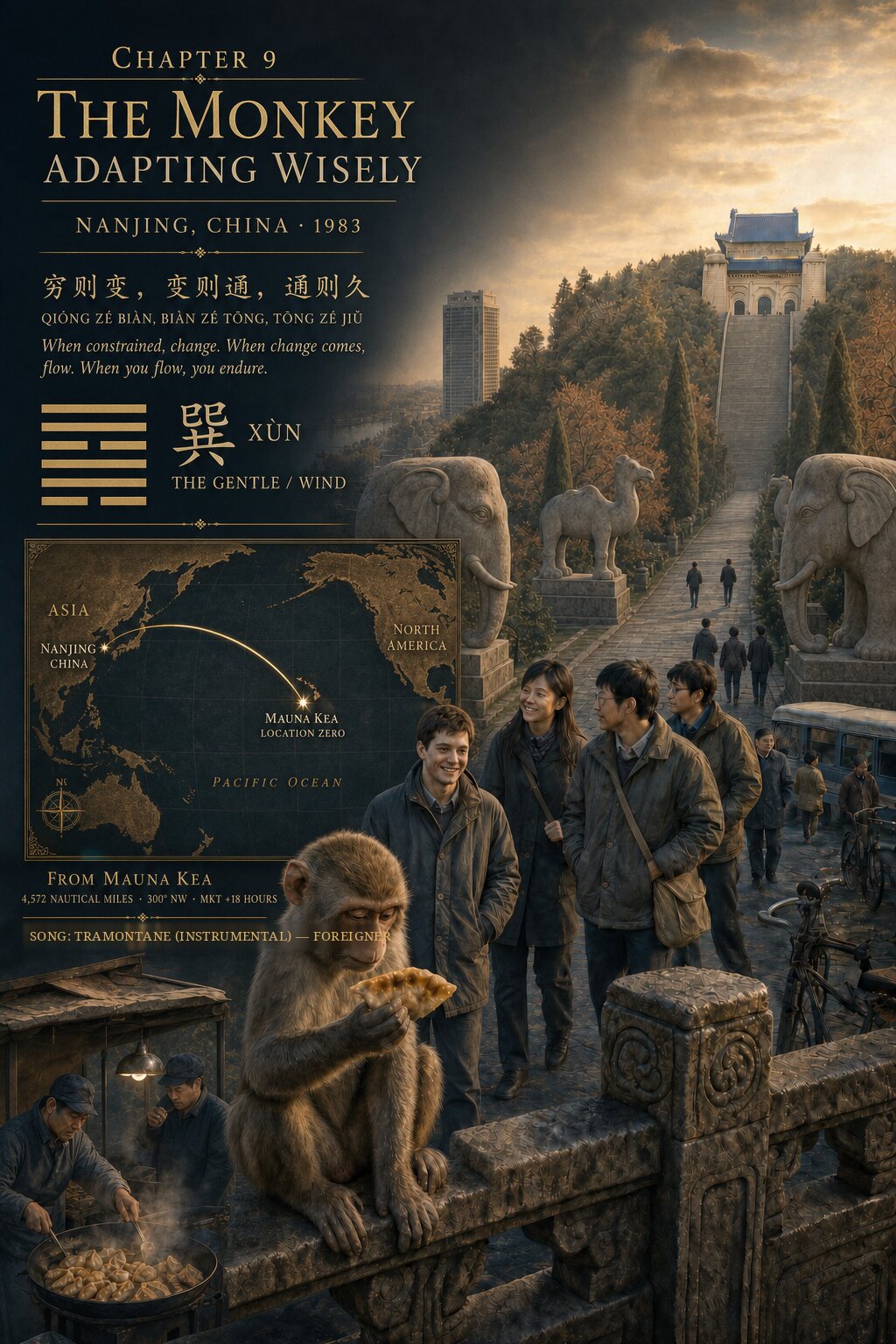
猴子捞月
Hóu zi lāo yuè
“The monkeys try to pull the moon from the water.”
The Monkey is clever, curious, theatrical, social, inventive, imitative, and occasionally impossible.
It studies the other animals and borrows whatever appears useful.
It tests boundaries.
It solves a problem no larger creature understands and then creates three new problems out of boredom.
It charms the crowd, steals the fruit, mocks authority, and discovers—usually later than everyone else—that cleverness is not the same as wisdom.
I have more Monkey in me than my Tiger chapter might admit.
The Rat finds the opening.
The Monkey wants to know whether the opening leads to a stage.
The Moon in the Well
A Chinese story tells of monkeys who see the moon reflected in a well.
Believing that the moon has fallen into the water, they form a chain. One holds a branch, another holds his legs, and the rest extend downward until the lowest monkey reaches toward the shimmering image.
The moon is real.
The reflection is real.
But the reflection is not the moon.
The monkeys nearly fall into the water while attempting to rescue something that remains safely in the sky.
The story is comic because their mistake appears obvious to us.
It is also profound because ambition often begins the same way.
We perceive something real.
Then we confuse its reflection with possession.
A vision may reveal a genuine possibility without proving that the visionary has the authority, resources, consent, or practical means to bring it into being.
I have spent much of my life reaching toward moons reflected in water.
Some reflections led me toward worthwhile work.
Others merely got my sleeves wet.
I can see the Monkey in those bicycle visits outside Xuzhou. A village gathered around the foreigner and his camera, and I enjoyed having an audience. It took some nerve to turn off the road, and I enjoyed the attention that followed.
The photographs help me keep the memory straight. The people in them had lives of their own before I came and after I left. Returning with their prints mattered more than imagining myself the hero of the scene.
Fiction Controls the Lighting
As a young man, I read James Clavell’s Noble House and imagined the great commercial empires of Asia.
Tai-pans.
Traders.
Governments.
Risk.
Loyalty.
Betrayal.
Decisions with consequences extending across civilizations.
Clavell’s novels enlarged my imagination. They helped me see Asia as sophisticated, dynamic, and historically alive at a time when many Americans regarded it through stereotypes.
I was particularly taken with Clavell's British and Scottish traders on the China coast, their daring and their capacity to imagine enterprises larger than the circumstances around them. Hong Kong seemed a place where the voyage could become a livelihood. Those novels joined the seafaring stories I already carried and helped make international trade feel like an adventure I might enter myself. Later, actual business would teach me how much depended on patient work, reliable partners, and keeping a promise after the excitement had passed.
They also introduced a danger.
Self-mythology.
Fiction controls the lighting.
The author determines when the hero enters the room, where the important people are seated, and which sentence brings the conversation to silence.
Real life makes no such arrangements.
The microphone fails.
The audience disagrees.
The budget is smaller than the vision.
The person convinced of his historical importance may discover that the room belongs to someone else.
He may even be asked to leave.
I have often wanted authority equal to the size of my ideas.
That desire is not entirely vain. It gave me courage to speak before consensus existed, travel where others hesitated to go, and imagine connections that more cautious people overlooked.
But imagination must be governed by other disciplines.
The teacher must listen.
The trader must verify.
The husband must return home.
The dismissed employee must remember that institutions have owners, responsibilities, and purposes independent of his arrival.
The Diagnosis
Bob Buckman’s diagnosis—that I wanted to run my own show—still contained truth.
Another Chinese saying came to mind, 山上无老虎,猴子称大王。shān shàng wú lǎohǔ, hóuzi chēng dàwáng: when there is no tiger on the mountain, the monkey becomes king. At Buckman, I had imagined myself as the Tiger. After I was shown the door, the Monkey felt less like a king than a young man without an office, title, or authority. The saying captures the comic, painful shift from believing I was ready to run the show to being told I no longer belonged there.
The Monkey sees the fruit before anyone else.
It does not always ask who planted the tree.
The same pattern appeared at Wangs International and in institutions where my imagination outran the authority I had been given.
At St. Andrew’s-Sewanee, I entered as a Mandarin teacher and soon saw an entire international strategy.
At McCallie, public schools, civic organizations, and sister-city work, I rarely confined my imagination to the assigned task.
Sometimes the larger vision was useful.
Sometimes it gave the snake feet.
Sometimes the Monkey had correctly identified the moon.
Sometimes he was still reaching into a well.
A Friendly Face for Tennessee
In 2016, I applied to represent Tennessee in China in a role focused on foreign direct investment.
I believed I possessed an unusual combination of qualifications.
Mandarin.
Decades of China experience.
Chemical and industrial trade.
Factory travel.
Relationships across Chinese cities.
Knowledge of Tennessee’s logistics, educational institutions, culture, manufacturing base, and civic possibilities.
I imagined becoming Tennessee’s friendly face in China.
The proposal was detailed.
I described investment outreach, industrial regions, Tennessee sites, travel, reporting, government coordination, culture, tourism, and succession.
I believed Tennessee had a compelling story.
Memphis possessed Federal Express and one of the world’s great logistical platforms.
Chattanooga had Volkswagen, advanced manufacturing, Wuxi, and a history of civic reinvention.
Nashville possessed music, growth, and international visibility.
East Tennessee combined research, energy, science, and manufacturing.
The state offered universities, hospitality, central geography, workforce, and culture.
A Chinese executive considering Tennessee needed more than financial incentives.
That executive needed to imagine a life.
Schools.
Neighborhoods.
Music.
Food.
Churches.
Travel.
Friendship.
A place where a family might belong.
I believed I could tell that story.
I was not selected.
What Part of the Moon Was Mine?
Rejection tempted me to conclude that the gatekeepers lacked vision.
Perhaps some did.
Institutions can be cautious, political, unimaginative, and overly dependent upon conventional credentials. They sometimes fail to recognize the person best suited to an unusual assignment.
But the Monkey asks a harder question.
What part of the moon did I actually hold?
My experience was real.
My relationships were real.
My language ability and knowledge of China were real.
Tennessee’s need for a stronger international strategy was real.
But a persuasive self-conception is not the same as an institution’s judgment of fit.
A public role also requires team alignment, accountability, discretion, predictable communication, and confidence that the representative will advance the administration’s priorities rather than enlarge the position according to his own vision.
My application presented a man prepared to do far more than occupy an office.
That may have been its strength.
It may also have been its warning label.
The distinction between prophet and crank is not the intensity of conviction.
It is whether conviction remains answerable to evidence, other people, and results.
The One-Eyed Man
An old saying often associated with Erasmus declares that in the country of the blind, the one-eyed man is king.
The image has appealed to me.
Long experience with China sometimes allowed me to see things other Tennesseans did not.
Mandarin opened doors.
Business travel supplied context.
Friendships revealed possibilities.
Historical memory allowed me to recognize patterns hidden from people encountering China only through recent headlines.
Sometimes I genuinely saw something early.
But partial sight creates its own danger.
A person who sees one dimension of a complicated problem may interpret every disagreement as blindness.
He begins believing that resistance proves his superiority.
A builder welcomes the engineer who warns that the bridge cannot bear the proposed load.
A dreamer who silences the engineer becomes dangerous.
The Covenant cannot be presented as my revelation to an unseeing world.
It must be offered as a hypothesis.
It must survive criticism.
Its architecture must contain many eyes: governments, cities, scientists, educators, businesses, indigenous communities, local residents, military experts, environmental advocates, young people, and those whose nations would bear the consequences of decisions made by larger powers.
A covenant built around one man’s vision is not a covenant.
It is a court.
Secretary General of Chattanooga
My imagination has never been naturally small.
Ridgeside Farm, situated where North meets South and East meets West, invited me to see Chattanooga as more than a scenic regional city.
The land carried Civil War history, black community memory, education, worship, immigration, and a personal bridge to China.
What if Chattanooga created a true Sister Cities Institute?
What if delegations, students, businesspeople, teachers, immigrants, and civic leaders possessed a place dedicated to international encounter?
What if Chattanooga became a kind of United Nations city for the American interior?
Naturally, I could imagine myself as Secretary General.
The Monkey appreciates the title.
The older man recognizes the joke.
There is genuine value in the vision. Chattanooga’s location, history, civic institutions, industrial relationships, and international ties could support something important.
That does not mean the city has been waiting for me to occupy a ceremonial chair.
Humor is a constitutional check upon self-importance.
The moment I can no longer laugh at “Secretary General Bob,” everyone else should become concerned.
The Public Monkey
My public voice carries the same mixture of insight and mischief.
Professional caution produces a great deal of bland public language. People repeat what institutions permit while privately questioning the consensus.
Independence has civic value.
Someone should challenge comfortable assumptions.
Someone should say that the room may be facing in the wrong direction.
Someone should ask whether the emperor’s dignity depends upon everyone agreeing not to mention his clothing.
The Monkey performs that function.
But provocation can become an appetite.
The person who always needs to shock the room is no longer independent. He is governed by the reaction he seeks.
A zinger may expose hypocrisy.
It may also close the ears of the very people one hopes to persuade.
The mature question is not merely whether the sentence is clever.
It is whether the sentence advances understanding.
I have not always asked that question before pressing “post.”
The Rooster will have more to say about public speech.
Images of the Pacific
Over time, my imagination produced a growing constellation of proposals.
The Covenant.
A Pacific Commonwealth of Nations.
A Round Table.
A disaster-response network.
A student passage.
A new meridian.
Games and cultural exchanges.
Railways.
A Memphis summit.
A Bering Strait connection.
Mauna Kea beneath the stars.
Each image reflected a possibility.
Images help people see.
They do not prove feasibility.
A map is not a railway.
An architectural rendering is not a building.
An invitation is not consent.
A stirring name does not create an institution.
The Monkey’s moon exists in the sky.
Its reflection may show us where to look.
The mistake comes when we reach into the water, grasp the image, and announce that the moon belongs to us.
The Covenant must survive after the poster is removed.
It must eventually produce structures, responsibilities, budgets, safeguards, measures, and the right to refuse.
Otherwise, it remains a beautiful reflection.
Learning Through Falling
The Monkey survives because it is flexible.
It falls, catches another branch, and tries again.
My career contained repeated falls.
Buckman taught that initiative without alignment can destroy an opportunity.
Wegochem taught that relationships at the edges of institutions create value.
Wangs International taught that admiration for a founder does not guarantee a place inside the company.
Synair taught that technical imagination can build an industry and that employment remains vulnerable.
Teaching taught that civilizations are plural.
Sister cities taught that ceremony must become repeated contact.
Sichuan taught that friendship must become service.
Ridgeside taught that global vision must answer to local memory.
Marriage taught that public dreams have private costs.
Rejection taught that vocation is larger than office.
Taken separately, the episodes resembled detours.
Together, they became a curriculum.
Looking Up
The cure for the Monkey’s mistake is not to stop reaching for the moon.
Human progress depends upon people willing to see a reflection and ask whether something seemingly impossible might be brought nearer.
The cure is to distinguish inspiration from endorsement.
Access from authority.
Imagination from completion.
A calling from a crown.
I still believe Tennessee can play a larger international role.
I still believe Chattanooga can become a more visible meeting place between histories and civilizations.
I still believe trustworthy relationships can alter the course of nations.
I still believe the Pacific requires an architecture more hopeful than permanent military escalation.
The moon is real.
I simply do not own it.
The Monkey reaches into the water.
Wisdom looks up.
The Goat taught me gratitude.
The Monkey taught me proportion.
The Rooster would ask whether I had prepared myself to announce the dawn—or merely grown fond of hearing my own voice.
Table of contents · Next: Chapter 10 · The Rooster: Sounding the Dawn

