
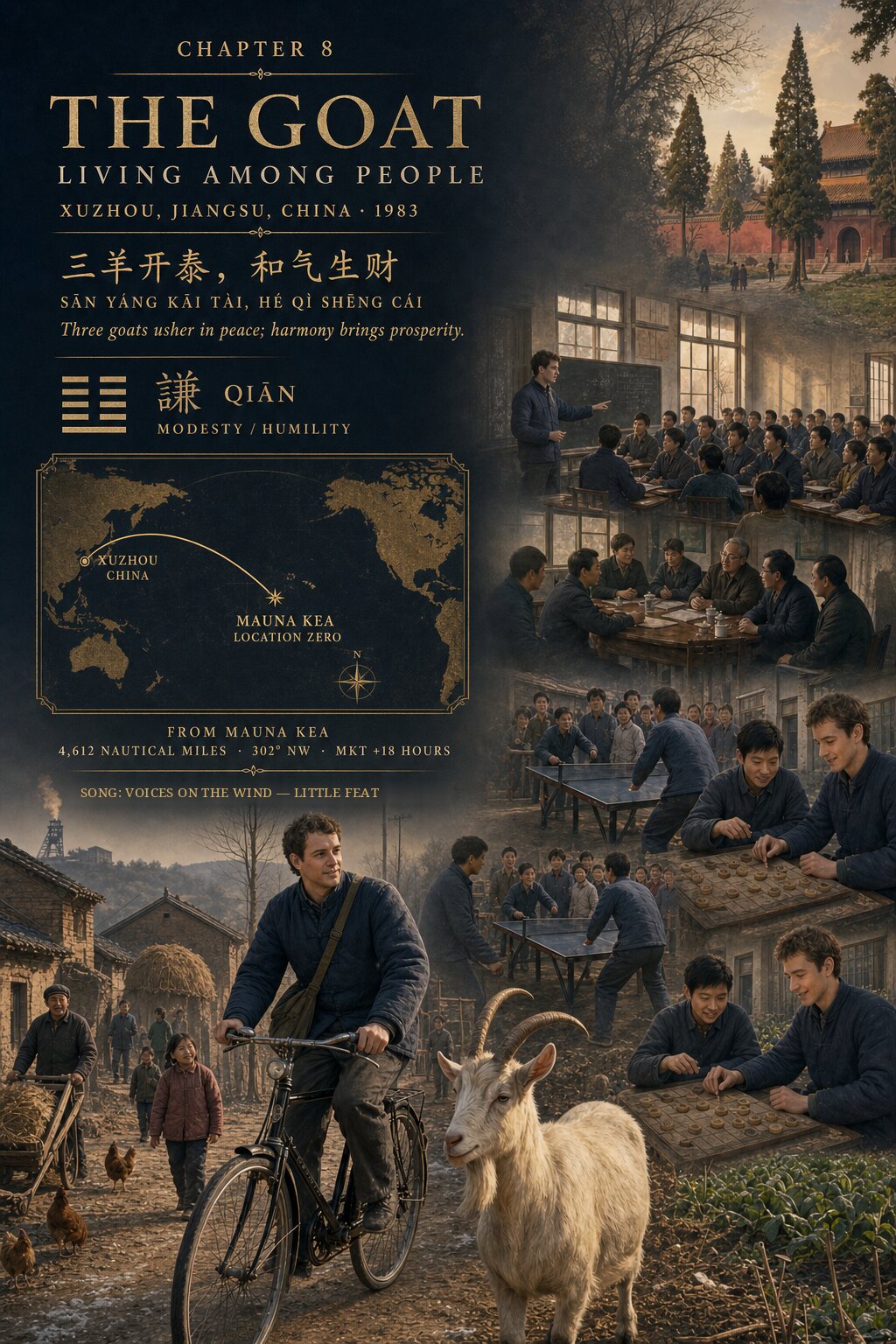
羔羊跪乳
Gāoyáng guì rǔ
“The lamb kneels to receive its mother’s milk.”
The Goat lives close to the ground.
It climbs where the Horse cannot run, finds nourishment in difficult terrain, and survives through awareness of the flock.
In Chinese tradition, the Goat or Sheep suggests gentleness, harmony, community, and filial gratitude. The image of a lamb kneeling to receive its mother’s milk became a symbol of something human beings easily forget:
We begin by receiving.
Before we earn, build, teach, travel, or lead, someone carries us.
Someone feeds us.
Someone prepares the ground upon which we eventually stand.
My life has contained many ambitions to give, lead, represent, warn, and build.
The Goat asks a more humbling question.
What did I receive?
And what do I owe?
An Inheritance of People
I received a family story that began before I was born.
I received my father’s example, my mother’s imagination, John’s persistence, and Andrew’s companionship.
I received education, books, travel, language instruction, professional introductions, and financial support.
I received teachers who challenged me and mentors who opened doors.
Arif Dirlik returned me to China after Buckman.
Ed Khalily and Bert Eshaghpour recognized a usefulness in me that did not fit comfortably inside a conventional corporate structure.
John M. Harbert allowed a teenage boy to see that global ambition and ordinary work could inhabit the same life.
Chinese hosts welcomed me when few Americans traveled through their cities.
Students trusted me to introduce them to another world.
Jan gave my wandering a home.
Thomas gave that home a future.
I also received land.
Land carries a different kind of obligation.
A story may flatter its inheritor.
Ground corrects him.
Ridgeside Farm
Ridgeside Farm and the former Missionary Ridge Baptist Church property stand at the eastern foot of Missionary Ridge in Chattanooga.
It is one of the quaintest, loveliest little pieces of land I know. Above it rises a ridge whose views still stop me. From the crest, the city and the surrounding country open out across a remarkable distance. The beauty is reason enough to pause. Knowing what happened on those slopes gives the view another meaning.
The land occupies a place where histories overlap.
Native American passage.
Settlement.
Civil War.
Slavery and emancipation.
black community life.
Education.
Worship.
Agriculture.
Railways.
Neighborhood growth.
Immigration.
And the selective memory by which cities decide which stories deserve to be marked.
On November 25, 1863, Union troops broke the Confederate defenses on Missionary Ridge. The Army of Tennessee withdrew toward Georgia, and Chattanooga remained in Union hands. The city became the supply base for Sherman’s Atlanta campaign the following year. Chickamauga had been a Confederate victory; Missionary Ridge helped determine what that victory could accomplish. In its strategic consequences, I regard the later battle as the more decisive one.
Sometimes I think of this as a place where slavery lost ground. The battle did not itself end slavery. Union victory and the Thirteenth Amendment still lay ahead. But the Confederate defeat here helped open the way into the Deep South. Standing beneath the ridge, I wonder how much harder that road might have been had its defenders held. The history reaches far beyond Chattanooga.
The Medal of Honor gives some of that history individual names. In March 1863, Secretary of War Edwin Stanton presented the first medals to six surviving members of Andrews’ Raiders, whose mission had targeted the railroad between Atlanta and Chattanooga. Jacob Parrott received the first. Later that year, Arthur MacArthur Jr. earned the honor for carrying his regiment’s flag onto the Confederate works at the crest of Missionary Ridge. These were Union honors. The Confederacy recognized its own soldiers through a separate Roll of Honor.
At Chattanooga National Cemetery, visitors can find the graves of several of Andrews’ Raiders. I would put the cemetery on the map as well, so a family that starts the day hearing about those men can find their names in stone.
In 1890, twenty-seven years after the battles and twenty-five years after the war ended, Congress established Chickamauga and Chattanooga National Military Park, the first national military park in the United States. Veterans from both armies had helped bring it into being. Antietam’s federal preservation began that same year; Shiloh followed in 1894, Gettysburg in 1895, and Vicksburg in 1899. The five sites emerged over a decade. Men who had survived the fighting were helping preserve its ground while they could still identify where they had stood.
I understand something of that impulse now. When the people who remember an experience grow old, the responsibility to record it becomes urgent. My own memories concern classrooms, friendships, factories, and journeys across the Pacific. The veterans’ memories concerned a war that had torn their country apart. In each case, something becomes harder to recover when its witnesses are gone.
Missionary Ridge was included in the national park’s original conception, though much of it remained privately owned. The government acquired separate reservations and linked significant positions along the crest. Its own administrative history records that some landowners’ prices frustrated further purchases. Today, monuments, tablets, and cannon stand among residential neighborhoods. The ridge’s fragmented preservation has a history of its own.
Horace Benson Hatcher lived behind the farm. We began as neighbors and became friends. He was a black Vietnam veteran, an accomplished photographer, and a man with a life far larger than anything I could have guessed across a property line. He had served two tours in Vietnam and earned two Bronze Stars. I had spent years crossing the Pacific for classrooms and commerce. Asia belonged to both our lives, though we had encountered very different parts of it.
Horace told me that people had given him grief for being my friend. They knew my outspoken politics and thought they knew the rest. He knew the man who sat with him. His wife, Reba, could set me straight when she thought I had behaved badly, and she could defend me fiercely when others dismissed me. Their friendship made room for correction. It did not require either of us to become someone else.
I thought of Arif Dirlik, the Marxist from Istanbul who had helped a radical conservative return to China. Once again, a person had looked past the category without overlooking the person’s faults. Horace’s warmth still moves me. A book about crossing boundaries would be incomplete if it sailed past the neighbor behind my own farm.
I sometimes think of Horace as my Brown, the loyal companion who stayed with Hornblower through uncertainty. It is an affectionate literary comparison, drawn from the books that helped me imagine a life of adventure. Horace brought his own experience, judgment, and independence to our friendship. He could see things I missed. With him and Reba, companionship included the freedom to speak plainly and the confidence that affection could survive disagreement. After all my journeys, I found that kind of fellowship just beyond my own property line.
Horace and I found a phrase that seemed to capture the property’s position:
“Where North meets South and East meets West.”
North and South meet there in the history of Missionary Ridge and the Civil War.
East and West meet there through Chattanooga’s relationship with China and through my own family.
But a satisfying phrase does not settle the meaning of the land.
It merely begins the inquiry.
Visionaries look at property and immediately imagine what might be added.
Stewards first ask what is already there.
Who walked this ground?
Who worshiped here?
Who learned here?
Who was buried, displaced, forgotten, or denied the authority to record the story?
Who still possesses the standing to speak for it?
Those questions changed the way I understood ownership.
A deed may identify the legal owner.
It does not make the past disappear.
The Church and the Community
A black congregation built the church that now stands on the property.
In 1865, a black elementary school was established. It was among the very first such schools built in Tennessee and the former Confederacy.
The site belonged to communities whose stories often survived in memory after public institutions neglected them.
Horace also helped bring the site’s living memory to our table. When I told him about Chattanooga civic leader Moses Freeman Jr. and his recorded interview with Clarence B. Robinson, Horace asked for twenty-four hours. The next day, Moses was at Ridgeside Farm. I invited elders from the church. We sat beneath the trees, drank beer, talked, and enjoyed one another’s company. History had acquired voices I could answer.
In 1983, Freeman interviewed Clarence B. Robinson, who identified Missionary Ridge Baptist Church as a center of several historic black communities east of the ridge.
My uncle Bill was an anthropologist. I would have liked to walk Shallowford Road with him and ask what he saw. I find myself wondering what it meant for a family to have a school and a church on this side of the ridge. Robinson could have drawn us a map from memory. Mr. Copeland owned the ground behind the church. The county school stood just west of it. On Sundays, people from Johnsonville and the neighboring communities came to worship here. Those are the directions I would want a visitor to have.
That testimony mattered.
The ground beneath my stewardship was not empty acreage waiting for my imagination.
It was already inhabited by memory.
The distinction is essential.
The American South contains an extraordinary capacity for beauty, faith, courage, hospitality, and belonging.
It also contains histories of slavery, segregation, racial violence, exclusion, and selective remembrance.
To love the South honestly is not to deny either inheritance.
A Missionary Ridge project must honor military courage without obscuring the conflict’s roots in slavery. It must also recognize the black churches, schools, families, and neighborhoods that sustained community life after emancipation.
A Promise to Live Up To
Horace later told me something Moses had said to him.
“Bob cannot be bought.”
I was deeply moved. I do not repeat the words as a certificate of my own virtue. I have wanted recognition, made mistakes, and sometimes mistaken stubbornness for principle. What Moses offered was trust. Once someone places that kind of confidence in you, the words become a standard you must keep trying to meet.
A bridge-builder has to remain answerable to the people on both banks. Friendship cannot require selling one’s judgment, and independence cannot mean refusing correction. Moses’s words brought the matter home: if I asked people to trust a covenant, they were entitled to ask what governed the man proposing it.
Moses later went to Wuxi himself. In the story he told, when fellow council members asked what he wanted to do, his answer was that he wanted to go to Wuxi, China. The conversations beneath our trees had joined the road Ron Littlefield and others helped keep open. A black civic leader from Chattanooga could carry his own experience across that bridge. He did not need me to speak for him.
A Local Covenant
I began imagining a park and greenway connected to the Ridgeside property.
When I speak to the Chattanooga City Council, I start with our state flag. Three stars stand for East, Middle and West Tennessee, with one white ring around them. Now picture a triangle laid over a map of Chattanooga. Put the first star at Chickamauga, where my great-grandfather Eli was wounded. Put the second at Point Park on Lookout Mountain. Put the third at Missionary Ridge, where Horace and I became neighbors. Close the triangle by drawing the line back to Chickamauga. Those are the three stops I’d like a family to visit.
At Chickamauga a family can start at the visitor center. At the visitor center across from the gates of Point Park, they can stand in front of James Walker’s painting of the Battle of Lookout Mountain. It is thirty feet wide. Adolph Ochs, who published the Chattanooga Times and the New York Times, helped buy land on the mountain to preserve it for the public. I used to wonder whether anybody had commissioned a painting of Missionary Ridge. Somebody had, all the way up in Minnesota. For the state capitol in St. Paul, architect Cass Gilbert commissioned Douglas Volk to paint The Second Minnesota Regiment at Mission Ridge. One of the men who had climbed our ridge wrote to Volk about what he had seen. Imagine a schoolchild from Chattanooga looking at that painting and recognizing the hill outside her window.
Here’s the question I put to Chattanooga. Chickamauga has a museum and restrooms. Point Park has a visitor center and restrooms just outside its gates. Why should a family get to the third corner, Missionary Ridge, and find neither at the battlefield stops? From a tourism point of view, I think Chattanooga is leaving money on the table. How long will a family stay to read a marker when a child needs a restroom? That’s why I’m proposing a Missionary Ridge National Park. I’d start with a place to stop, a public restroom and a museum where a family could see how the fighting on that hill changed the course of the war, then step outside and look at the hill itself.
I have taken that question to people who lead Chattanooga’s foundations. My friend Dean Arnold helped me understand the scale of the Coca-Cola bottling fortune here. In his account of the Lupton family, Dean compared the estate of Jack’s father, Cartter Lupton, to Howard Hughes’s. What interests me about Jack is something anybody can see on the riverfront. His gifts and the Lyndhurst Foundation helped build the Tennessee Aquarium. In China I had visited a factory that made citric acid for drinks. Here in Chattanooga, the bottling business helped give children a place to stand eye to eye with a fish. That gives me some encouragement when I ask who might help us welcome a family to Missionary Ridge.
The National Park Service does offer anniversary programs on Missionary Ridge, including guided walks and driving tours. I would like Chattanooga to build on that work with an annual civic observance on November 25. A mayoral proclamation recognizing a Missionary Ridge remembrance day could give it a public focus. Schools, historians, neighborhood groups, and visitors could take part in walks and a ceremony that remembers the lives lost and explains the battle’s place in the destruction of slavery. The residential setting calls for care, access, and respect for the people who live there. I believe the city has a tourism opportunity here, along with an obligation to make its history more accessible.
The vision included trails, gardens, a pond, gathering spaces, historical interpretation, a market pavilion, an amphitheater, and a restored or repositioned church. A path might connect the property with the ridge and with other parts of Chattanooga’s civic landscape.
The idea joined history, nature, education, worship, neighborhood life, and international friendship.
It also exposed the moral test of every grand vision.
Before asking America, China, Russia, Hawaii, and the nations of the Pacific to enter a covenant, could I help neighbors agree about a few acres in Tennessee?
Could the vision survive zoning?
Traffic?
Funding?
Maintenance?
Noise?
Historical disagreement?
The interests of people who already lived nearby?
World peace that cannot build and maintain a public restroom is not yet a program.
The church also keeps me honest. It came to Jan and me through a generous conveyance for a nominal payment. I have kept up the taxes and grounds, but the building still needs serious work and is not usable. Some of my decisions have not served it well. That unfinished responsibility hurts. Paying a bill and drawing a vision are not the same as restoring a place a community can use.
Ridgeside became my local laboratory of covenant.
A greenway is diplomacy at walking speed.
People who would never attend a summit share a path.
Children encounter history outside the classroom.
Neighbors who disagree politically may pause beside the same water.
Dogs, gardens, music, worship, theater, markets, and memory give people different reasons to occupy the same ground without demanding that they become identical.
That is a modest form of civilization.
It may also be where peace begins.
A Covenant That Does Useful Work
The same practical test belongs at the heart of the Pacific Covenant. I want it to help nations become better stewards of the people whose lives their decisions touch. Its work would include making it easier to exchange products and information, to travel and study, and to share stories, music, and culture. Political cooperation should make those encounters more possible. Commercial cooperation should give people more chances to work together. Cooperation on security should help keep those relationships from being destroyed by war.
If that cooperation deepened over time, I would put another possibility on the table: a gold-based common currency representing the Covenant’s founding nations. Participating countries might eventually choose it in place of their separate currencies and establish a central bank to administer their common monetary policy. I offer this as a distant possibility to examine together. Members would have to agree on the terms of the gold backing, the custody of reserves, and how decisions would be made. A currency would have to grow out of agreements people trusted and institutions they could hold accountable.
Who would set interest rates? How would smaller countries have a voice? What would members owe one another when one economy prospered and another suffered? Those questions belong in the proposal from the beginning. The usefulness of the Covenant would be measured in the lives of its members: whether a student could learn abroad, a family could trade on fair terms, or neighbors across an ocean could understand one another a little better.
From Pseudo-Community to True Community
In the 1980s, I met the psychiatrist and author M. Scott Peck when he came to the Tennessee Governor’s School for International Studies. His book The Different Drum gave language to a difficulty I had been encountering all my life. He described a movement from pseudo-community, where people conceal differences to preserve surface harmony, through chaos, when those differences erupt, toward emptiness, when participants surrender the need to control one another, and finally toward true community.
The sequence is uncomfortable, which is precisely why it matters. My natural impatience often wanted to move directly from introduction to agreement. The experience of marriage, teaching, neighborhood friendship, and diplomacy taught otherwise. A community is not achieved simply because its members smile for the same photograph. It becomes real when they can name differences, withstand correction, and continue to work together. A Pacific Covenant would need that courage. It must permit disagreement without treating disagreement as disloyalty.
The Flock Corrects the Visionary
I have often imagined myself through solitary animals.
The Tiger.
The Horse.
The Dragon.
The Rat finding the crack no one else has noticed.
Those creatures are defined partly by distinction.
The Goat belongs to the flock.
That matters.
Civilization is not built by solitary visionaries, however gifted or energetic they may be. Families, churches, schools, clubs, farms, neighborhood associations, volunteer groups, businesses, and sister cities carry the daily work of belonging.
My responsibilities as president of the Chattanooga Civitan Club, along with men’s breakfasts, church relationships, teaching communities, and civic friendships, may appear small beside the Covenant.
Yet these civic commitments are part of the same work: bringing people into a local circle of service. The title matters chiefly because it gives me work to do with my neighbors. A person who hopes to bring nations together ought to be willing to help people gather in his own town.
Civitan also brings the family story back into view. The organization began in Birmingham in 1917, the city where my grandfather Ellis grew up. Its commitment to people with intellectual and developmental disabilities gives our local work a meaning I cannot separate from my brother John, who has lived with cerebral palsy. I do not approach the needs of children and families as a distant category of philanthropy. I grew up knowing someone whose dignity could never be measured by his physical independence.
My father was a physician, and my Uncle Tom was an orthopedic surgeon. Care for others was part of the family inheritance long before I became a club president. Through the Chattanooga Civitan’s Children's Foundation, that inheritance meets the practical work of helping children with disabilities. We work with several local agencies that provide assistance and education for those less fortunate.
John also belongs in the account of my ambition. I sometimes felt that I ought to do enough for both of us. That feeling could drive me toward accomplishments larger than I knew how to manage, but it also kept bringing me back to a simpler responsibility: whatever I might achieve should leave room for someone who could not travel the same road.
A global covenant unsupported by local habits of service would be an empty declaration.
Trust requires people close enough to know whether someone actually appears.
Does he contribute?
Does he keep his word?
Does he help clean up afterward?
The flock knows.
It is much harder to maintain a heroic self-image among people who have watched you forget a meeting or leave someone else to stack the chairs.
Community corrects abstraction.
Professor Zhan
Through Jan, I inherited another family history.
Her stepfather, Professor Zhan Yizhi, had studied under James Yen before 1949. He had feared imprisonment by the Nationalists and later returned from British-administered Hong Kong to the mainland following the Communist victory.
Following an eighteen year sentence in labor camp for political thought crimes, he resumed his scholarly life at the Sichuan Academy of Social Sciences in Chengdu, near the world Jan knew as home.
I remember a small moment from the late 1990s.
I entered his name into an internet search on my computer.
Several results appeared.
Today, when nearly everyone leaves a digital trail, that may sound unremarkable.
For Professor Zhan, it was a restoration of public identity.
The joy on his face remains with me.
The search could tell him that his work and identity had not vanished.
Near the end of his life, he wrote and self-published his autobiography.
He still left words behind.
The Goat’s lesson of gratitude is not sentimental. Parents and elders do not pass down only comfort. They pass down endurance, unfinished work, wounds, and responsibilities.
Professor Zhan’s life placed a claim upon those who came after him.
Education mattered because ignorance could be manipulated.
Memory mattered because a person could be erased twice—first from public life and later from history.
Dignity mattered because power had once attempted to take it from him.
He was a very fine man.
The Earthquake
On May 12, 2008, a devastating earthquake struck Wenchuan and large areas of Sichuan.
Buildings collapsed.
Families lost children.
Schools were destroyed.
Communities already carrying difficult histories confronted a new landscape of grief.
Sichuan was not a distant province to us.
It was Jan’s home region.
It contained relatives, memories, friendships, schools, and places whose names belonged to our family conversations.
Jan went into action.
She raised funds and awareness. She understood that grief needed to become useful work.
Sympathy alone could not rebuild a classroom.
The Goat kneels in gratitude.
Then it rises.
Montana’s Check
At the time, I was teaching at St. Andrew’s-Sewanee School.
One of my students was Montana Rhoton.
One day, after the earthquake, Montana gave me a check for five hundred dollars to help and launched a fundraising drive to assist the Dujiangyan school and its students.
Her check brought me to tears.
In 2012, the year Sir John Templeton would have turned a hundred, Winchester held its Spirit on the Square celebration. Montana and her mother Beth were the reason we attended. We had a little booth for the Montana Scholarship Fund, which had started out helping children in rural China learn English. Four years earlier, Montana had handed me that check. Now we were sharing that story with a wider audience.
Today Montana and her family tend the land at Storybrooke Farm outside Winchester, Tennessee, and raise Scottish Highland cattle. Those well-tempered beasts with shaggy hair in their face seem to exhibit human qualities.
James Yen Technical School
In the spring of 2009, St. Andrew’s-Sewanee sponsored a second journey to the James Yen Technical School in Dujiangyan, perhaps the only school in China bearing his name.
James Yen—晏阳初 Yàn Yángchū—was one of the great advocates of rural education and reconstruction. He believed ordinary people did not lack intelligence; they lacked opportunity. Development therefore had to join education, health, livelihood, and local self-government while leaving communities as authors of their own future.
Jan’s aunt and stepfather had studied under Yen before 1949, and Professor Zhan later helped establish the school.
Dujiangyan stands where the immense Sichuan valley meets the edge of the Tibetan Plateau. Around 256 BC, engineers divided the flow of the Min River there. They let part of the river carry floodwater and sediment away and channeled part toward the farms of the Chengdu Plain. The farmers still depend on that water. The water, mountain air, and green landscape give the city a clarity that photographs cannot hold. UNESCO recognized the irrigation works together with nearby Mount Qingcheng, with its long history of Taoist worship.
The city lies close to Chengdu, Jan’s home, and to the Sichuan Academy of Social Sciences. That connection joined family history, education, Sichuan, and our response to the earthquake.
Altogether, we raised several thousand dollars to support the school. We visited several times.
Yen moved to the Philippines in 1952 and in 1960 founded the International Institute of Rural Reconstruction. I have had some contact with the organization he created, though I hope for deeper cooperation. The school in Dujiangyan offers another unfinished relationship. I may return one day—not as a donor arriving with answers, but as a student of Yen’s conviction that help must strengthen local knowledge and capacity.
The Ground in Sichuan and Tennessee
Dujiangyan and Missionary Ridge appeared at first to belong to unrelated stories.
One stood in Sichuan, damaged by an earthquake.
The other stood in Chattanooga, layered with Civil War and black community history.
One involved a technical school and rural reconstruction.
The other involved a church, possible park, greenway, and neighborhood.
The longer I lived, the more clearly the two places spoke to one another.
Both asked whether memory could become service.
Both asked whether an outsider—or even a legal owner—would listen before directing.
Both asked whether education could help people inherit difficult ground without becoming prisoners of its wounds.
Both required relationships lasting longer than the ceremony.
The Goat finds nourishment in rough terrain.
A covenant must do the same.
It must create practical benefit under imperfect conditions rather than waiting for complete harmony.
Gratitude Has Names
Gratitude becomes vague when it has no names.
I owe gratitude to my parents, even where family life was complicated.
I owe gratitude to John for showing me the endurance of the turtle while I raced like the hare.
I owe gratitude to Harbert for allowing a teenage boy to witness scale grounded in work.
I owe gratitude to Arif for remembering me after Buckman.
To Ed and Bert for recognizing an unconventional usefulness.
To Ed Gomberg for bringing me to Chattanooga.
To Chinese teachers, students, factory managers, and families who allowed me to learn inside their country’s transformation.
To Bart and Kitty Trescott, real pioneers in friendship. Bart helped Chinese students in Carbondale find a place to live and a ride when they needed one. Kitty helped preserve the Midwest association’s records so that the rest of us could learn from the people who came before us.
To Professor Zhan for showing what intellectual dignity can survive.
To Horace and Reba Hatcher for friendship strong enough to include correction, and to Moses Freeman and Clarence Robinson for helping memory speak from the ground.
To Montana for converting a classroom lesson into a five-hundred-dollar act of compassion.
To Jan for turning concern into organization and international affection into practical service.
To Thomas for becoming himself rather than the symbol his father might have been tempted to make him.
Gratitude requires service.
The kneeling lamb rises.
What Nourishes Us Claims Us
The Goat converts possession into obligation.
Land is not merely something I own.
History is not merely something that flatters my ancestry.
China is not merely a source of adventure.
Students are not merely an audience.
Family is not merely a source of support.
What nourishes us places a claim upon us.
The principle applies to nations as well as individuals.
Powerful countries often treat smaller states as terrain, markets, military bases, votes, supply chains, or strategic assets.
A covenant begins when the powerful kneel long enough to receive instruction from those whose land, water, culture, and future are at stake.
The people most affected must be participants, not scenery.
Authors, not objects.
The Goat kneels not because it is worthless.
It kneels because it knows life was given before it was earned.
The land beneath Missionary Ridge, the school in Dujiangyan, the family table, and the Pacific itself ask the same question:
Will gratitude become stewardship?
The Horse carried me over the long road.
The Goat taught me to kneel upon the ground.
The Monkey would ask whether the moon I reached for was real—or only its reflection.
Table of contents · Next: Chapter 9 · The Monkey: The Moon in the Water

