
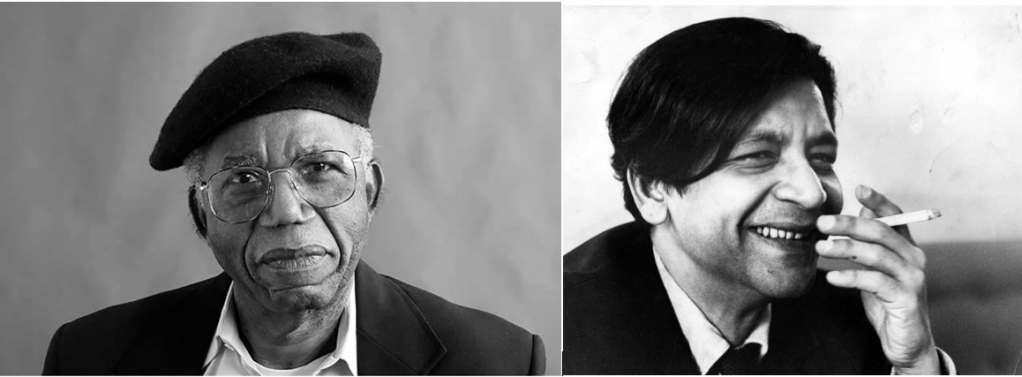
At the end of Chinua Achebe’s Things Fall Apart, a British district commissioner considers how much space to give Okonkwo in the book he plans to write. A paragraph ought to do it, he figures. We’ve just spent a whole novel in this man’s company. We know his father, his children, his pride, and the friend who grieves for him. I wonder how many judgments about Africa have been written by somebody who thought a paragraph would do.
Achebe (1930–2013) grew up in Nigeria. V. S. Naipaul (1932–2018), born in Trinidad, approached postcolonial Africa through the eyes of Salim, a shopkeeper in A Bend in the River. For Salim, the grand promises of independence offer little protection when a ruler can take away his business. Achebe’s objection had to do with the audience. Achebe thought Naipaul had a Western reader in mind. What would an African reader recognize in that portrait, and what would he miss? Yet Achebe could be unsparing about his own leaders. He devoted a whole book, The Trouble with Nigeria, to their failures.
What Americans see in Israel and Palestine
I hear an echo of that disagreement when Americans talk about Israel and Palestine. Some Americans look at what Israelis have built in a small country, at the refuge it offered Jews fleeing persecution, and at the danger Israeli families face when armed groups attack civilians. They ask what choices Palestinian leaders and neighboring governments have made, and what those choices have cost their own people.
Others begin with a Palestinian family that lost its home in 1948, or a farmer in the occupied West Bank who sees an Israeli settlement expand near his land. What would it mean to tell that farmer to judge by results? He is judging by results. He can see them from his window. The comparison to Achebe and Naipaul is mine. What I take from those two writers is a habit worth bringing to this debate. Before I decide who bears responsibility, I ought to hear from the people who live with the decision. That includes the Israeli parent worried about an attack and the Palestinian parent worried about losing a home.
What a railway can tell us
I’d like to see Africa become the breakaway success of the twenty-first century. China has a part to play, and its own history ought to give it some sympathy for a country negotiating with a stronger trading partner. Britain wanted Chinese tea, silk, and porcelain. British merchants used the proceeds from Indian opium sold in China to pay for those goods. When Chinese authorities seized the opium, Britain went to war. You can understand why a Chinese negotiator might have a long memory about the terms of trade. A Kenyan negotiator is entitled to one, too.
Take the railway from Mombasa to Nairobi, built by a Chinese contractor with financing largely from China. Kenya’s statistics office reports that its standard-gauge railway carried about 2.7 million passengers and 7.3 million tonnes of freight in 2025. That’s a lot of people getting somewhere they wanted to go. As a man who would dearly like to see better passenger rail in Tennessee, I’m inclined to give credit where it’s due. I’d also like to hear from Kenyan passengers about the fare, from businesses about the freight rates, and from taxpayers about the loan. Each has a claim on the answer.
Then there’s the phone in a shopkeeper’s pocket. Chinese companies such as Transsion have made affordable handsets for African markets. Before we Americans lecture anybody on whom to buy from, we might look down at our feet. By the U.S. footwear industry’s own count, 99 percent of the shoes we buy are imported. If an American company can offer that shopkeeper a better phone at a price she can afford, I’m all for it.
My enthusiasm runs up against the testimony of miners in Zambia. In 2011, workers at Chinese-run copper mines told Human Rights Watch about inadequate ventilation, worn protective equipment, and threats of dismissal if they refused dangerous work. They also welcomed the jobs. Blood Diamond dramatized the cruelty of the diamond trade during Sierra Leone’s civil war. These Zambian miners were speaking about a different mineral, a different country, and their own working lives. They knew precisely what they wanted changed.
And then there are the rhinos. I wish saving a rhino were as simple as making Viagra cheaper. What would that do about a customer who wants the horn carved into a bracelet? The International Rhino Foundation identifies buyers in China and Vietnam and points to demand for carvings as well as supposed medicinal uses. I’d like to see the countries where the horn is sold put as much effort into stopping that trade as African rangers put into protecting the animals.
What would success in Africa look like to me? A Kenyan merchant who can get her goods to port at a fair price. A Zambian miner who can refuse a dangerous shift and still have a job in the morning. Better yet, I’d like to hear what success looks like to them. Africans have spent long enough as the subject of somebody else’s book. I hope the coming decades bring them the prosperity they’ve earned and the freedom to say, in their own words, what it’s for.
Reading behind this essay
Achebe on Naipaul · A Bend in the River · Holocaust survivors and Israel’s founding · Palestinian displacement in 1948
Britain and the opium trade · Financing Kenya’s railway · Kenya’s 2026 Economic Survey, table 13.7(b)
Affordable phones in Africa · U.S. footwear figures · Testimony from Zambian copper miners · The trade in rhino horn, page 8


Leave a Reply